


- Canadian Dollar finds the middle as investor appetite churns.
- Bank of Canada rate call slated for the midweek.
- US NFP expectations to draw attention through the week.
The Canadian Dollar (CAD) is cycling familiar levels on Monday with markets awaiting another rate showing from the Bank of Canada (BoC) and this week’s key US Nonfarm Payrolls (NFP) report due on Friday. The BoC is expected to hold rates at 5% on Wednesday, and investors hopeful for a rate cut from the Federal Reserve (Fed) will be looking for softening economic figures from the US this week.
The data from Canada this week will be the BoC’s rate call, with Friday’s Canadian labor figures due to get eclipsed by the US NFP employment numbers. Canada’s Unemployment Rate is expected to tick higher this week, and current market forecasts call for a pullback in the US NFP print.
Daily digest market movers: Canadian Dollar mostly flat as markets hinge on rate cuts
- Quiet start to the week as markets focus on Fed rate cut odds.
- Softer US data last week leads to an uptick in June rate cut hopes.
- BoC expected to hold steady on rates on Wednesday.
- Tuesday’s US ISM Services Purchasing Managers Index (PMI) for February is forecast to tick down to 53.0 from 53.4.
- Markets will be looking for softer US data prints as investors hope a weakening US economy will boost odds of a Fed rate cut.
- CME FedWatch Tool sees over 70% odds of a Fed rate trim in June at current cut.
- Wednesday’s BoC rate call is forecast to see no moves from BoC Governor Tiff Macklem.
- The US ADP Employment Change for February is slated for Wednesday and is forecast to show an uptick is US employment to 150K for the month, up from the previous month’s 107K.
Canadian Dollar price today
The table below shows the percentage change of Canadian Dollar (CAD) against listed major currencies today. Canadian Dollar was the strongest against the Japanese Yen.
| USD | EUR | GBP | CAD | AUD | JPY | NZD | CHF | |
| USD | -0.17% | -0.29% | 0.08% | 0.10% | 0.24% | 0.05% | 0.07% | |
| EUR | 0.17% | -0.12% | 0.24% | 0.27% | 0.41% | 0.22% | 0.24% | |
| GBP | 0.29% | 0.12% | 0.35% | 0.39% | 0.53% | 0.33% | 0.36% | |
| CAD | -0.08% | -0.23% | -0.35% | 0.04% | 0.16% | -0.03% | 0.00% | |
| AUD | -0.10% | -0.27% | -0.39% | -0.03% | 0.12% | -0.05% | -0.03% | |
| JPY | -0.24% | -0.42% | -0.57% | -0.20% | -0.15% | -0.21% | -0.17% | |
| NZD | -0.05% | -0.21% | -0.33% | 0.03% | 0.06% | 0.19% | 0.03% | |
| CHF | -0.08% | -0.24% | -0.36% | 0.00% | 0.03% | 0.16% | -0.03% |
The heat map shows percentage changes of major currencies against each other. The base currency is picked from the left column, while the quote currency is picked from the top row. For example, if you pick the Euro from the left column and move along the horizontal line to the Japanese Yen, the percentage change displayed in the box will represent EUR (base)/JPY (quote).
Technical analysis: Canadian Dollar shifts to flat side as market eyes drift
The Canadian Dollar (CAD) is mostly flat on Monday with the Loonie shedding around four-tenths a percent against the Pound Sterling (GBP) to kick off the trading week. The CAD is close to flat against the US Dollar (USD), trading within a tenth of a percent from Monday’s opening bids.
The USD/CAD pair is set to trade into a flat range for a third consecutive trading day. Bids are pushing into the middle and prices are hung up on rangebound figures between 1.3600 and 1.3550. The 1.3600 handle is the immediate near-term technical ceiling, and prices continue to trade on the high side of the 200-day Simple Moving Average (SMA) at 1.3477.
USD/CAD hourly chart
USD/CAD daily chart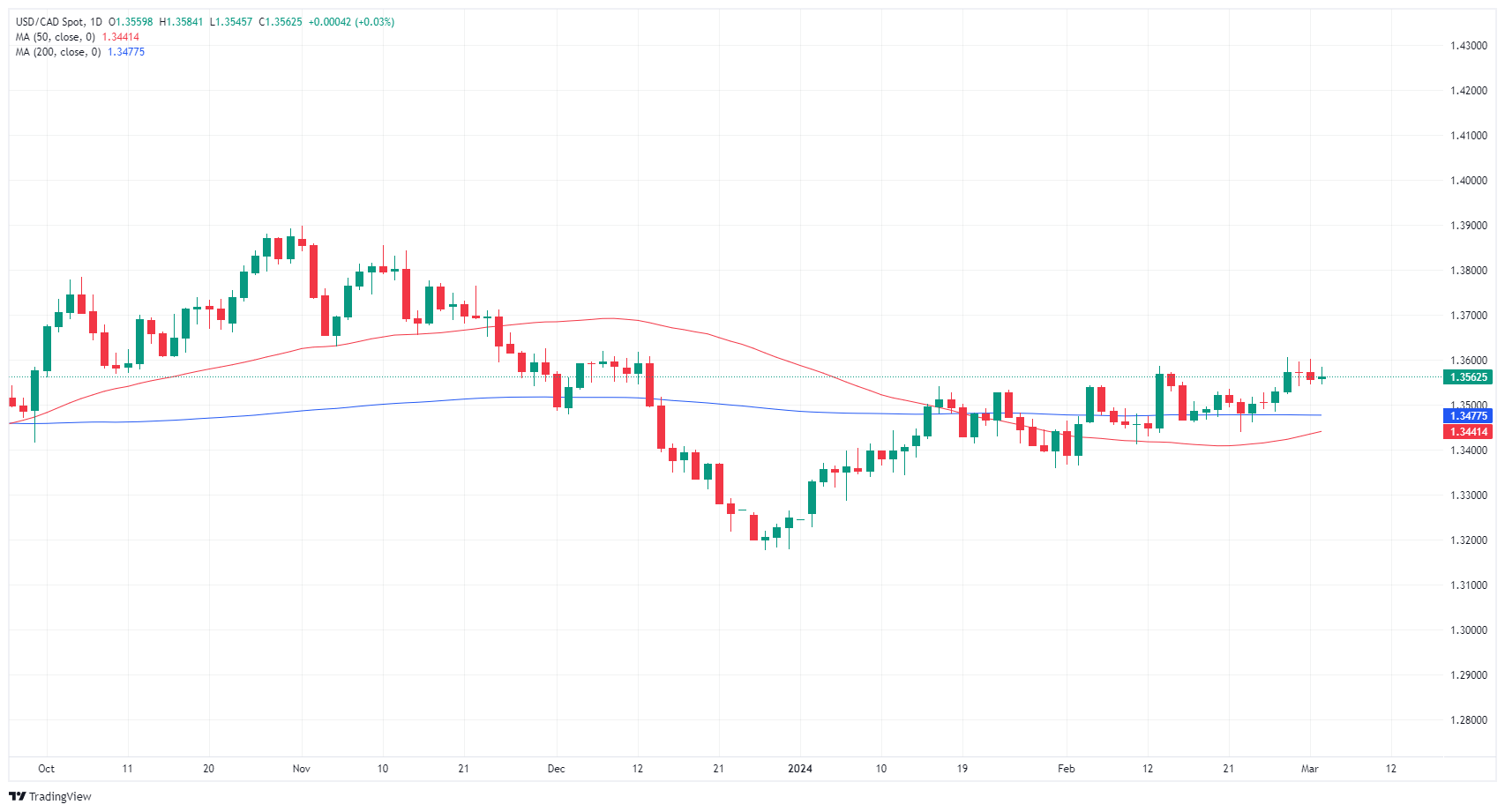
Bank of Canada FAQs
The Bank of Canada (BoC), based in Ottawa, is the institution that sets interest rates and manages monetary policy for Canada. It does so at eight scheduled meetings a year and ad hoc emergency meetings that are held as required. The BoC primary mandate is to maintain price stability, which means keeping inflation at between 1-3%. Its main tool for achieving this is by raising or lowering interest rates. Relatively high interest rates will usually result in a stronger Canadian Dollar (CAD) and vice versa. Other tools used include quantitative easing and tightening.
In extreme situations, the Bank of Canada can enact a policy tool called Quantitative Easing. QE is the process by which the BoC prints Canadian Dollars for the purpose of buying assets – usually government or corporate bonds – from financial institutions. QE usually results in a weaker CAD. QE is a last resort when simply lowering interest rates is unlikely to achieve the objective of price stability. The Bank of Canada used the measure during the Great Financial Crisis of 2009-11 when credit froze after banks lost faith in each other’s ability to repay debts.
Quantitative tightening (QT) is the reverse of QE. It is undertaken after QE when an economic recovery is underway and inflation starts rising. Whilst in QE the Bank of Canada purchases government and corporate bonds from financial institutions to provide them with liquidity, in QT the BoC stops buying more assets, and stops reinvesting the principal maturing on the bonds it already holds. It is usually positive (or bullish) for the Canadian Dollar.
