


The Euro Area’s flash PMI readings for September delivered a mixed bag, with the composite index edging up to 51.2 from 51.0, marking a 16-month high but falling short of signaling robust growth momentum.
The divergence between sectors painted a picture of an uneven recovery, with services resilience offset by manufacturing weakness across both Germany and France.
Let’s examine which setups from our watchlist capitalized on this mixed PMI outcome and how they performed against a backdrop of surging dollar strength following surprisingly robust US economic data.
Watchlists are price outlook & strategy discussions supported by both fundamental & technical analysis, a crucial step towards creating a high quality discretionary trade idea before working on a risk & trade management plan.
If you’d like to follow our “Watchlist” picks right when they are published throughout the week, check out our BabyPips Premium subscribe page to learn more!
The Setup
What We Were Watching: Euro Area PMIs for September 2025
- The Expectation: Markets anticipated modest improvement with Manufacturing PMI holding above 50.0
- Data outcome: Mixed results, with Services beating (51.4 vs 50.9 expected) but Manufacturing disappointing (49.5 vs 50.8 expected)
- Market environment surrounding the event: Initial risk-on sentiment reversed mid-week as strong U.S. data reinforced dollar strength and Fed-ECB policy divergence narratives
Event Outcome
The September flash PMI data revealed concerning divergences within the Euro Area economy.
While services activity surprised to the upside at 51.4 versus 50.9 expected, manufacturing disappointed significantly, dropping to 49.5 from 50.7 and missing the 50.8 forecast, slipping back into contraction territory for the first time in three months.
Key Takeaways:
- Composite PMI printed at 51.2, up from 51.0 but signaling only modest expansion
- Manufacturing PMI fell to 49.5 from 50.7, badly missing the 50.8 forecast and returning to contraction
- Services PMI surprised higher at 51.4 versus 50.9 expected and 50.5 previous
- Germany Manufacturing slumped to 48.5, missing the 50.0 forecast significantly
- France Manufacturing dropped to 48.1 from 50.4, below the 50.1 expected
- Germany Services jumped to 52.5, surprising versus 49.9 expectations
- New orders stalled completely after August’s brief uptick, with manufacturing orders falling sharply
- Employment remained unchanged as business confidence dipped to a four-month low
- On net, there seems to be more negative than positive in the latest Eurozone PMIs
Fundamental Bias Triggered: Bearish EUR setups
Broad Market and Exogenous Drivers:
Monday-Tuesday: Euro Climb and Wobble
The week began with ECB officials Stournaras and Kazaks declaring the rate-cutting cycle over, providing initial euro support. However, Tuesday’s mixed PMI release immediately challenged this narrative, with manufacturing weakness offsetting services strength. Fed Chair Powell’s labor market concerns briefly weakened the dollar, but gains proved fleeting.
Mid-Week: Risk Turnaround
Wednesday saw German business sentiment (IfO) disappoint at 87.7 versus 89.2 expected, compounding concerns about Europe’s largest economy. Risk sentiment turned negative during London hours. The dollar caught a serious bid during Asian trading that sustained through both London and New York sessions, with Fed officials pushing back against aggressive easing expectations.
Thursday-Friday: Dollar Domination
Thursday delivered the knockout blow for EUR/USD as U.S. GDP was revised sharply higher to 3.8% from 3.3% while jobless claims plummeted to 218k versus 240k expected. This data combination crushed hopes for aggressive Fed cuts, sending the dollar soaring. Friday’s Core PCE came in-line at 2.7% year-over-year, while Trump’s overnight threat of 100% pharmaceutical tariffs added another layer of uncertainty for European exporters.
EUR/USD: Bearish EUR Event Outcome + Risk-Off Scenario
= Arguably good odds of a net positive outcome
EUR/USD 1-hour Forex Chart by TradingView
EUR/USD proved the most legitimate setup from our watchlist, delivering a textbook bearish reaction to the disappointing manufacturing data. The pair was testing resistance near the Pivot Point and 1.1800 major psychological level ahead of the PMI releases, providing an ideal entry point for shorts.
The initial reaction saw the pair dip briefly as the manufacturing miss registered with traders, but the real move came Wednesday (traders repricing less dovish Fed rhetoric) & Thursday when the combination of a strong U.S. GDP revision and impressive jobless claims data created a perfect storm for dollar bulls.
EUR/USD slipped through the channel bottom, the 1.1750 minor psychological level and eventually the 1.1700 handle, eventually making its way to S1 (1.1667) before stabilizing. The pair bounced off of this area but struggled to mount any meaningful recovery, as the fundamental narrative had clearly shifted in favor of continued dollar strength during the latter half of the week.
The setup delivered approximately 50-70 pips from the initial entry zone around 1.1800, with those who held through Thursday’s U.S. data likely capturing roughly 120-140 pips until S1.
Not Eligible to move beyond Watchlist – Bullish EUR Setups and Bearish EUR/AUD Setup
EUR/AUD: Bearish EUR Event Outcome + Risk-On Environment

EUR/AUD 1-hour Forex Chart by TradingView
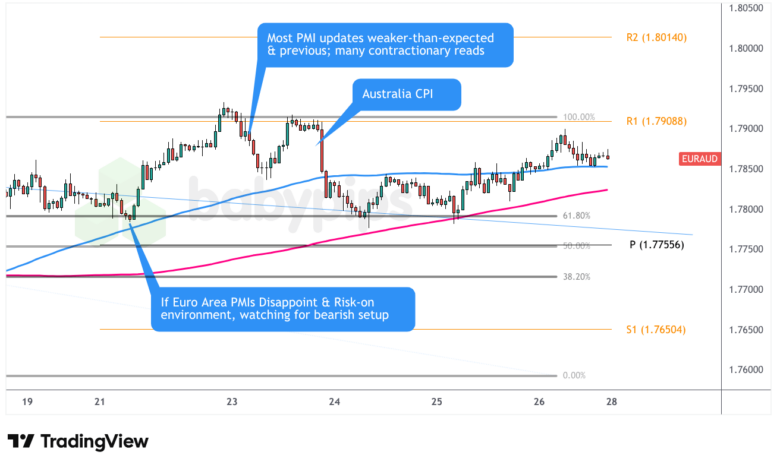
EUR/AUD faced a challenging environment, as the pair was on a tear early in the week and busted through the initial resistance zone discussed in our watchlist. Australia’s own mixed data flow added a layer of complexity to the shifting risk narrative, before AUD eventually picked up on some support after Australia’s CPI release.
The pair rallied closer to R1 (1.7908) leading up to the Euro Area PMI releases, which then triggered an initial selloff followed by a quick recovery back to the resistance. Another round of selling pressure kicked in around Australia’s inflation print, taking the pair back down to support around the 1.7800 major psychological mark.
However, the pair remained stubbornly bid above the broken resistance zone for the remainder of the week, invalidating our bearish setup conditions. The 61.8% Fibonacci retracement level provided solid support, and any attempts to push lower were quickly bought.
This setup served as a reminder that even with favorable event outcomes, the broader risk environment can completely negate directional biases.
EUR/CHF: Bullish EUR Event Outcome + Risk-On Environment

EUR/CHF 1-hour Forex Chart by TradingView
EUR/CHF entered the PMI release trading within our identified 0.9340-0.9355 resistance zone, setting up nicely for a potential bullish breakout should the data surprise to the upside.
However, the manufacturing disappointment invalidated this setup from moving beyond our watchlist, and initially pushed the pair lower toward the Pivot Point at 0.9336, even as the broader market environment wasn’t consistently risk-off enough to drive significant franc buying.
Midweek risk-off flows kept the pair below the ceiling, sending it further south as the day went on before the moves were quickly reversed as risk sentiment stabilized. The pair chopped around within a 30-pip range throughout the week, respecting both the resistance zone above 0.9350 and finding support near 0.9330.
EUR/CAD: Bullish EUR Event Outcome + Risk-Off Scenario

EUR/CAD 1-hour Forex Chart by TradingView
EUR/CAD was consolidating slightly above the R1 Pivot resistance at 1.6302 when the PMI data was released and invalidated this setup from moving beyond the Watchlist stage. We saw an initial bearish reaction, which found support at this inflection point, then surprisingly rallied up to the 1.6350 minor psychological level as the Loonie appeared to trail USD weakness early in the week.
However, mid-week geopolitical tensions and brief oil price spikes brought a bit more support for the commodity-related currency, which also took cues from the bullish dollar turnaround, leading to a breakdown below R1 on Thursday. Price later on found support at the 1.6250 minor psychological handle, then retraced its drop back to the broken support.
The Verdict
The EUR/USD setup was not only the most logical to move beyond Watchlist stage, but arguably also delivered the best risk/reward among our watchlist, benefiting from both the disappointing Euro Area manufacturing data and the subsequent surge in dollar strength from exceptional US economic data later in the week.
EUR/AUD was arguably qualified to move beyond Watchlist given the mixed broad market environment, and it provided modest opportunities for nimble traders but lacked the follow-through as risk sentiment shifted away from higher-yielding currencies later in the week while bullish EUR/CAD and EUR/CHF setups were invalidated by the region’s manufacturing industry miss.
Overall, we rate the EUR/USD setup as “highly likely” probable in supporting a net positive outcome as the pair stayed below the resistance levels discussed for a bearish scenario and delivered further downside momentum as the narrative favored further upside for the dollar as the week progressed.
Key Takeaways:
Dominant Currency Themes Override Regional Data
While the Euro Area PMI disappointment provided initial direction, the week’s price action was ultimately dominated by U.S. dollar strength following shifting Fed sentiment on rate cuts & Thursday’s impressive GDP and jobless claims data.
This reinforced that when one currency has multiple converging bullish catalysts, it tends to overwhelm single-event outcomes in other currencies.
Application: Consider the broader fundamental calendar and identify which currency has the most catalysts aligning in its favor, rather than focusing solely on individual event outcomes.
Mixed Data Requires Selective Pair Choice
The divergence between services strength and manufacturing weakness in the PMI data created ambiguous signals. EUR/USD worked because the dollar had its own bullish drivers, while crosses like EUR/CHF struggled without a clear risk-off catalyst.
Application: When facing mixed economic data, prioritize setups where the counter-currency has clear fundamental drivers, rather than relying solely on the event currency’s direction.
Technical Levels Matter More in Low-Conviction Environments
With the PMI data sending mixed signals and risk sentiment fluctuating, key technical levels like the 1.1800 and 1.1750 levels on EUR/USD and pivot points across all pairs played crucial roles in defining entry and exit points.
Application: In environments with conflicting fundamental signals, lean more heavily on technical analysis for trade management while keeping position sizes conservative.
Disclaimer: The forex analysis content provided in Babypips.com is intended solely for informational purposes only. The technical and fundamental scenarios discussed are presented to highlight and educate on how to spot potential market opportunities that may warrant further independent research and due diligence. This content shows how we cover a portion of the full trading process, and does not constitute that we ever give specific investment or trading advice. The setups and analyses presented on Babypips.com are very likely not suitable for all portfolios or trading styles.
Trade and risk management are the sole responsibility of each individual trader. All trading decisions and their subsequent outcomes are the exclusive responsibility of the individual making them. Please trade responsibly.
Trading responsibly means knowing as much as you can about a market before you think about taking on risk, and if you think this kind of content can help you with that, check out our BabyPips Premium subscribe page to learn more!

