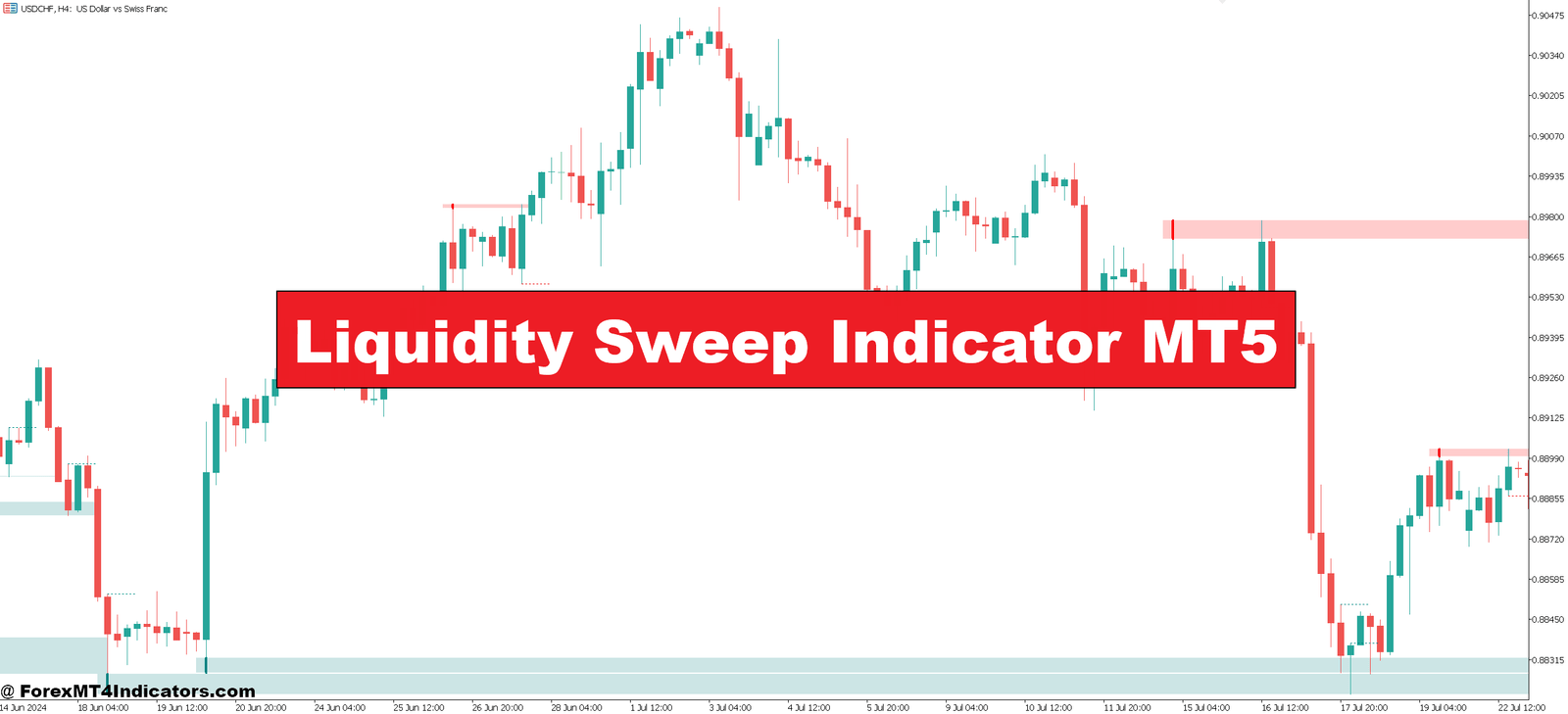
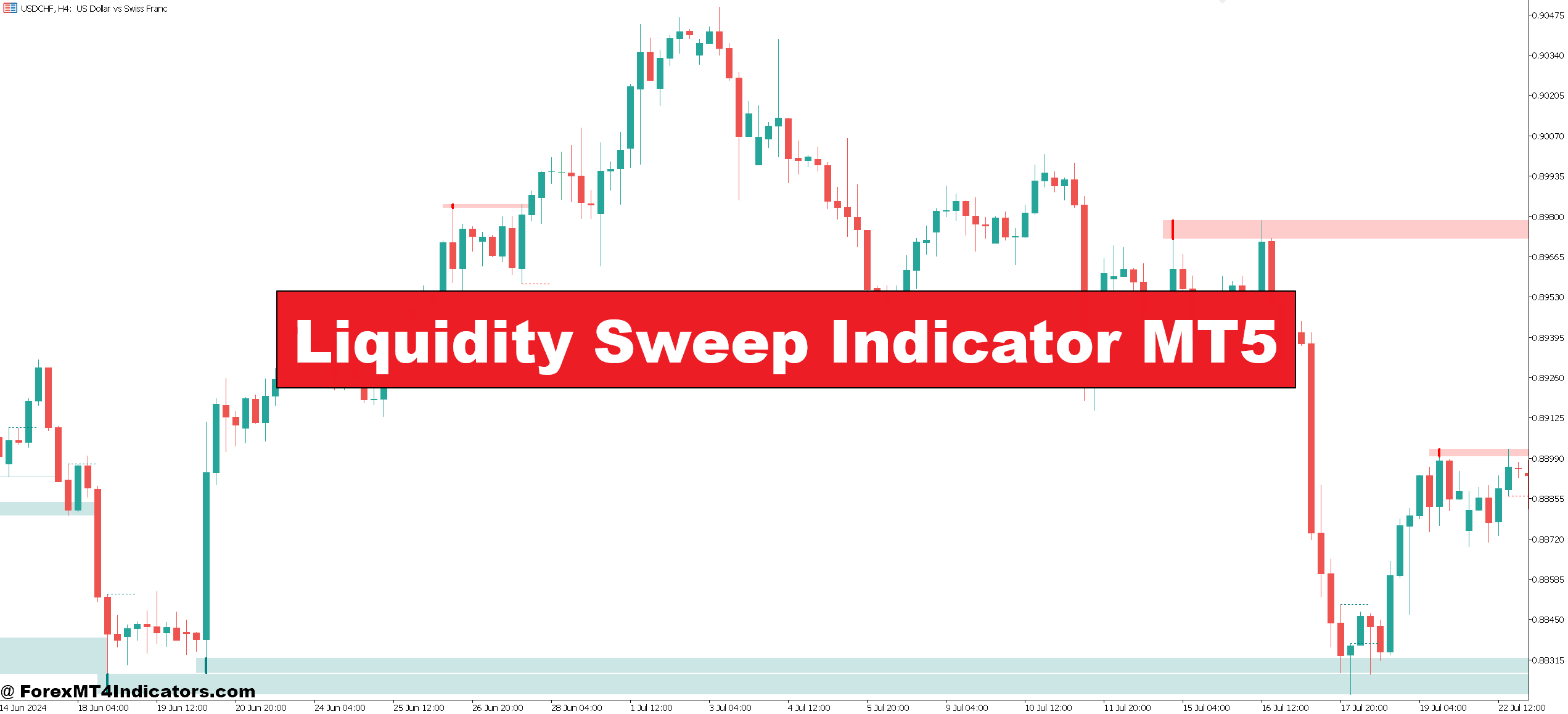
The Liquidity Sweep Indicator for MT5 addresses this by identifying when price deliberately hunts stop clusters before reversing. Instead of trading every break, traders gain context about which breaks might snap back. This doesn’t eliminate losses trading never works that way but it adds a filter that experienced institutional traders have used for years.
What Makes Liquidity Sweeps Different From Regular Breakouts
A liquidity sweep occurs when price briefly penetrates a known level support, resistance, previous swing high or low where stops cluster, then rapidly reverses direction. The key word is “briefly.” While genuine breakouts hold and extend, sweeps dart through the level like a quick raid then retreat.
The indicator tracks these characteristics through wick analysis and momentum shifts. It scans for price action that violates key levels but fails to close beyond them on the current timeframe. On the 15-minute chart, that might mean a candle wicks below the Asian session low by 10-15 pips but closes back inside the range. The algorithm flags these patterns with visual markers.
Here’s what separates this from standard support/resistance indicators: timing and intent recognition. Regular S/R tools simply mark price levels. This indicator attempts to identify when those levels are being exploited rather than respected or broken. It looks for the signature characteristics of stop hunts quick penetration, high volume spikes on the sweep candle, immediate reversal momentum.
The Technical Logic Behind Detection
The indicator calculates potential stop zones by analyzing recent swing points. Most retail traders place stops just beyond obvious highs and lows. If EUR/USD made a swing low at 1.0850, stops cluster at 1.0845 or 1.0840. The indicator maps these probable zones automatically.
When price approaches these zones, the algorithm monitors three factors. First, penetration depth how far past the level did price travel? Sweeps typically move 5-20 pips beyond the level depending on the pair’s average volatility. Second, time spent beyond the level. Genuine breaks usually close beyond the level; sweeps reject quickly, often within the same candle or the next. Third, volume characteristics. The sweep candle often shows increased volume as stops trigger, followed by reduced volume on the reversal.
The MT5 version uses indicator buffers to mark identified sweeps with arrows or dots at the reversal point. Parameters typically include lookback period (how many bars to scan for swing points), sensitivity threshold (minimum penetration distance), and time tolerance (maximum bars price can stay beyond the level before it’s considered a genuine break rather than a sweep).
Real Trading Applications and Market Context
Let’s get specific. GBP/JPY on the 1-hour chart, August 2024. Price formed a swing high at 191.50 during London session. As New York opened, a sudden spike hit 191.65, triggering breakout buyers and stop-losses from shorts. Within two candles, price collapsed to 190.80 a 85-pip reversal. The liquidity sweep indicator would have flagged this move because the breakout candle closed as a bearish engulfing pattern with a large upper wick.
The practical application works best when combined with market structure awareness. Sweeps happen more frequently during low-liquidity periods (Asian session for majors, Sunday evening) or immediately before major news releases when dealers want to clear one side before volatility hits. On NFP Friday mornings, watching for sweeps into 8:30 AM EST can prevent getting stopped out right before the actual move begins.
Traders often use this indicator as a filter rather than a standalone signal. If the indicator marks a liquidity sweep below support, that’s not automatically an entry signal. But it does suggest the support level remains valid and shorts got trapped. The actual entry might wait for a break of structure back to the upside, a momentum indicator confirmation, or a rejection candle pattern.
That said, not every marked sweep leads to profitable reversals. Sometimes price sweeps multiple times before genuinely breaking. AUD/USD in range-bound Asian sessions can sweep both sides of a 40-pip range three or four times in a single night. The indicator helps identify these patterns but doesn’t solve the ranging problem.
Customization for Different Trading Styles
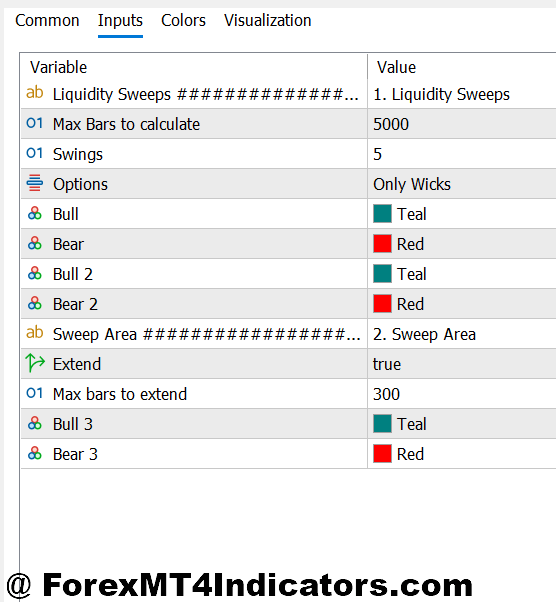
The default settings work for swing traders on 4-hour and daily charts, but intraday scalpers need adjustments. The sensitivity parameter controls how aggressively the indicator flags potential sweeps. Lower sensitivity (higher threshold) means it only marks clear, textbook sweeps. Higher sensitivity catches more subtle moves but generates false signals on regular volatility.
For scalping on 5-minute charts, traders often increase the lookback period to 40-50 bars and reduce the penetration threshold to 3-5 pips for pairs like EUR/USD. The high-frequency approach means you’re watching for quick stop hunts within tight ranges. On daily charts tracking position trades, extend the lookback to 20-30 days and increase penetration threshold to 30-50 pips for proper swing point identification.
Currency pair volatility matters. GBP pairs move twice the distance of EUR pairs on average. A 15-pip sweep on EUR/USD equals about 30 pips on GBP/USD in relative terms. Some traders maintain different indicator instances with pair-specific settings rather than using universal parameters.
The visual customization also helps. Changing arrow colors for sweeps above resistance (potential shorts) versus below support (potential longs) creates instant visual clarity. Some versions allow alerting when a sweep gets identified, useful for traders monitoring multiple pairs.
Strengths, Limitations, and Reality Checks
The indicator excels at preventing premature exits. Knowing that a stop hunt might be developing helps traders hold positions through brief adverse moves. It’s also valuable for re-entry opportunities if you got stopped out but the indicator confirms a sweep occurred, that’s a logical level to rejoin the original trade with confirmation.
The weakness shows up in choppy, directionless markets. When there’s no clear trend or larger move developing, sweeps don’t lead to strong reversals. Price just bounces between levels. The indicator becomes noise rather than signal in these conditions. You’ll see markers everywhere but no profitable follow-through.
Another limitation: it’s retrospective in nature. The indicator can only confirm a sweep after the reversal begins. That means you’ve already missed the exact low or high. Entries come on the pullback or retest, which is fine for swing traders but frustrating for those seeking perfect timing.
And here’s the honest truth institutional traders adapt. The patterns that worked consistently five years ago appear less frequently now because everyone’s aware of them. Liquidity engineering has become more sophisticated. Sometimes the “sweep” is actually the genuine move, and the reversal is the fake-out. No indicator solves this completely.
How to Trade with Liquidity Sweep Indicator MT5
Buy Entry

- Wait for the sweep below support – Enter only after price wicks below a key level by 10-20 pips then closes back above it on the same candle or next candle.
- Confirm with bullish structure break – Don’t buy immediately on the sweep; wait for price to break above the previous 15-minute high to confirm reversal momentum.
- Target previous range highs – Set take profit at the most recent swing high or resistance level, typically 30-50 pips away on EUR/USD 1-hour chart.
- Place stop-loss 5 pips below sweep low – Position your stop just beneath the wick that created the liquidity sweep, not at the support level itself.
- Avoid buying in strong downtrends – Skip sweep signals when price is below the 200-period MA on 4-hour chart, as reversals rarely hold in trending markets.
- Look for volume spikes on sweep candle – The liquidity grab should show increased volume (150%+ of average) indicating stops were actually triggered.
- Best during session overlaps – Focus on sweeps that occur during London-New York overlap (8am-12pm EST) when liquidity returns and reversals gain momentum.
- Risk maximum 1-2% per trade – Even textbook sweep setups fail 30-40% of the time, so never overleverage based on a single indicator signal.
Sell Entry

- Identify sweep above resistance – Enter short when price spikes 10-20 pips above a swing high, triggers stops, then reverses with a bearish close.
- Wait for bearish confirmation candle – Require the candle after the sweep to close below the sweep candle’s open before entering your short position.
- Set stops above the sweep high – Place stop-loss 5-10 pips above the highest wick point, giving the trade room but protecting capital if genuinely breaking out.
- Target support or structure lows – Aim for previous swing lows or support zones, typically 40-80 pips on GBP/USD 4-hour timeframe.
- Avoid during news events – Don’t short sweeps within 30 minutes before major news releases (NFP, CPI, FOMC) as volatility can extend the sweep.
- Check for lower timeframe rejection – Drop to 5-minute chart and confirm sellers stepped in with consecutive bearish candles after the sweep.
- Use tighter stops on ranging markets – In choppy Asian session ranges, reduce stop distance to 10-15 pips as sweeps happen frequently both directions.
- Exit half position at 1:1 risk-reward – Lock in partial profits when trade moves equal to your stop distance, then let remainder run to main target.
Integrating With Your Trading System
The liquidity sweep indicator works best as one component in a broader system. Pair it with trend identification don’t look for bullish sweep reversals in strong downtrends. Combine it with momentum oscillators like RSI; if a sweep occurs while RSI shows divergence, that’s stronger confluence.
Some traders use it strictly as a filter. They have their regular strategy for entries but add a rule: “Don’t enter counter to recent sweeps.” If the indicator just marked a sweep below support, avoid taking shorts for the next several hours. This defensive application reduces whipsaw losses.
Others use it proactively, waiting for sweeps into key levels as their primary setup. When EUR/USD sweeps below a major daily support, they’re ready with a pending buy order above the sweep candle high, targeting a return to range midpoint. This aggressive approach requires experience reading market context not every sweep deserves a full position.
Recommended MT4/MT5 Broker
XM Broker
- Free $50 To Start Trading Instantly! (Withdraw-able Profit)
- Deposit Bonus up to $5,000
- Unlimited Loyalty Program
- Award Winning Forex Broker
- Additional Exclusive Bonuses Throughout The Year
- Exclusive 90% VIP Cash Rebates for all Trades!

Already an XM client but missing out on cashback? Open New Real Account and Enter this Partner Code: VIP90