


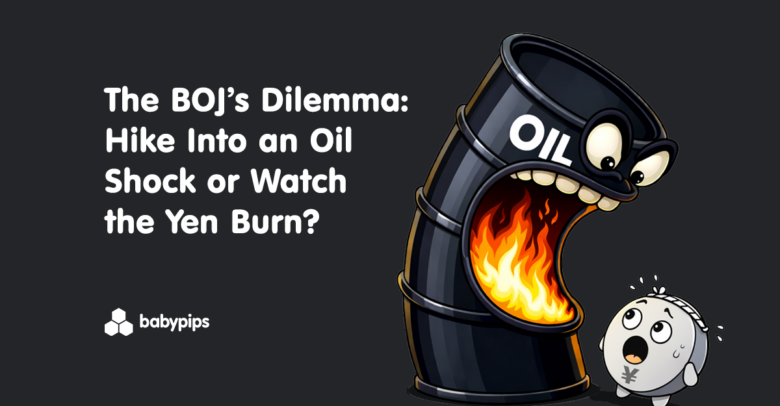
The Bank of Japan (BOJ) has long been the outlier of the global financial world. While other central banks were aggressively hiking interest rates to battle post-pandemic inflation, Japan stayed anchored to its ultra-low rate policy. However, the tides are shifting.
The summary of the BOJ’s March meeting, released this week, paints a picture of a policy board in the midst of an identity crisis:
Should they raise interest rates to defend the Japanese yen?
Or keep them low to protect a fragile economy, even if it means watching the currency “burn?”
The Setup: A Yen Squeezed From Two Directions
Japan is one of the most energy-dependent major economies in the world, importing about 90% to 95% of its oil, mostly from the Middle East, along with a large share of its food. So when oil prices spike, Japan feels it immediately.
When the yen weakens against the US Dollar, it takes more yen to buy the same barrel of oil. This creates a double-whammy effect:
- higher oil prices in dollar terms, and
- a currency that converts those dollars into even more yen.
The data is starting to show it. Import prices rose 2.8% year over year in February 2026, the fastest since July 2024. Fuel and food costs are climbing around 5% to 7% annually. Core inflation is at 1.6%, uncomfortably close to the Bank of Japan’s 2% target.
That’s imported inflation, driven by forces outside Japan’s control. For households, this feels like fuel and food cost more, but wages are not keeping up.
The Bank of Japan’s Dilemma
The BOJ wants inflation driven by rising wages and confident consumers. What it has instead is something messier and a lot harder to fix. At its March 18 – 19 meeting, the BOJ held its benchmark rate at 0.75%, but the summary released Monday showed a board increasingly split on what comes next, and why.
On one side, several hawkish members are sounding the alarm. The yen’s persistent weakness is no longer a tailwind for exporters. It’s starting to look like a tax on households and small businesses. From their perspective, waiting only makes things worse.
A weaker currency keeps feeding inflation, and risks letting it stick. One member even floated a larger rate hike, pointing to rising risks from the Middle East.
On the other side are the doves, who are worried about tightening too soon. Japan’s inflation isn’t the result of a strong economy; external shocks are pushing it. Hiking into that environment risks choking off the modest growth Japan has managed to hold onto, without fixing the real problem.
This is the imported inflation trap. When inflation is driven by strong domestic demand, rate hikes can cool spending and bring prices down. But when it comes from an oil shock or a weaker currency, higher borrowing costs just add pressure. Households end up paying more at the pump and on everyday goods, while also facing more expensive loans.
So the tradeoff is brutal. Raise rates to defend the yen, and risk tipping the economy into recession. Hold rates steady, and the yen keeps sliding, pushing the cost of living even higher.
The Art of Verbal Intervention
As the yen flirted with 18-month lows against the dollar, Japan’s top currency diplomat, Atsushi Mimura, stepped under the spotlight and used the word “decisive” to describe potential future actions.
In the world of central banking, this is known as Verbal Intervention. It is a psychological game played with currency traders.
Think of it as a “Shot Across the Bow.” The government doesn’t actually spend any money yet; instead, they use escalating language to signal that they are ready to step into the market and physically buy Yen (and sell Dollars) to prop up the price.
The usual verbal warnings can mean different things:
- “Monitoring markets:” We see what’s happening.
- “Watching with a sense of urgency:” We are getting annoyed.
- “Decisive action” / “Excessive volatility:” We have the finger on the trigger.
When a diplomat uses the word “decisive,” the market treats it as a red flag. It tells traders that betting against the yen has just become a very dangerous game, as the BOJ could intervene at any moment, causing a sudden, sharp spike in the yen’s value.
Promoted: Capitalize on BOJ Policy Shifts Without Risking Your Own Funds.
With Japanese officials getting ready to possibly intervene in the currency markets, market volatility can rise quickly. Why risk your personal capital during extreme volatility?
Most proprietary firms terminate your evaluation account if you execute a trade during a major macroeconomic release, but FundedNext permits news trading across all models.
Test your BOJ policy thesis with up to $300,000 in simulated capital, and take advantage of their Free Trial to experience the platform risk-free.
Explore FundedNext and Start Your Free Trial!Disclosure: We may earn a commission from our partners if you sign up through our links.
Market Impact: What Moved and Why
Thanks to the verbal intervention and BOJ members’ split, analysts now expect a BOJ rate hike at the April 27 – 28 meeting, plus around a 65% chance of rates reaching 1.00% by May.
USD/JPY hit 160.00 for the first time since July 2024, when Japanese officials last intervened to prop up the currency. After Mimura spoke, it pulled back sharply, a reminder of how much weight markets attach to escalating official language.
AUD/JPY and yen crosses broadly felt the pressure, tracking the risk-off bid into the dollar alongside the Middle East-driven oil surge.
The BOJ’s internal disagreement matters for these pairs. As long as the board stays split and the timing of rate hikes remains uncertain, the gap between Japanese rates and higher-yielding economies stays wide. That gap is what keeps the yen carry trade alive. Investors borrow cheaply in yen and deploy that capital into higher-yielding assets elsewhere.
Key Lessons for Traders
Words are weapons — if you know which ones to watch. Japan’s intervention playbook follows a well-worn escalation ladder: officials start with mild concern, warn against “excessive” moves, then deploy heavier language. It was the first time Mimura used the term “decisive” — language traders typically read as a signal of the authorities’ readiness to intervene. The yen moved on a word, not a policy change.
Verbal intervention buys time, not outcomes. Mimura’s comment pulled USD/JPY back by half a big figure. But without a genuine BOJ policy shift or a drop in oil prices, the pressure doesn’t disappear. If intervention does occur, the first goal will be to shock the market and break one-way USD/JPY positioning — but without support from a weaker dollar, lower oil prices, or a firmer policy path, any recovery in the yen may prove temporary.
Not all inflation is equal. The BOJ wants inflation driven by wages and domestic spending, not imported oil. When a central bank talks about the source of inflation, that’s a signal it may not act as aggressively as the headline CPI number alone would suggest. Understanding that nuance prevents you from misjudging a policy trajectory.
Watch the speed, not just the level. Japanese officials are more likely to react when yen weakness becomes rapid, speculative, and one-sided — the pace of the move matters almost as much as the 160 level itself.
The Bottom Line
The BOJ is navigating a genuinely difficult moment. An oil shock is driving inflation through imported costs, the yen is at an 18-month low, and the policy board can’t agree on whether hiking rates now helps or hurts. Meanwhile, Japan’s currency diplomat just fired the clearest verbal warning shot in months.
The next major flashpoint is the April 27–28 BOJ meeting. Watch oil prices, yen crosses, and any further escalation in official language before then. If “decisive” becomes “imminent,” brace for volatility.
Central bank communication is a tool. Learning to read its escalation patterns is one of the most practical skills a forex trader can build.
Promoted: Master Your Execution During Macro Shocks
When verbal interventions move major currency pairs, does your execution stay clinical or get emotional? TradeZella’s trade replay tool lets you revisit your past trades tick-by-tick. See exactly where your entry slipped or why you hesitated, so you can dominate the next volatility spike with a data-driven playbook.
Start Your Journal with Tradezella and use code “PIPS20” to save 20% on your first purchase!
Disclosure: To help support our free daily content, we may earn a commission from our partners if you sign up through our links, at no extra cost to you.
