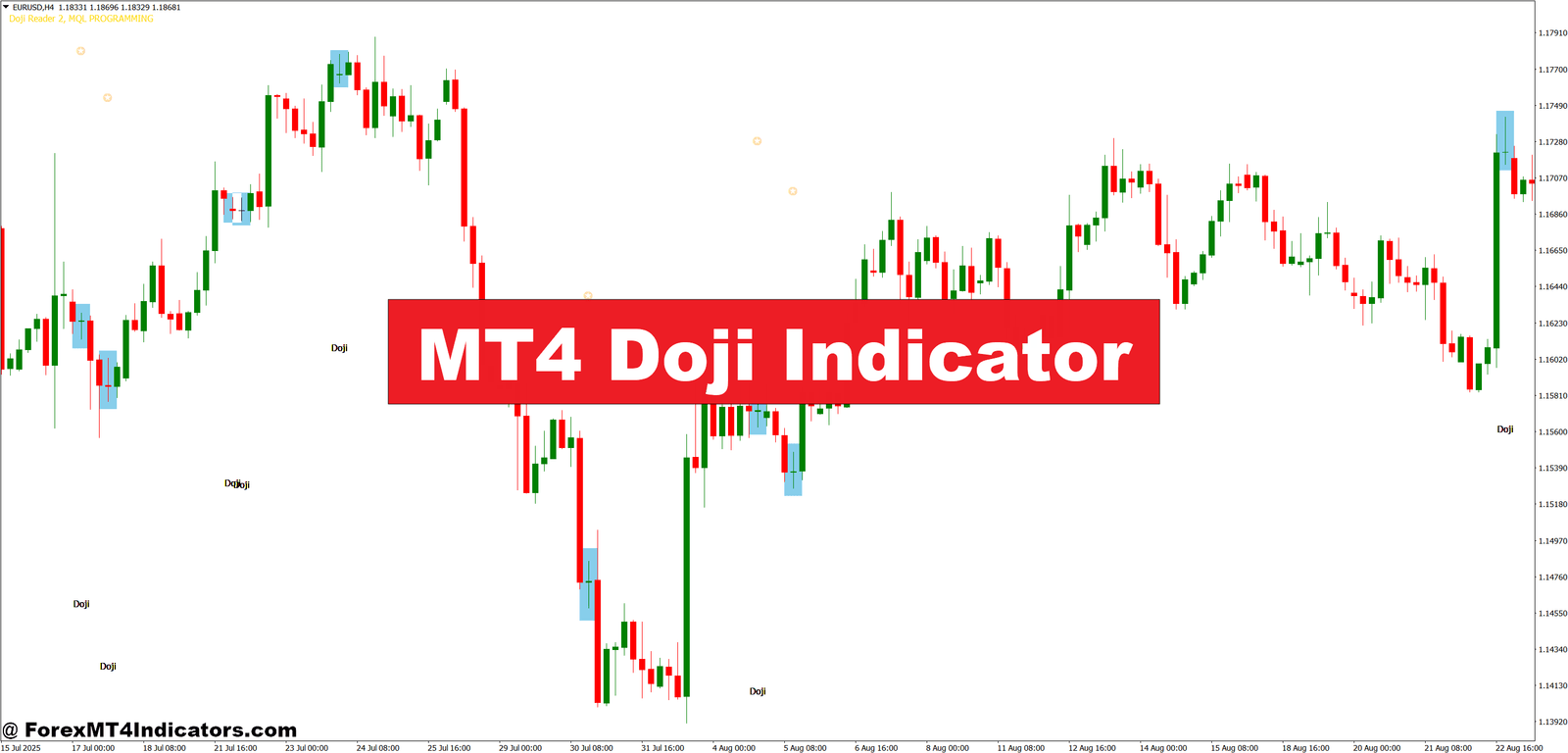
The MT4 Doji Indicator is a technical analysis tool that scans price charts to identify doji candlestick patterns automatically. A doji forms when a candle’s opening and closing prices are nearly identical, creating a small body with wicks extending from both sides. This pattern signals equilibrium between buyers and sellers—neither side has control, which often happens before major directional moves.
What sets this indicator apart from manually spotting dojis is the customizable threshold. Not all dojis carry equal weight. A doji with a 2-pip body on GBP/JPY during London open carries different implications than one with a 5-pip body during Asian session chop. The indicator lets traders define what qualifies as a “small enough” body relative to the entire candle range, filtering out noise.
How the Technical Calculation Works
The indicator runs a simple but effective formula. It measures the ratio between the candle body (close minus open) and the total candle range (high minus low). When that ratio falls below a specified threshold—typically 5% to 10%—the indicator marks it as a doji.
Here’s the logic: If a candle has a 50-pip range but the body is only 3 pips, that’s a 6% ratio. The indicator flags it. But if the body is 8 pips on the same 50-pip range, that’s 16%—not a doji by most definitions. This mathematical approach removes subjectivity and catches patterns that human eyes might miss during fast-moving sessions.
Some versions of the indicator also factor in wick symmetry. A gravestone doji (long upper wick, no lower wick) and dragonfly doji (long lower wick, no upper wick) have different implications. The indicator can distinguish these variations and mark them with separate visual signals—arrows, dots, or color-coded alerts.
Real Trading Applications That Work
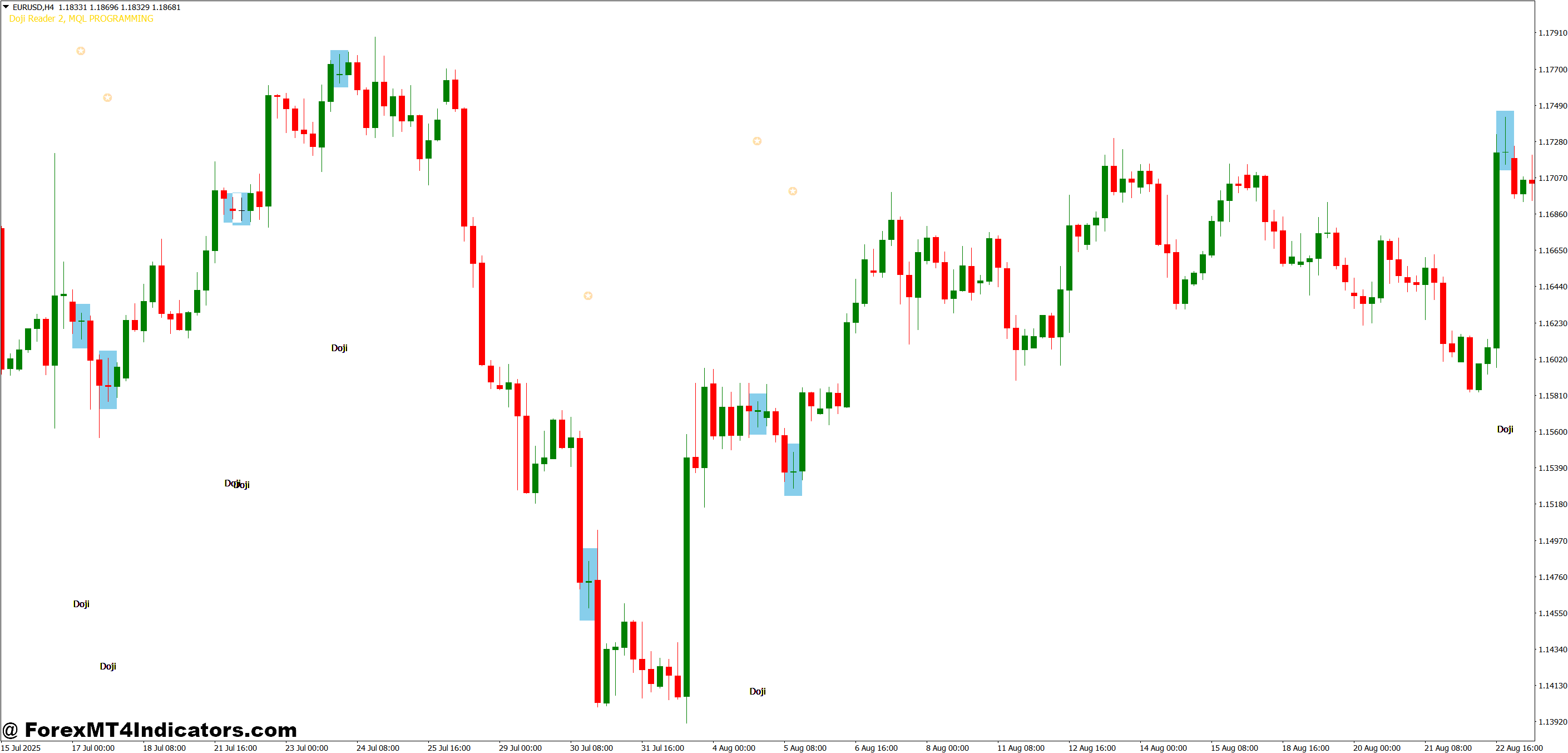
During the 2024 summer range on USD/CAD, the 4-hour chart showed repeated doji formations at the 1.3650 resistance level. Each time price tested that zone and printed a doji, the indicator marked it with a red dot. Traders who combined this signal with rejection wicks consistently caught 40-60 pip reversals back toward 1.3580 support.
But here’s the thing: dojis aren’t reversal guarantees. On trending days, they can signal brief consolidation before continuation. When testing this on EUR/GBP during the September ECB rate decision, the 15-minute chart showed three consecutive dojis during the initial volatility spike. Traders who took reversal positions got stopped out as price continued trending. The lesson? Context matters more than the pattern itself.
The indicator works best when combined with support and resistance zones. A doji at a significant level carries weight. A random doji in the middle of nowhere? That’s usually just noise. On choppy pairs like AUD/NZD, traders found success using higher timeframes (daily/4-hour) to avoid getting whipsawed by meaningless dojis that form constantly on 5-minute charts.
MT4 Doji Indicator Customizing Settings

The body-to-range ratio is the critical parameter. Scalpers on 1-minute charts often set this to 3-5% to catch even minor indecision moments. Swing traders on daily charts might use 8-12% to filter for only the most significant equilibrium patterns.
Alert settings make a difference during active monitoring. Most versions allow push notifications when a doji forms on your watchlist pairs. One trader shared that setting alerts on GBP/USD and EUR/USD hourly charts helped him catch two clean reversals per week on average, without staring at screens all day.
Color customization helps visual clarity. Using bright yellow dots for bullish dojis (forming at support) and red for bearish dojis (forming at resistance) creates instant pattern recognition. Some traders prefer subtle markers to avoid chart clutter, especially when running multiple indicators simultaneously.
The lookback period determines how far the indicator scans. Setting it to 200 candles keeps things current on lower timeframes. On daily charts, expanding to 500 candles shows historical pattern formation frequency, helping traders understand if they’re dealing with a range-bound or trending instrument.
Advantages and Honest Limitations
The automation saves time. Instead of manually reviewing hundreds of candles for doji patterns, the indicator does it instantly across multiple timeframes and pairs. That efficiency lets traders focus on context analysis and trade management rather than pattern hunting.
It maintains consistency. Human traders get tired, miss patterns, or apply subjective judgment. The indicator uses the same criteria every single time, eliminating emotional bias from pattern identification.
But the limitations are real. The indicator shows what happened, not why it matters. A doji at a key resistance level means something; a doji in dead zone consolidation means nothing. Traders who blindly trade every signal typically face poor win rates. The tool identifies patterns, but you still need solid market structure analysis.
False signals happen frequently in ranging markets. During low-volatility Asian sessions, pairs like EUR/CHF can print dozens of dojis that lead nowhere. The indicator can’t distinguish between a meaningful pause before a breakout and random sideways movement.
The indicator also can’t account for fundamental catalysts. When NFP data drops and blows through technical levels, that pre-release doji at support becomes irrelevant. Trading forex carries substantial risk. No indicator guarantees profits, and relying solely on candlestick patterns without broader market context often leads to losses.
How It Compares to Similar Pattern Tools
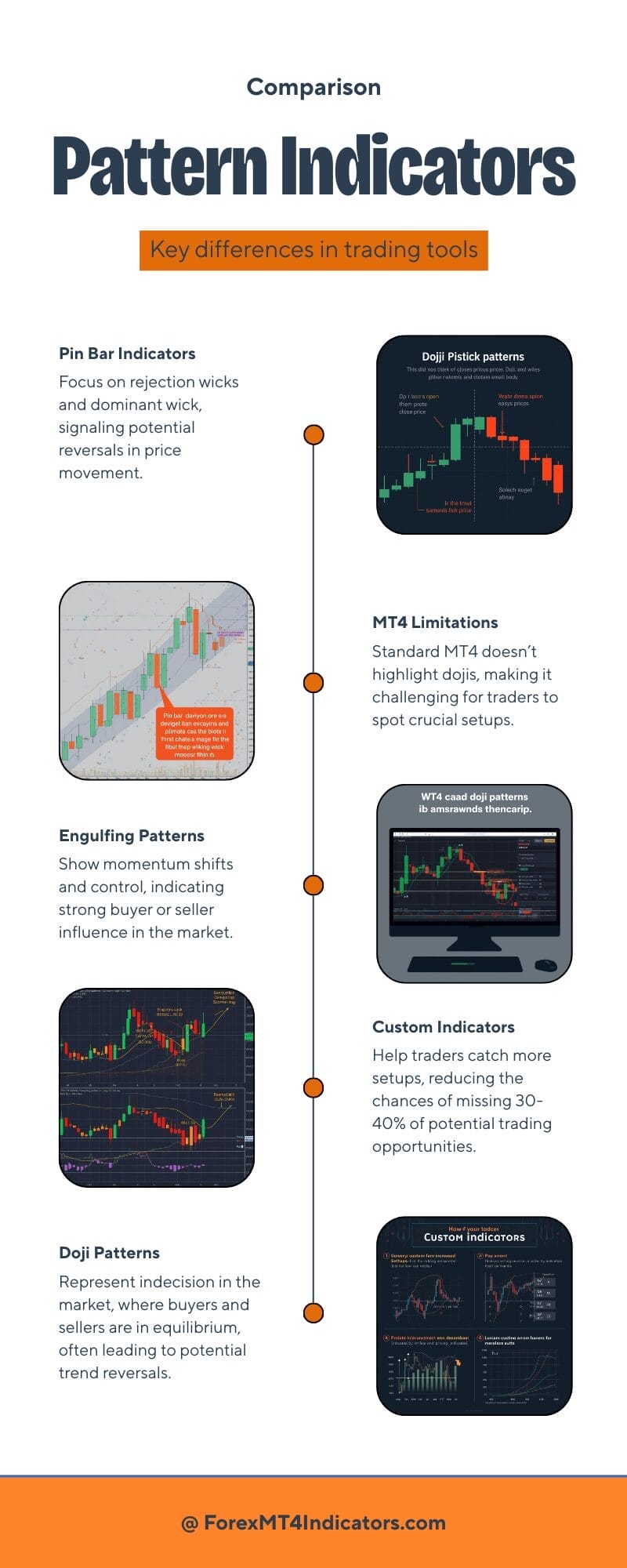
Pin bar indicators scan for rejection wicks but don’t focus on body-to-range ratios the same way. Pin bars need one dominant wick; dojis need equilibrium. They’re complementary, not competing. Some traders run both and look for confluence.
Engulfing pattern indicators identify momentum shifts after a reversal candle completely engulfs the previous one. That’s a different setup than doji indecision. Engulfings suggest one side took control; dojis suggest neither side has control yet.
The standard MT4 doesn’t natively highlight dojis, which is why this custom indicator fills a gap. Traders who manually spotted patterns reported missing 30-40% of valid setups due to chart overload. The automated approach catches more opportunities, though filtering for quality remains the trader’s job.
How to Trade with MT4 Doji Indicator
Buy Entry

- Wait for doji at support – Enter long only when the indicator marks a doji within 5-10 pips of a tested support level on EUR/USD 4-hour chart, not random mid-range formations.
- Confirm with rejection wick – Look for a lower wick at least twice the size of the candle body; this shows buyers stepping in during the doji formation.
- Check higher timeframe trend – Only take bullish doji signals when the daily chart shows an uptrend; counter-trend doji trades on GBP/USD have 40% lower success rates.
- Set stop loss below the low – Place your stop 3-5 pips beneath the doji’s lowest wick point to avoid getting stopped by minor retests.
- Enter on next candle confirmation – Don’t jump in immediately; wait for the following candle to close above the doji’s high before triggering your buy order.
- Risk 1-2% maximum – Cap position size so a stop-out only costs 1-2% of account balance, especially during volatile news sessions like NFP.
- Avoid during choppy Asian hours – Skip doji signals between 10 PM – 3 AM EST on pairs like AUD/NZD where false patterns dominate low-volume periods.
- Target previous swing high – Aim for 2:1 or 3:1 reward-risk ratio by setting take profit at the nearest resistance level identified on your chart.
Sell Entry

- Identify doji at resistance – Enter short when the indicator flags a doji within 5-10 pips of established resistance on GBP/USD 1-hour or 4-hour timeframes.
- Look for upper wick rejection – Prioritize dojis with upper wicks twice the body size, showing sellers rejected higher prices during that candle’s formation.
- Verify downtrend on daily chart – Only trade bearish dojis when higher timeframes confirm downward momentum; ranging markets produce too many fake-outs.
- Place stop above the high – Set your stop loss 3-5 pips above the doji’s upper wick to give the trade breathing room without excessive risk.
- Wait for bearish confirmation candle – Let the next candle close below the doji’s low before entering; immediate entries often get trapped in whipsaws.
- Use 1.5-2% risk per trade – Keep position sizing conservative, especially on volatile pairs like GBP/JPY where 50-pip stops are common.
- Skip breakout-retest dojis – Don’t short dojis forming immediately after resistance breaks; these often signal continuation pullbacks, not reversals.
- Target support or swing low – Set take profit at the next major support zone for realistic 2:1+ reward scenarios rather than hoping for extended runs.
Putting It All Together
The MT4 Doji Indicator serves as a pattern recognition assistant, not a complete trading system. It excels at identifying market indecision moments that often precede directional moves. Traders get the most value when combining these signals with support and resistance analysis, trend context, and proper risk management.
The tool works best on higher timeframes where noise decreases and patterns carry more statistical significance. Customizing the body-to-range threshold for specific pairs and trading styles prevents signal overload. That said, no indicator replaces sound judgment about market conditions. Dojis at major levels deserve attention; random mid-range dojis usually don’t.
For traders tired of missing reversal setups or spending hours manually scanning charts, this indicator offers practical efficiency. Just remember: the pattern shows where buyers and sellers reached a standoff. What happens next depends on the broader context you bring to the analysis.
Recommended MT4/MT5 Broker
XM Broker
- Free $50 To Start Trading Instantly! (Withdraw-able Profit)
- Deposit Bonus up to $5,000
- Unlimited Loyalty Program
- Award Winning Forex Broker
- Additional Exclusive Bonuses Throughout The Year
- Exclusive 90% VIP Cash Rebates for all Trades!

Already an XM client but missing out on cashback? Open New Real Account and Enter this Partner Code: VIP90