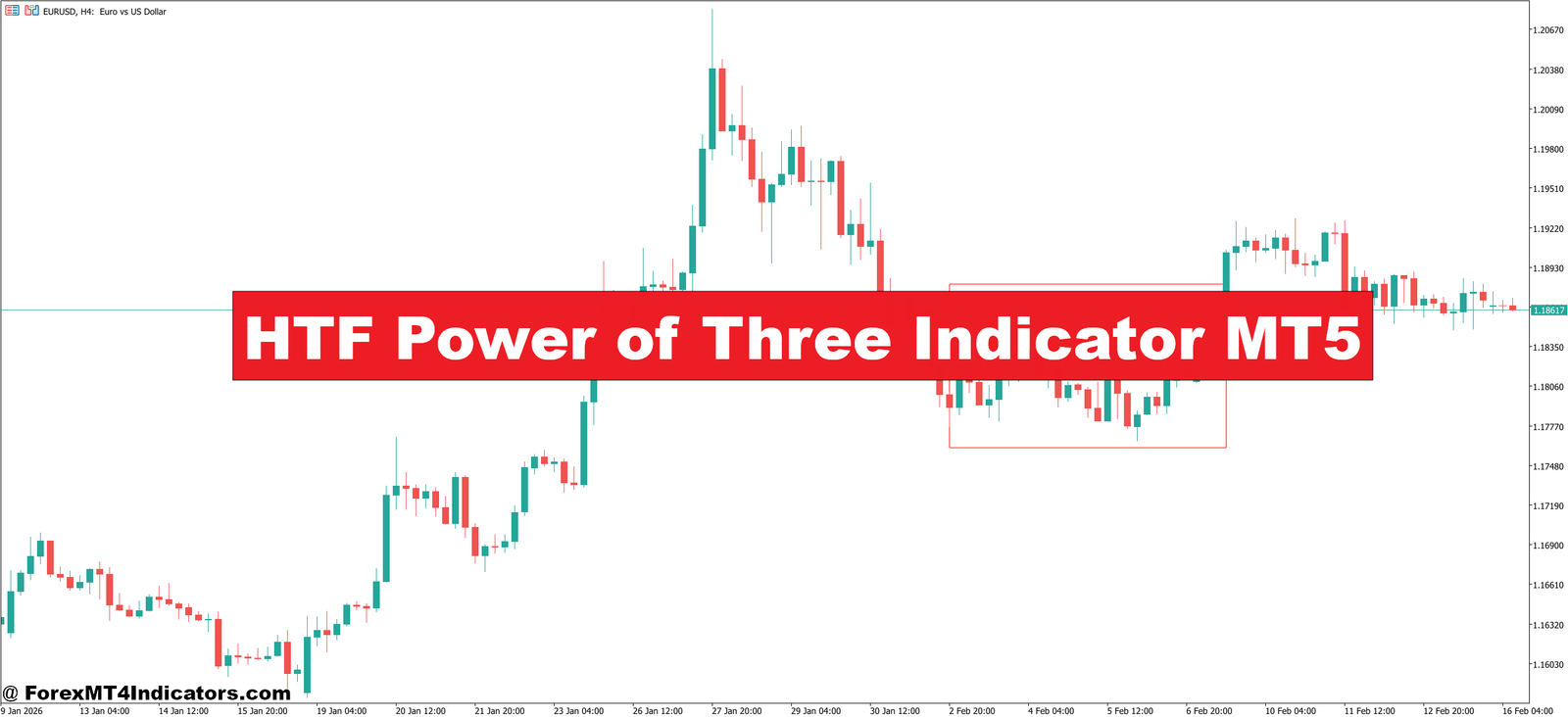
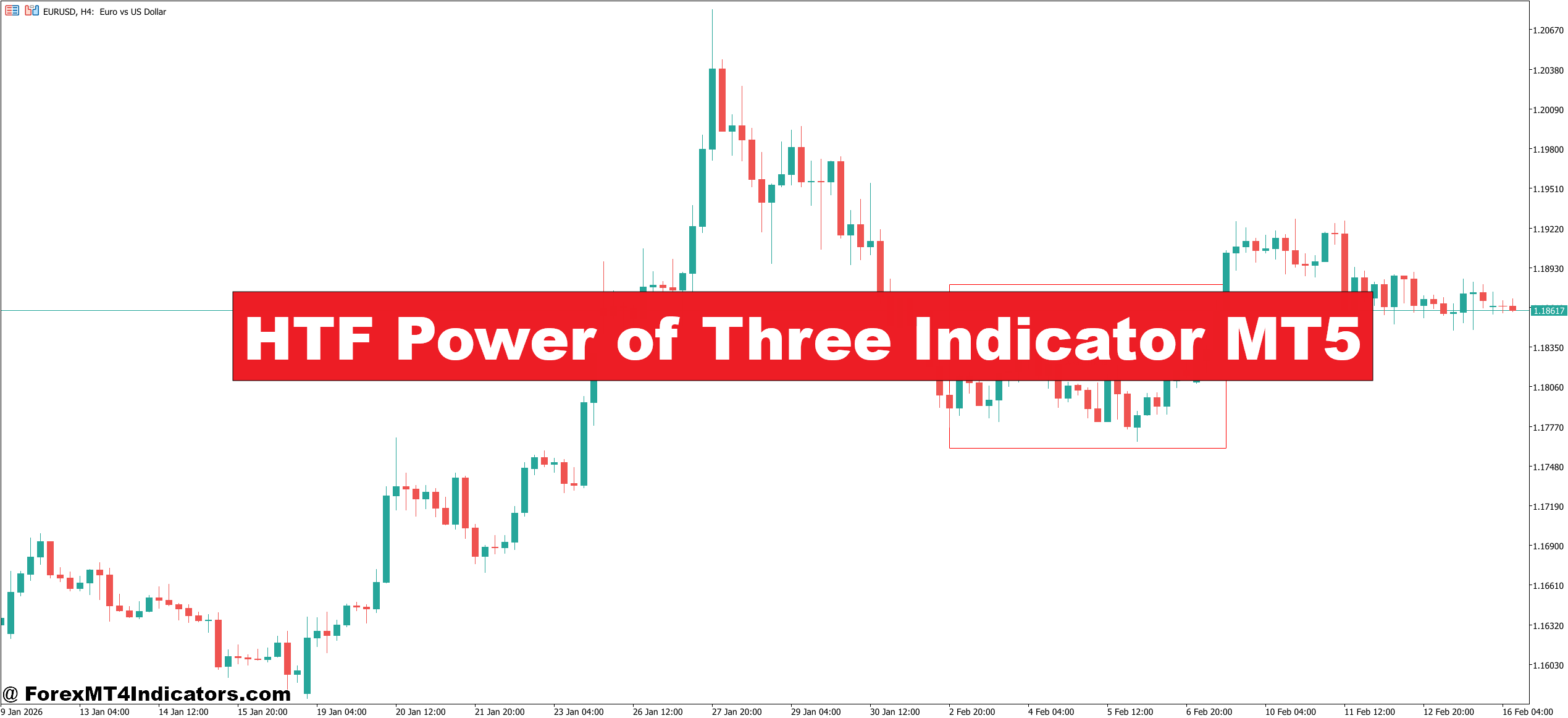
The HTF Power of Three Indicator MT5 tackles this exact problem. It brings higher timeframe market structure directly to your trading chart, eliminating the need to constantly flip between different periods. By visualizing where institutional money is likely positioned and which phase of the market cycle you’re in, this tool helps traders align their positions with the dominant trend rather than fighting it.
What is the HTF Power of Three Indicator?
This indicator applies the Power of Three methodology across multiple timeframes simultaneously. For those unfamiliar, Power of Three refers to the three distinct phases markets move through: accumulation (consolidation), manipulation (stop hunts and false moves), and distribution (the actual trending move where institutions fill their orders).
The HTF version displays these phases from daily, 4-hour, or weekly charts right on your preferred trading timeframe. Instead of manually checking the D1 chart, then the H4, then your 1-hour setup, the indicator overlays critical levels and zone markings automatically. It identifies key swing highs, swing lows, and liquidity zones where price is likely to react.
How the Indicator Functions
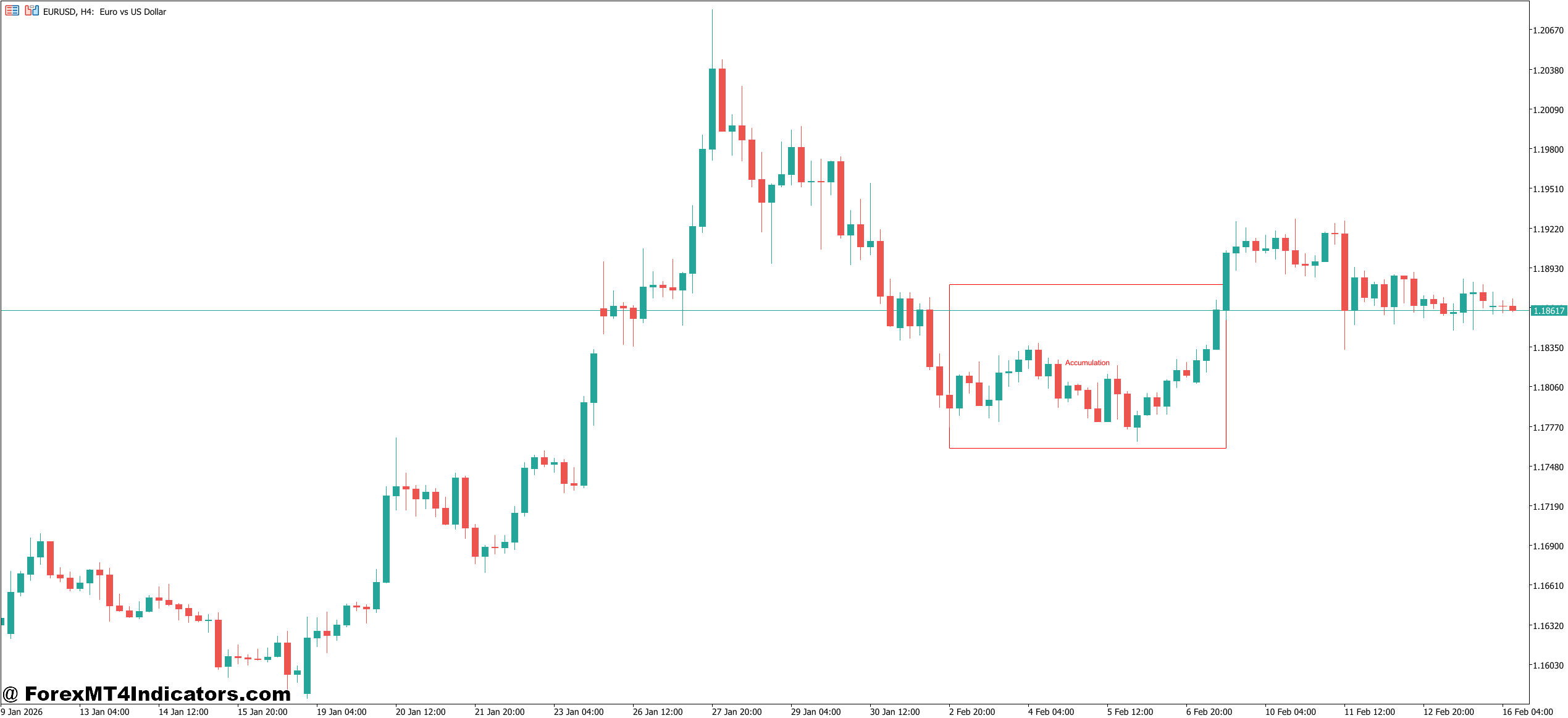
The calculation behind this tool isn’t rocket science, but it requires precision. The indicator scans your selected higher timeframe—let’s say the daily chart—and identifies the most recent swing structure. It marks the last major swing high, swing low, and any internal ranges where price spent significant time consolidating.
These levels then appear on your lower timeframe chart as colored zones or lines. Most versions use a color-coding system: blue for accumulation zones, red for manipulation areas, and green for distribution phases. The indicator updates in real-time as new candles form on the higher timeframe, so you’re always working with current market structure.
Here’s what sets it apart from basic support and resistance indicators. It doesn’t just plot horizontal lines. The tool tracks whether the higher timeframe is in an uptrend, downtrend, or ranging market. This context matters enormously. A support level in a downtrend becomes a potential short entry, while that same level in an uptrend is where you’d look for longs.
Trading Applications That Actually Work
Testing this on EUR/USD during the March 2024 NFP release showed its practical value. The 1-hour chart was choppy, giving multiple false breakout signals. But the indicator displayed the daily timeframe accumulation zone between 1.0850 and 1.0880. Every time price returned to this area on the hourly chart, buyers stepped in aggressively.
One specific setup occurred on March 8th. Price had pushed down to 1.0855 on the hourly, triggering stops below the Asian session low. The indicator showed this was still within the daily accumulation phase—classic manipulation. Traders who entered long at 1.0860 with stops below 1.0840 caught the subsequent 70-pip move to 1.0930 as distribution began.
The GBP/JPY pair tells a similar story. During volatile London sessions, the 15-minute chart often becomes a choppy mess. But when the H4 indicator marks a clear distribution phase to the upside, those 15-minute pullbacks become low-risk entries rather than reversal trades. On volatile pairs like this, knowing the higher timeframe bias prevents you from shorting into a freight train.
Risk management improves dramatically too. If the daily chart shows distribution complete and entering a new accumulation phase, smart traders tighten their targets on existing positions. The indicator essentially telegraphs when a move is exhausting.
Customization for Different Trading Styles

The default settings typically reference the daily chart, but you’ve got flexibility. Scalpers might set it to pull from the 4-hour timeframe while trading 5-minute charts. Swing traders often use the weekly timeframe displayed on daily or 4-hour charts.
Most versions let you adjust the lookback period—how many candles the indicator analyzes to determine structure. The standard 20-period setting works well for currency majors. But on slower pairs like AUD/NZD, extending this to 30 or 40 periods captures the broader market rhythm better.
You can also toggle which elements display. Some traders only want the accumulation zones visible, hiding the manipulation and distribution markers to reduce chart clutter. Others prefer seeing all three phases to understand the complete cycle.
Color customization helps if you’re running multiple indicators. Changing the zone colors to match your chart theme prevents confusion. And if you trade multiple pairs simultaneously, consistent color schemes across all charts speeds up visual processing.
Real Advantages and Honest Limitations
The biggest advantage? Context. You simply can’t make consistently good decisions trading the 15-minute chart in a vacuum. This tool forces alignment with where the real money is positioned. It also saves time—no more flipping through timeframes trying to mentally map out market structure.
For newer traders, it provides guardrails. When the indicator shows daily distribution to the downside, taking random long trades becomes much harder to justify. That discipline prevents a lot of stupid mistakes.
But let’s be straight about the limitations. This indicator won’t catch every reversal or perfectly time every entry. Markets sometimes ignore higher timeframe structure during major news events or when liquidity is thin. The indicator can also lag slightly during fast-moving markets since it relies on closed candles from the higher timeframe.
It’s not a standalone system either. You still need proper entry triggers, risk management, and confirmation from price action or other indicators. Some traders make the mistake of treating the zones as exact support and resistance levels, entering blindly when price touches them. That’s a recipe for getting chopped up. The zones show you where to pay attention, not where to automatically place orders.
And here’s something crucial: no indicator works in isolation. Combine this with basic candlestick patterns, volume analysis, or momentum indicators for the best results. On ranging days, the Power of Three structure might be less relevant than pure support and resistance.
How to Trade with HTF Power of Three Indicator MT5
Buy Entry

- Daily accumulation zone hold – When price dips into the daily accumulation zone on your 1-hour or 4-hour chart and forms a bullish rejection candle, enter long with a 20-30 pip stop below the zone low. Works best on EUR/USD and GBP/USD during London session.
- Manipulation spike reversal – If price drops below the accumulation zone by 15-20 pips (triggering stops) then immediately reverses back inside within 1-2 candles, that’s a classic manipulation move. Enter long on the reversal candle close with stops 10 pips below the spike low.
- Distribution phase confirmation – Once the indicator shifts from accumulation (blue) to distribution (green) on the higher timeframe, wait for the first pullback on your trading chart. Enter when price retraces 30-50% of the initial breakout move with a 2:1 risk-reward minimum.
- Higher timeframe trend alignment – Only take buy signals when both the H4 and daily indicators show upward distribution or fresh accumulation forming higher. Don’t fight a daily downtrend even if the 1-hour looks bullish—you’ll get stopped out.
- Volume spike at zone – When price hits the accumulation zone and you see a volume increase of 150%+ compared to the previous 5 candles, that’s institutional buying. Enter long within that volume candle or the next, targeting the previous swing high.
- Multiple timeframe sync – If the H4 shows accumulation and the daily just started distribution upward, that’s your highest probability setup. Enter on any 15-minute or 1-hour bullish engulfing pattern with a 25-pip stop, aiming for 75+ pips on pairs like GBP/USD.
- Avoid during major news – Don’t take buy signals 30 minutes before or after high-impact news releases like NFP or central bank decisions. The indicator zones often get violated during these volatile periods regardless of structure.
- Weekend gap caution – If price gaps down Monday opening and lands in a daily accumulation zone, wait for at least 2 hours of trading before entering. Weekend gaps create false setups about 60% of the time in backtesting.
Sell Entry

- Daily distribution exhaustion – When the indicator shows distribution phase complete and price enters a new accumulation zone at the top of the range, that’s your short setup. Enter when price fails to break the upper accumulation boundary twice on the 4-hour chart.
- Rejection at manipulation high – If price spikes above the accumulation zone (stop hunt) then reverses back inside with a strong bearish candle on GBP/JPY or EUR/USD, enter short immediately. Place stops 15-20 pips above the manipulation high.
- Lower timeframe breakdown – Once the daily indicator flips to downward distribution (red), take the first break below the accumulation zone on your 1-hour chart. Enter on the candle close below the zone with a 30-pip stop above the zone high.
- Failed accumulation break – When price tries to break above the daily accumulation zone but closes back inside on the H4 chart, that failure often leads to sharp drops. Enter short on the next bearish candle with targets at the zone’s lower boundary, typically 50-80 pips away.
- Triple timeframe bearish alignment – If weekly, daily, and H4 all show distribution to the downside, any rally into the accumulation zone becomes a premium short entry. Use 15-minute charts for precise entries when price stalls at the zone.
- Momentum divergence warning – When price makes higher highs but your RSI or MACD shows lower highs while at the top of an accumulation zone, short the next bearish engulfing candle. Tighten stops to 20 pips since divergence setups can whipsaw.
- Don’t short during strong trends – If the daily indicator shows continuous upward distribution for 5+ days, avoid shorting even if you see manipulation wicks. The trend is too strong, and you’ll likely catch a minor pullback instead of a reversal.
- Asian session trap avoidance – Avoid taking sell signals during thin Asian session hours (2-6 AM GMT) even if the setup looks perfect. Wait for London open when real volume enters the market, or your 40-pip stop might get hit on low-liquidity noise.
Making It Work for Your Trading
Start by picking one pair you know well. Install the indicator and observe how the higher timeframe phases align with price movement on your trading timeframe. Don’t take trades immediately—just watch for a week. You’ll start noticing patterns, like how price often respects the accumulation zones or how manipulation phases precede strong directional moves.
Once comfortable, develop a simple rule set. For example: only take long trades when the indicator shows daily accumulation or distribution to the upside, and only when price gives a specific entry signal within those zones. That could be a bullish engulfing candle, a break of the previous candle’s high, or whatever entry method you trust.
The key is integration, not replacement. This tool enhances your existing strategy by adding higher timeframe context. Traders who try to use it as a magic bullet typically end up disappointed.
Trading forex carries substantial risk and isn’t suitable for all investors. No indicator guarantees profits, and past performance doesn’t predict future results. Risk only capital you can afford to lose.
The HTF Power of Three Indicator MT5 offers a systematic way to incorporate multi-timeframe analysis without the mental overhead of constantly switching charts. It won’t make you a profitable trader overnight, but it addresses a fundamental problem many struggle with trading against the grain of institutional positioning. Used properly with sound risk management and a solid entry strategy, it becomes a valuable component of a complete trading approach. The real question isn’t whether the indicator works, but whether you’ll put in the screen time to understand how your specific pairs move through these market phases.
Recommended MT4/MT5 Broker
XM Broker
- Free $50 To Start Trading Instantly! (Withdraw-able Profit)
- Deposit Bonus up to $5,000
- Unlimited Loyalty Program
- Award Winning Forex Broker
- Additional Exclusive Bonuses Throughout The Year
- Exclusive 90% VIP Cash Rebates for all Trades!

Already an XM client but missing out on cashback? Open New Real Account and Enter this Partner Code: VIP90