Prior future
Futures
Futures or a futures contract represents a legal agreement to buy or sell a security or asset at a predetermined price at a specified time in the future. Of note, the parties are not known to each other.These transactions usually involve commodities or other securities involving the buying and selling for a forward or predetermined price.Futures also adhere to a delivery date, which specifies the date of delivery and payment. Relative to other forms of investing futures are much more complex, as they involve specified and non-flexible parameters.Futures Trading ExplainedFutures contracts are negotiated at exchanges that act as a unified marketplace for both buyers and sellers. Buyers of contracts represent long position holders, while selling parties constitute short position holders.Both parties risk their counterparty walking away if the price goes against them. As such, the contract can involve both parties incurring a margin of the value of the contract with a mutually trusted third party.This margin can range substantially, depending on the current volatility of the market of the security being traded.Futures can be incredibly risky and are the textbook definition of market speculation. A trader who predicts that the price of an asset will move in a certain direction can contract to buy or sell it in the future at a price.If this prediction is correct, the trader will profit. If the prediction is incorrect there will be losses. Futures trading is considered an advanced type of trading that requires prior knowledge and understanding.For this reason, retail traders will seldom be afforded access to futures trading by brokers without first undergoing specific questions or account requirements.
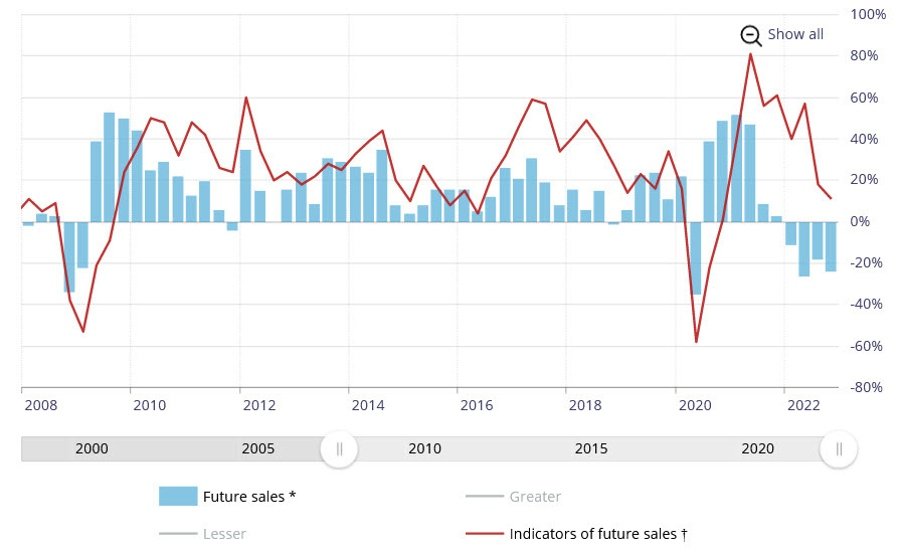
Read this Term sales +18
BOS indicator +0.07 vs +1.74 prior
Capex +20 vs +29 prior
Employment +35 vs +47 prior
One-year inflation record 4.49% vs 4.69% prior
Two-year inflation 2.95% vs +3.14% prior
Five-year inflation 2.41% vs 2.49% prior
Input prices -39 vs -39 prior
Output prices -10 vs -24 prior
Wages +31 vs +38 prior
Firms with supply chain bottlenecks +22.77 vs +43 prior
According to the survey, “most firms expect Canada to be in a recession within the next 12 months, the majority of those firms think it will be mild,” the survey says.
In a special section, the BOC reported that nearly three-quarters of businesses reported that rising interest rates are having unfavourable effects on their operations and decisions.
Given the ongoing rapid decline in this survey, the BOC may think twice about hiking rates this month. At the same time, this data showing a lack of confidence in getting inflation
Inflation
Inflation is defined as a quantitative measure of the rate in which the average price level of goods and services in an economy or country increases over a period of time. It is the rise in the general level of prices where a given currency effectively buys less than it did in prior periods.In terms of assessing the strength or currencies, and by extension foreign exchange, inflation or measures of it are extremely influential. Inflation stems from the overall creation of money. This money is measured by the level of the total money supply of a specific currency, for example the US dollar, which is constantly increasing. However, an increase in the money supply does not necessarily mean that there is inflation. What leads to inflation is a faster increase in the money supply in relation to the wealth produced (measured with GDP). As such, this generates pressure of demand on a supply that does not increase at the same rate. The consumer price index then increases, generating inflation.How Does Inflation Affect Forex?The level of inflation has a direct impact on the exchange rate between two currencies on several levels.This includes purchasing power parity, which attempts to compare different purchasing powers of each country according to the general price level. In doing so, this makes it possible to determine the country with the most expensive cost of living.The currency with the higher inflation rate consequently loses value and depreciates, while the currency with the lower inflation rate appreciates on the forex market.Interest rates are also impacted. Inflation rates that are too high push interest rates up, which has the effect of depreciating the currency on foreign exchange. Conversely, inflation that is too low (or deflation) pushes interest rates down, which has the effect of appreciating the currency on the forex market.
Read this Term back to trend should worry policymakers.
A separate survey of consumers showed 5-year inflation expectations edging down to 5.1% with 71.5% of Canadians expecting a mild-to-moderate recession in the next 12 months.
ADVERTISEMENT – CONTINUE READING BELOW