


Markets started the week in wait-and-see mode ahead of Tuesday’s US inflation data, with trade headlines and central bank chatter steering sentiment.
The dollar saw an early dip but reversed into the European session as traders shifted defensive ahead of the CPI release.
Here are headlines you may have missed in the last trading sessions!
Headlines:
- On Saturday, Chinese inflation reports came in mixed, with headline CPI coming in slightly better than expected and PPI falling short
- Over the weekend, FOMC member Bowman backed rate cuts for each of the three remaining meetings this year, citing labor market concerns
- Nvidia and AMD to pay 15% of China chip sale revenues to US government
- U.S., China extend tariff truce by 90 days
- US President Trump said imports of gold will not face US tariffs
- US President Trump named EJ Antoni, chief economist of the conservative Heritage Foundation, to lead the Bureau of Labor Statistics
- Brazil Finance Minister Fernando Haddad said his virtual meeting with US Treasury Secretary Scott Bessent had been canceled, no new date set for the call
- Bloomberg reports FOMC members Bowman, Jefferson, Logan are also under consideration to serve as next Fed Chair
- U.K. BRC retail sales monitor for July: 1.8% y/y (2.5% forecast; 2.7% previous)
- Australia NAB business confidence for July: 7.0 (3.0 forecast; 5.0 previous)
Broad Market Price Action:
Dollar Index, Gold, S&P 500, Oil, U.S. 10-yr Yield, Bitcoin Overlay Chart by TradingView
Markets traded cautiously on Monday as investors looked ahead to Tuesday’s US inflation data and digested Trump’s 90-day extension of the China tariff deadline. European indices were mixed, with the UK’s FTSE 100 up 0.23%, Germany’s DAX down 0.26%, and France’s CAC 40 off 0.28%.
In the US, stocks eased after the Nasdaq touched fresh intraday highs. The S&P 500 slipped 0.25% to 6,373 after failing to break above 6,400, while the Dow lagged with a 0.45% drop. Reports that Nvidia and AMD would pay 15% of Chinese AI chip revenues to the US government added pressure on tech. Treasury yields were little changed, with the 10-year edging down 1.2 basis points to 4.27% as positioning continued ahead of the U.S. CPI release.
Gold fell 1.3% to $3,340 after Trump said on Truth Social that gold imports would not face tariffs, clearing up Friday’s uncertainty. Bitcoin jumped to $122,300 before reversing to close near $118,500. WTI crude oil added 0.27% to $64.05, supported by the China tariff extension but capped by caution ahead of Friday’s Trump-Putin Ukraine peace talks.
FX Market Behavior: U.S. Dollar vs. Majors:

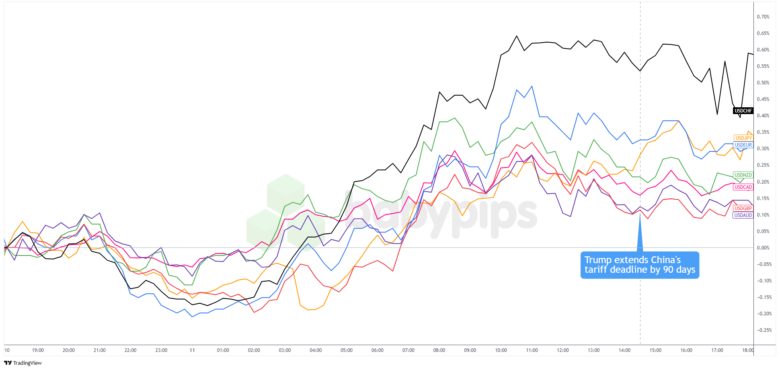
Overlay of USD vs. Majors Chart by TradingView
The dollar started the week on softer footing after mixed Chinese inflation data prompted cautious risk-taking that, ironically, weighed on safe-haven demand, with thinner liquidity from Japan’s Mountain Day holiday adding to the drift lower. However, the currency quickly reversed course into the European open as traders grew increasingly defensive ahead of Tuesday’s US CPI release.
Trump’s 90-day extension of the China tariff deadline provided temporary relief but failed to sustain risk appetite, with the dollar gaining broadly as uncertainty mounted over upcoming US-China trade negotiations and Friday’s Trump-Putin meeting. The Greenback showed particular strength against the antipodes ahead of the RBA’s expected rate cut, while also advancing against the euro and Sterling despite the BOE’s “hawkish cut.”
The yen weakened as safe-haven flows remained mixed throughout the session. The dollar’s broad strength into the close reflected defensive positioning ahead of inflation data that could determine whether the Fed cuts rates in September, with markets pricing a high probability of a quarter-point reduction. Treasury yields held steady while gold fell sharply, supporting the greenback’s late-session advance.
Upcoming Potential Catalysts on the Economic Calendar
-
U.K. employment change for June at 6:00 am GMT
- U.K. average earnings incl. bonus (3Mo/Yr) for June
- U.K. average earnings excl. bonus (3Mo/Yr) for June
- U.K. unemployment rate for June
- U.K. claimant count change for July
- Germany ZEW economic sentiment index for August at 9:00 am GMT
- Euro Area ZEW economic sentiment index for August at 9:00 am GMT
- U.S. NFIB business optimism index for July at 10:00 am GMT
- Canada building permits for June at 12:30 pm GMT
- U.S. CPI reports for July at 12:30 pm GMT
- U.S. Fed Barkin speech at 2:00 pm GMT
- U.S. Fed Schmid speech at 2:30 pm GMT
- U.S. API crude oil stock change for August 8 at 8:30 pm GMT
- New Zealand electronic card retail sales for July at 10:45 pm GMT
- Japan Reuters Tankan index for August at 11:00 pm GMT
- Japan PPI for July at 11:50 pm GMT
Sterling and the euro could see early volatility in the European session with U.K. jobs and wage data followed by German and Euro area ZEW sentiment readings, where stronger prints may lift the European currencies despite tariff concerns.
In the U.S. session, Uncle Sam’s highly anticipated July CPI will likely be the main driver for USD direction, with Fed speakers and API crude data providing secondary market cues.
As always, look out for global trade developments and geopolitical headlines that could influence overall market sentiment. Stay nimble and don’t forget to check out our Forex Correlation Calculator when taking any trades!

