


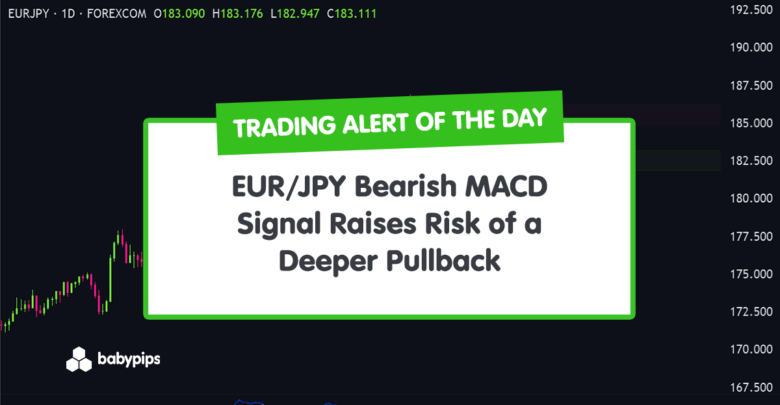
EUR/JPY is showing fresh signs of momentum fatigue after a multi-week rebound attempt.
The latest daily candle pushed sharply lower from the 184.50 area, hinting that sellers are still active near recent highs.
At the same time, a closely watched momentum gauge has flipped, putting the recent upswing back under scrutiny.
Traders often treat this type of shift as an “early warning,” but the follow-through is what tends to separate noise from a meaningful turn.
Welcome to “TA Alert of the Day.” Each day after the market close, MarketMilk scans for popular technical indicator alerts. We use these alerts as the basis for a mini-lesson, breaking down what each alert means, why it matters, and how traders might interpret it. The goal is to help beginner traders not only spot these alerts but also understand the logic behind them and how they can inform trading decisions.
What MarketMilk Has Detected
MarketMilk detected a bearish MACD(12,26,9) crossover on the daily timeframe, where the MACD line moved below its signal line.
This crossover occurred as EUR/JPY pulled back from the recent cluster of closes around 184.00–184.49, following an upswing that began from the mid-March lows near 182.35–182.77.
Price action also shows rejection from the 184.60–184.78 zone (a prior high area from late February and again in late March), keeping that region in focus as near-term resistance.
What This Signals
Traditionally, a bearish MACD crossover suggests that upside momentum is weakening and can attract sellers if the move is sustained.
When it appears after a rebound into a known resistance zone (here, the mid-to-upper 184s), it often marks a transition from “bounce” conditions to a more cautious, two-sided market where pullbacks can expand.
If downside follow-through develops, traders commonly watch whether price revisits and reacts to the recent swing support band around 182.60–182.80.
However, this same pattern can also represent a routine momentum reset within a broader range, especially if the price quickly reclaims the broken area and the MACD histogram stabilizes.
EUR/JPY has shown several periods in the dataset where momentum oscillated around trend changes (for example, the February downswing into the 181.20–181.95 region and the subsequent recovery back toward 184.70+).
In that context, a crossover can sometimes coincide with a shallow dip rather than a sustained decline.
Alternatively, the bearish crossover can become a false signal (whipsaw) if EUR/JPY holds above nearby support and snaps back above 184.00.
That scenario is more common when the crossover happens while MACD values are still relatively close together, and when the price remains inside a broader consolidation zone rather than breaking structure.
The outcome depends heavily on follow-through selling, where the close prints relative to 184.00 and 182.60–182.80, and whether volatility expands after the crossover.
Context and confirmation are essential, particularly on daily signals, where a single session can change the short-term momentum read quickly.
How It Works
The MACD (Moving Average Convergence Divergence) compares two exponential moving averages (typically 12- and 26-period) to measure momentum and trend direction.
The signal line is a 9-period EMA of the MACD line, and crossovers between them are used to identify shifts in momentum.
When the MACD line crosses below the signal line, it indicates that recent price momentum has slowed versus the longer baseline, often aligning with pullbacks, trend pauses, or potential reversals.
Traders also monitor the histogram (the distance between MACD and signal) to gauge whether bearish momentum is strengthening or fading.
Important: MACD is a lagging indicator, meaning it confirms a momentum shift after the price has already started to move. In ranging markets, crossovers can occur frequently and produce whipsaws, so location (near support/resistance) and confirmation from price structure typically matter more than the crossover alone.
What to Look For Before Acting
Do not assume EUR/JPY is starting a sustained downtrend. Consider these factors:
✅ A daily close below 183.00 and whether price accepts below that level for more than one session
✅ Reaction at the nearby support zone around 182.60–182.80 (recent low area and prior pivot)
✅ Whether the MACD histogram continues to move further negative (expanding bearish momentum) versus flattening
✅ Any attempted rebound failing near 184.00–184.25 (possible “lower high” behavior)
✅ Whether resistance near 184.60–184.78 remains defended (late-Feb and late-Mar supply zone)
✅ Alignment on a higher timeframe: check the Weekly chart for trend structure and whether momentum is rolling over there as well
✅ Broader JPY risk sentiment (equity volatility, rates expectations) and whether it supports sustained JPY strength
✅ Upcoming macro catalysts (ECB/BoJ communication, inflation/rates data) that could overwhelm technical signals
Risk Considerations
⚠️ Whipsaw risk: MACD crossovers can flip back quickly if EUR/JPY rebounds into the mid-184s
⚠️ Support snapback: The 182.60–182.80 area may attract buyers, producing sharp counter-moves
⚠️ Event risk: Central-bank or inflation surprises can invalidate momentum signals abruptly
⚠️ Range conditions: If price remains boxed between ~182.60 and ~184.70, crossovers may be less reliable
Potential Next Steps
Consider keeping EUR/JPY on a watchlist and monitoring whether price breaks structure (e.g., holds below 183.00 and tests 182.60–182.80) or instead reclaims 184.00+ and invalidates the bearish momentum shift.
If you trade this signal, many traders prefer waiting for confirmation from a subsequent daily close and managing risk around nearby invalidation levels (such as a reclaim of the 184.25–184.50 area).
Position sizing and a plan for volatility around scheduled macro events can help keep the crossover in perspective.
Trade Idea (Bullish Continuation Scenario)
Setup:
Look for continuation higher if price can hold above the 182.0–182.8 support zone and eventually break through 184.8–186.0, confirming that buyers are regaining control.
Entry:
Enter long on a daily close above 186.0, confirming a breakout from the current range.
Alternatively, enter on a controlled pullback into 182.0–182.8 if price stabilizes there and turns back higher.
If price fails to hold the support zone and closes decisively below 182.0, stand aside and wait for either deeper support to form or a fresh breakout later.
Stop Loss:
For breakout entries: stop on a daily close back below 184.0. That would invalidate the breakout by showing price could not hold above the former resistance.
For pullback entries: stop on a daily close below 181.0. That would invalidate the support-hold idea and signal that the range is breaking lower.
Take Profit:
Target 189.0–190.0. That is the next realistic upside area if price breaks out and continues higher.
Bottom Line for Bulls:
EURJPY is still constructive on the higher timeframe, but right now it is trapped between support near 182.0–182.8 and resistance near 184.8–186.0.
A breakout above 186.0 would favor continuation of the broader uptrend, while a loss of 182.0 would shift the focus toward a deeper corrective move.
Trade Idea (Bearish Rejection Scenario)
Setup:
Look for a bearish rotation if price continues to reject the 184.8–186.0 supply zone and starts to lose the 182.0–182.8 demand zone, signaling that sellers are gaining control inside the range.
Entry:
Enter short on a daily close below 182.0, confirming a breakdown from the current range.
Alternatively, if price rallies into 184.8–186.0 and prints a clear bearish rejection candle, enter short on the next daily close back below 183.5, confirming that resistance is holding.
If price instead breaks and closes decisively above 186.0, stand aside, as that would invalidate the bearish setup and favor bullish continuation.
Stop Loss:
For breakdown entries: stop on a daily close back above 183.5. That would invalidate the breakdown by showing price has reclaimed the lower edge of the prior range.
For rejection entries near resistance: stop on a daily close above 186.2. That would invalidate the bearish idea by confirming that supply has failed and the market is breaking higher.
Take Profit:
Target 179.50. That marks the next larger support zone below the current range and is the most likely area where buyers could step back in.
Bottom Line for Bears:
EURJPY is compressing below a clear supply zone, and repeated failure near 184.8–186.0 keeps the risk of a downside rotation alive.
A confirmed break below 182.0 would favor a move toward 179.5, while a breakout above 186.0 would cancel the bearish thesis and restore the broader uptrend.
This content is strictly for informational purposes only and does not constitute as investment advice. Trading any financial market involves risk. Please read our Risk Disclosure to make sure you understand the risks involved.

