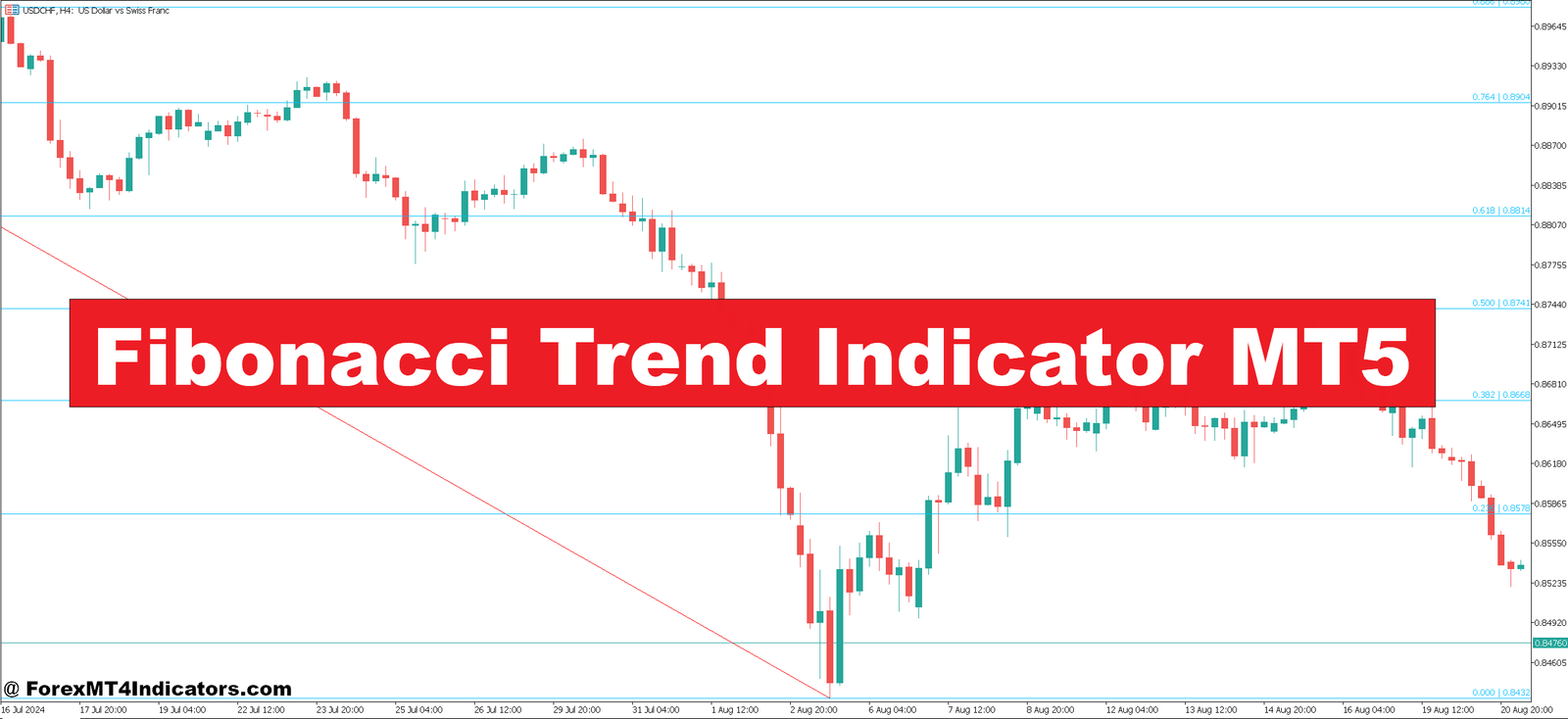
The Fibonacci Trend Indicator MT5 addresses this challenge by merging two proven concepts: Fibonacci retracement levels and trend direction analysis. This tool plots dynamic zones based on recent price swings while simultaneously identifying whether the market is trending up, down, or sideways. Traders get visual confirmation of both trend strength and potential reversal points on a single chart.
What the Fibonacci Trend Indicator MT5 Actually Does
This indicator automatically calculates Fibonacci retracement levels from recent swing highs and lows, then colors the zones based on current trend direction. Unlike static Fibonacci tools that require manual drawing, this MT5 version updates continuously as new price bars form.
The indicator displays bands or zones on the chart, typically colored green during uptrends and red during downtrends. Some versions add a neutral color like yellow for ranging markets. These visual cues help traders quickly assess market conditions without analyzing multiple indicators.
What sets this tool apart is the trend filtering component. It doesn’t just plot Fibonacci levels—it evaluates whether price respects those levels within the context of the prevailing trend. A 38.2% retracement during a strong uptrend signals something different than the same retracement in a downtrend.
The Technical Framework Behind the Indicator
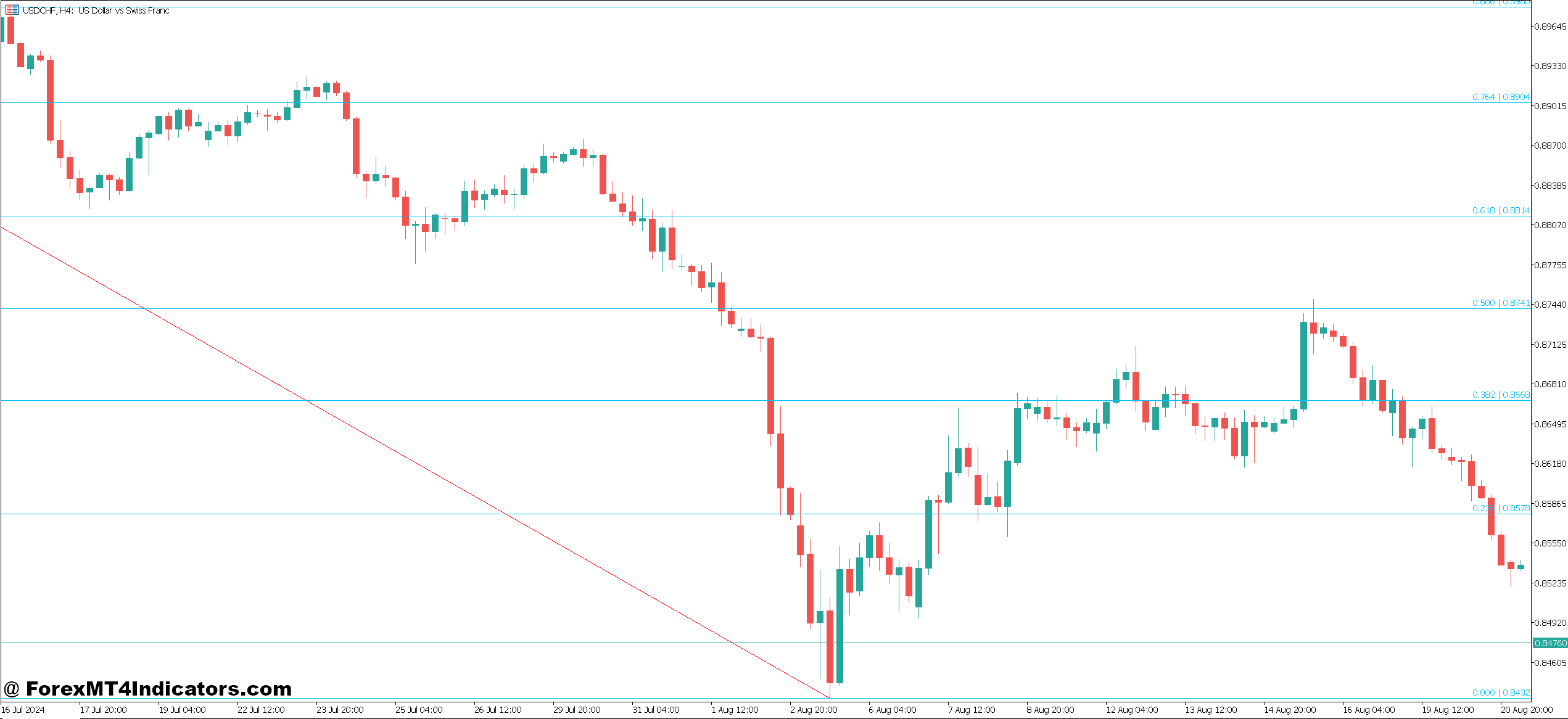
Most Fibonacci Trend Indicators for MT5 use a multi-step calculation process. First, the algorithm identifies swing highs and swing lows over a specified lookback period, typically 20 to 50 bars depending on the timeframe. Then it calculates standard Fibonacci ratios: 23.6%, 38.2%, 50%, 61.8%, and sometimes 78.6%.
The trend component usually relies on a moving average crossover system or a directional movement calculation similar to ADX. When shorter-period averages stay above longer ones, the indicator interprets this as an uptrend. The Fibonacci zones then display in the bullish color scheme.
Here’s what happens in practice: On a GBP/JPY 1-hour chart, the indicator spots a swing low at 182.50 and swing high at 184.20. It calculates the 38.2% retracement at 183.55. If the 20-period EMA stays above the 50-period EMA, the zone shows green, suggesting traders look for long entries near 183.55.
The refresh rate matters. Some versions recalculate with every tick, which can cause the levels to shift during volatile periods. Others lock the calculation at bar close, providing more stable levels but potentially slower reaction to sharp reversals.
Real Trading Applications and Scenarios
Traders commonly use this indicator for trend pullback entries. Say AUD/USD is trending up on the daily chart. Price rallies from 0.6500 to 0.6720, then starts pulling back. The Fibonacci Trend Indicator shows green zones at the 38.2% (0.6636) and 50% (0.6610) levels. A trader might place a buy order at 0.6636 with a stop below 0.6600, targeting the previous high.
The color-coding becomes especially useful during choppy sessions. On a Tuesday morning, EUR/GBP might whipsaw between 0.8550 and 0.8580 for hours. If the indicator turns yellow or neutral, experienced traders know to stand aside or reduce position sizes. This prevents getting chopped up by false breakouts.
Some traders combine this indicator with price action confirmation. When price reaches a Fibonacci zone in a trending market, they wait for a rejection candle pattern before entering. On USD/CAD, price might drop to the 61.8% level during an uptrend. A bullish engulfing candle at that zone, combined with green coloring from the indicator, provides stronger entry conviction.
The tool works differently across timeframes. On 15-minute charts, the levels shift frequently, making them better suited for scalpers who can monitor positions closely. Daily charts provide more stable Fibonacci zones that swing traders use for position entries. Weekly charts show major retracement levels that institutions might defend.
Settings and Customization Options
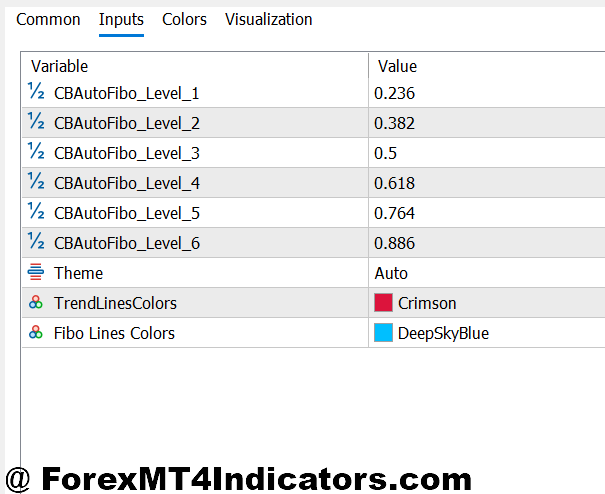
Most MT5 versions of this indicator offer several adjustable parameters. The lookback period controls how many bars the algorithm uses to identify swings. A 20-bar lookback on a 1-hour chart considers roughly one trading day of data. Extending this to 50 bars smooths the levels but makes them less responsive to recent price action.
Traders can typically adjust the Fibonacci ratios themselves. Some prefer adding the 23.6% level for shallow retracements in strong trends. Others remove the 78.6% level, viewing it as too deep for reliable trend continuation entries.
The trend sensitivity setting—often called the “trend period” or “MA period”—determines how quickly the indicator switches between bullish and bearish states. A shorter period (like 10 bars) makes it more reactive, switching colors frequently. A longer period (50 or 100 bars) keeps the indicator in trend mode longer but may lag during actual reversals.
Color customization helps with chart readability. Traders running dark chart backgrounds might change the uptrend color from green to cyan for better contrast. Those who are colorblind often switch to high-contrast combinations that work with their vision.
For currency pairs like GBP/JPY or GBP/USD that trend strongly, some traders increase the lookback period to capture larger swings. On ranging pairs like EUR/CHF, they might reduce sensitivity to avoid constant color switching.
Strengths, Weaknesses, and What to Watch For
The main advantage is speed. Drawing Fibonacci retracements manually takes time and requires subjective decisions about which swing points to use. This indicator handles that automatically, letting traders focus on execution rather than analysis.
The trend filter adds valuable context. Fibonacci levels appear in any market condition, but they perform better in trending environments. By color-coding based on trend direction, the indicator helps traders avoid fighting the prevailing momentum.
But here’s where it gets tricky. The automatic swing detection doesn’t always match what a human analyst would choose. During sideways markets, the algorithm might identify minor swings as significant, creating levels that price ignores. A trader watching NZD/USD range between 0.6100 and 0.6150 might see Fibonacci zones appear and disappear as the indicator recalculates.
Whipsaws happen during trend transitions. The indicator might show green zones as price makes a final push higher, only to switch red as the reversal confirms. Traders entering at what looks like a 38.2% retracement in an uptrend might actually be catching a falling knife as the trend shifts.
The indicator also suffers from repainting on some versions. If it recalculates with every tick rather than at bar close, levels visible during price movement might vanish or shift after the bar completes. This makes backtesting unreliable and can frustrate real-time traders.
Compared to standard Fibonacci tools, this automated version trades precision for convenience. A skilled analyst examining EUR/USD might identify a swing low from three weeks ago as the critical level, while the indicator only looks back 50 bars. That said, the time saved often outweighs the occasional imprecision.
Against other trend indicators like MACD or ADX, the Fibonacci Trend Indicator provides clearer price targets. MACD signals trend direction but doesn’t tell traders where to enter. This tool offers both: trend direction and specific retracement levels for entries.
How to Trade with Fibonacci Trend Indicator MT5
Buy Entry

- Wait for green zone confirmation – Only enter long positions when the indicator displays green/bullish coloring, signaling an active uptrend on your chosen timeframe (1-hour or higher).
- Enter at the 38.2% or 50% retracement level – Place buy orders when price pulls back to these Fibonacci zones during uptrends; EUR/USD often respects the 38.2% level in strong trends, while deeper pullbacks to 50% offer better risk-reward ratios.
- Confirm with candlestick rejection – Wait for a bullish engulfing, hammer, or pin bar to form at the Fibonacci zone before entering; don’t buy just because price touches the level.
- Set stops below the 61.8% level – Place your stop loss 5-10 pips below the next Fibonacci zone to give the trade breathing room while maintaining clear invalidation; on GBP/USD 4-hour charts, this typically means 30-50 pip stops.
- Avoid entries during yellow/neutral signals – Skip trades when the indicator shows ranging conditions, even if price reaches a Fibonacci level; ranging markets produce false signals and whipsaws.
- Check higher timeframe alignment – Verify the daily chart also shows green/bullish coloring before taking 1-hour or 4-hour buy signals; alignment across timeframes increases probability.
- Don’t chase price above the swing high – If price already broke above the recent swing high that created the Fibonacci levels, wait for a new pullback rather than buying extended moves.
- Reduce position size before major news – Cut your standard position size by 50% if NFP, FOMC, or other high-impact events occur within 12 hours; Fibonacci levels often fail during volatile news reactions.
Sell Entry

- Confirm red zone activation – Only take short positions when the indicator turns red/bearish, indicating a confirmed downtrend on your trading timeframe.
- Enter at 38.2% or 50% retracement rallies – Sell when price bounces up to these Fibonacci levels during downtrends; the 38.2% level works well on EUR/USD during strong bearish momentum.
- Look for bearish rejection candles – Wait for shooting stars, bearish engulfing patterns, or strong rejection wicks at the Fibonacci zone before selling; don’t short blindly at the level.
- Place stops above the 61.8% zone – Set your stop loss 5-10 pips above the next Fibonacci retracement level; on GBP/JPY daily charts, this provides adequate protection while keeping risk defined.
- Skip trades in choppy conditions – Ignore sell signals when the indicator shows neutral/yellow coloring or rapidly switches between red and green; this indicates ranging price action.
- Verify daily timeframe trend direction – Before taking 1-hour or 4-hour sell signals, confirm the daily chart also displays red/bearish coloring for higher probability trades.
- Don’t sell below major swing lows – If price already dropped below the swing low that generated the Fibonacci levels, wait for a new counter-trend rally to appear before shorting.
- Avoid trading during Asian session reversals – Price often makes false moves during low-volume Asian hours (especially on EUR/USD and GBP/USD); wait for London open to confirm the Fibonacci level holds before entering.
Putting It All Together
The Fibonacci Trend Indicator MT5 serves traders who want automated support and resistance levels within trending markets. It works best when combined with solid risk management—using appropriate stop losses below the next Fibonacci level and position sizing that accounts for the distance to the stop.
Trading forex carries substantial risk. No indicator guarantees profits, and past performance of any tool doesn’t ensure future results. Markets can blow through Fibonacci levels during high-impact news events or sudden sentiment shifts.
What makes this indicator valuable is the efficiency it brings to chart analysis. Traders running multiple currency pairs can quickly scan for trending markets with clear retracement setups. The color-coding provides instant visual feedback about market conditions.
That said, no single indicator should drive trading decisions. Price action, economic calendar events, and overall market structure matter just as much. The Fibonacci Trend Indicator works best as one piece of a broader trading system—not as a standalone solution.
For traders committed to trend-following strategies, this tool eliminates the manual work of drawing Fibonacci levels while adding trend confirmation. That combination helps catch pullback entries in genuine trends while avoiding the costly mistake of buying into reversals. Start with conservative settings on a demo account, then adjust based on your timeframe and trading style.
Recommended MT4/MT5 Broker
XM Broker
- Free $50 To Start Trading Instantly! (Withdraw-able Profit)
- Deposit Bonus up to $5,000
- Unlimited Loyalty Program
- Award Winning Forex Broker
- Additional Exclusive Bonuses Throughout The Year
- Exclusive 90% VIP Cash Rebates for all Trades!

Already an XM client but missing out on cashback? Open New Real Account and Enter this Partner Code: VIP90