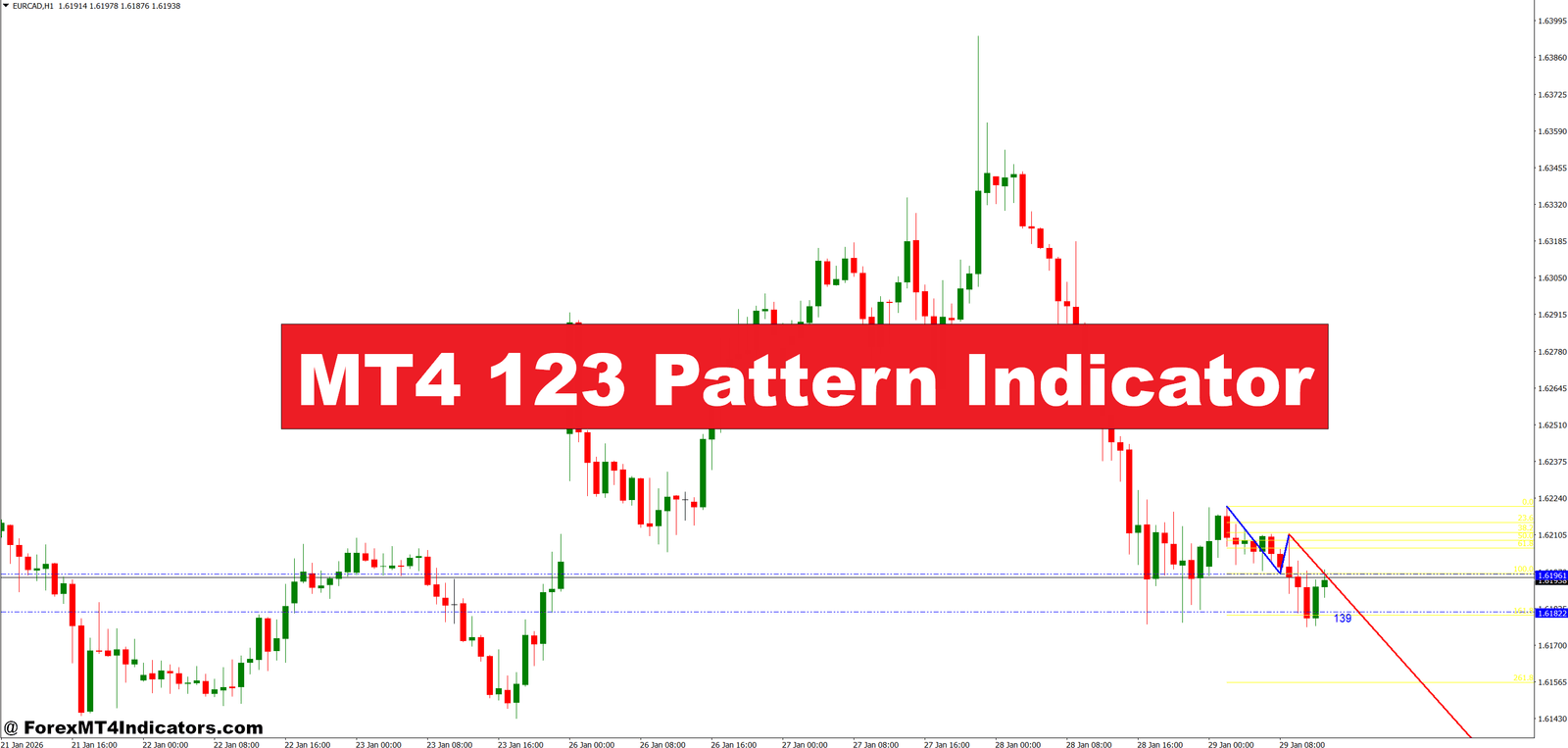
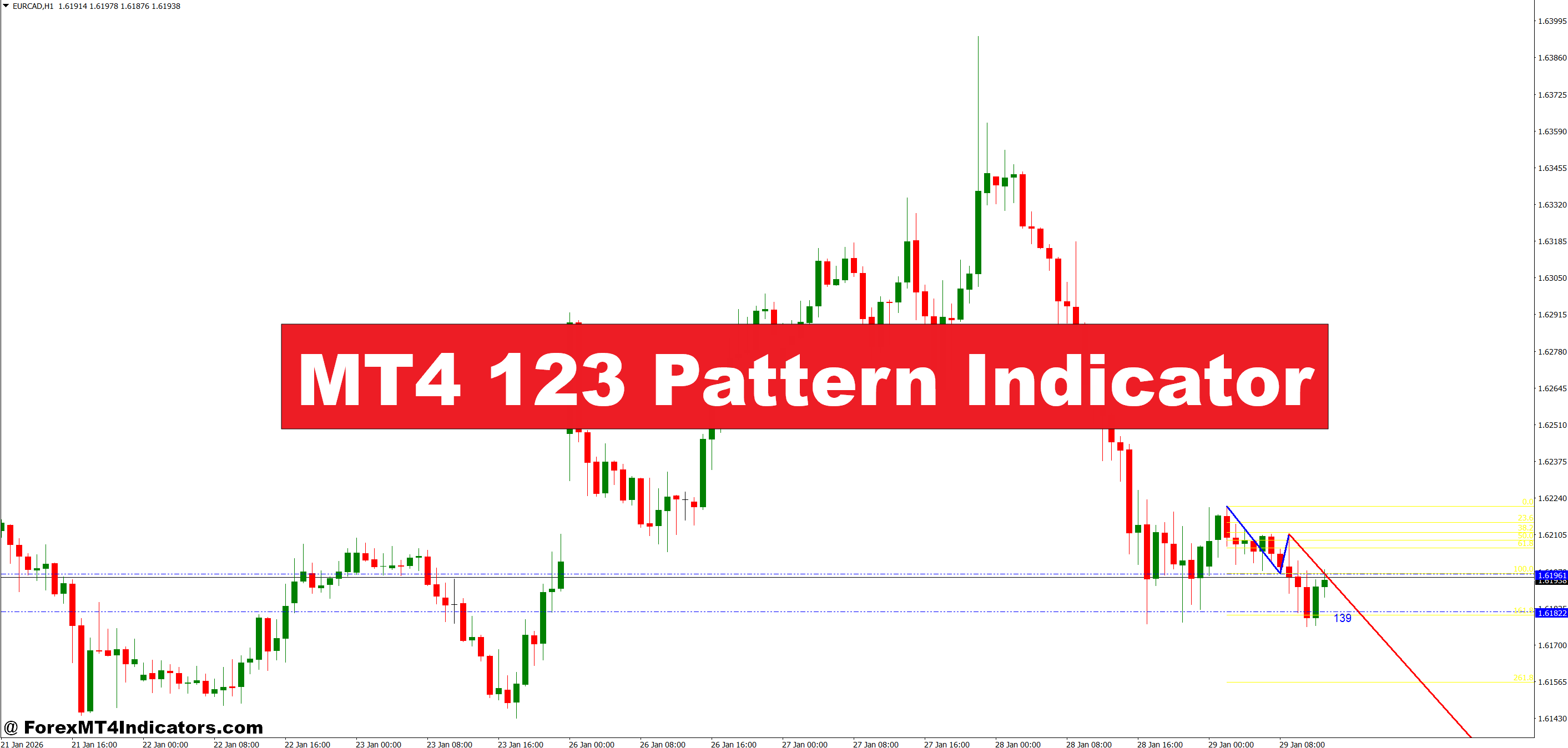
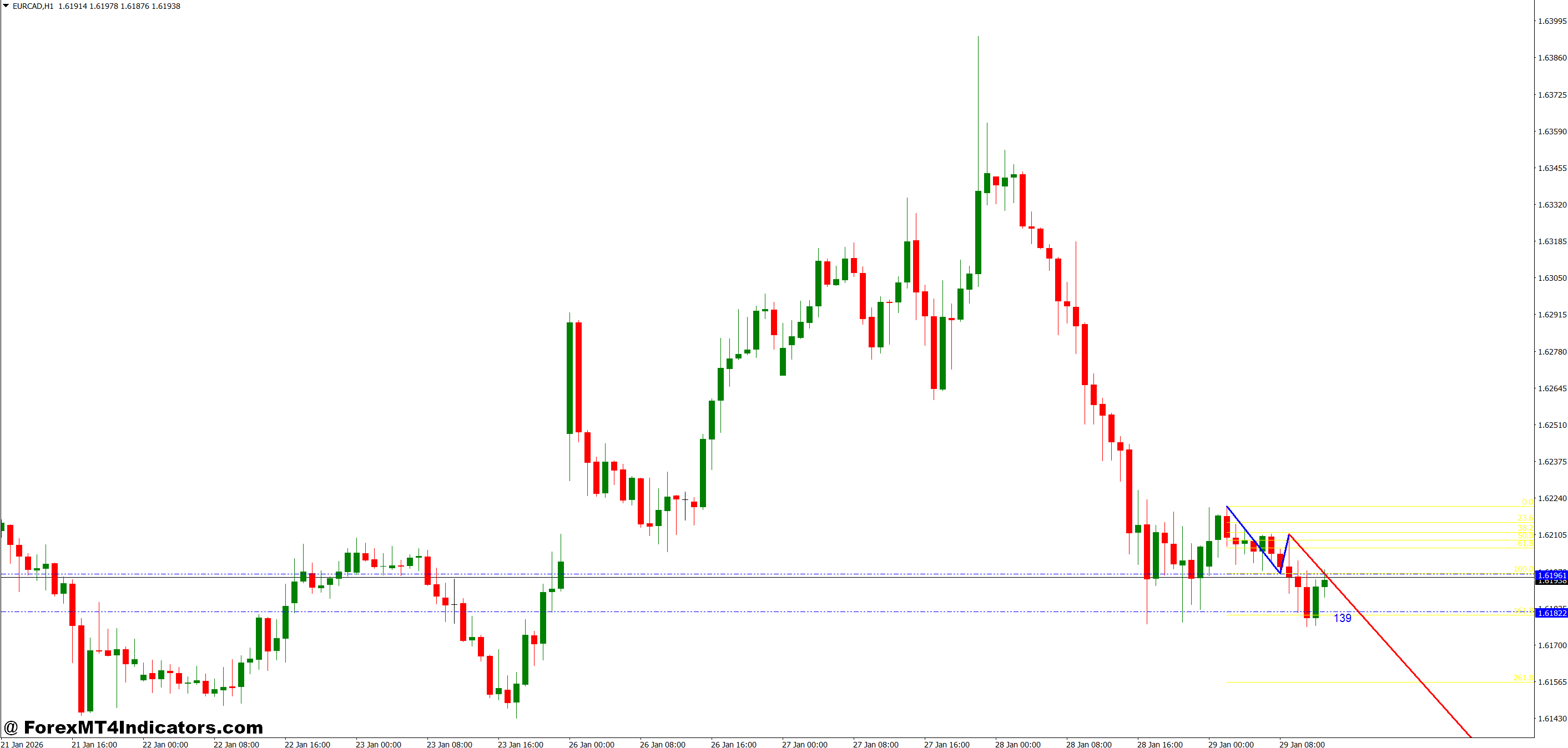
The 123 pattern isn’t some secret formula it’s a basic price structure that shows up repeatedly across all markets. Point 1 marks the extreme of the current move, whether that’s a swing high in an uptrend or a swing low in a downtrend. Point 2 forms when price pulls back from that extreme. Point 3 happens when price tries to resume the original direction but fails to make a new extreme. That failure at point 3 is where things get interesting. When price breaks back below point 2 in a downtrend (or above point 2 in an uptrend), the pattern completes and suggests a potential reversal.
The MT4 123 Pattern Indicator automates the detection of these three points. It scans price action in real-time and plots visual markers when the structure appears. Most versions will draw lines connecting the three points and highlight the trigger level—that break of point 2 that signals entry.
The Technical Logic Behind Detection
Here’s how the indicator identifies valid patterns. First, it looks for a clear directional move that creates an obvious swing point. The algorithm typically requires price to move a minimum distance from a recent pivot to avoid marking every tiny wiggle as point 1. Once that swing forms, the indicator watches for a retracement that creates point 2. This retracement needs to be substantial enough to show genuine profit-taking or loss of momentum—usually at least 30-40% of the initial move.
Point 3 becomes valid when price attempts to resume the trend but stops short of point 1. The distance between point 1 and point 3 matters. If price nearly reaches the previous extreme, the pattern loses its reversal characteristics. Most quality indicators require point 3 to fail by a meaningful margin, typically staying at least 20-30 pips away from point 1 on major pairs.
When price closes beyond point 2 in the opposite direction, the indicator triggers an alert. Some versions draw an arrow or change the pattern color to signal the breakout. This breakout level becomes the trigger for potential entries.
Applying the Pattern in Live Trading
Let’s walk through a real scenario. GBP/USD had been declining from 1.2650 to 1.2480 over several hours on the 4-hour chart. That low at 1.2480 formed point 1. Price then bounced to 1.2540, establishing point 2 at that swing high. The subsequent decline stalled at 1.2500—point 3—failing to take out the original low. When price closed above 1.2540, the 123 pattern completed.
Traders using this setup would enter long at the break of 1.2540 with a stop below point 3 at 1.2495. The initial target might be set at the distance from point 1 to point 2, projected upward—roughly 60 pips in this case. That puts the target near 1.2600. The actual move pushed to 1.2615 before consolidating.
Not every pattern plays out this cleanly. On choppy Friday afternoons in August, price might break point 2, reverse, break it again, and whipsaw traders repeatedly. The indicator will mark the pattern regardless of market conditions. That’s why experienced traders look for additional confirmation before entering. If the 123 pattern appears at a major support or resistance zone, it carries more weight. When the pattern forms during the London open with increasing volume, it tends to follow through better than patterns forming during the Asian session grind.
MT4 123 Pattern Indicator Customizing Settings
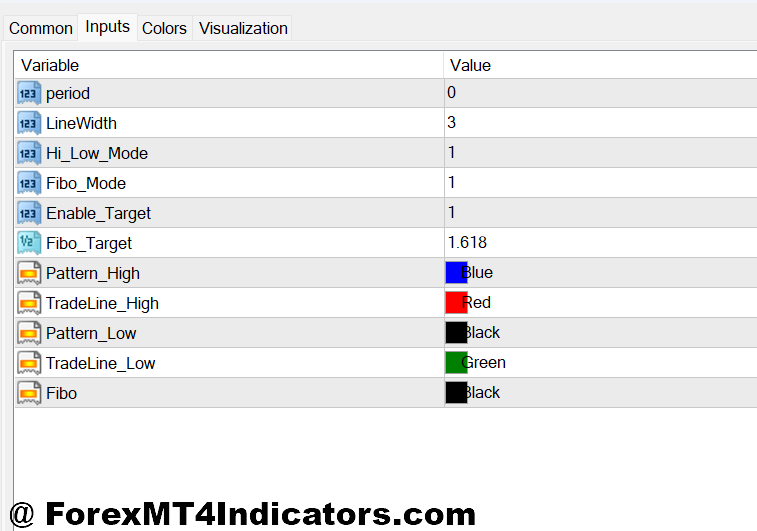
The indicator’s sensitivity depends heavily on how you define a “valid” swing point. The swing detection parameter controls this. Setting it to 5 means the indicator requires 5 bars on each side of a potential point 1 to confirm it as a legitimate swing. Increasing this to 8 or 10 reduces noise but might miss faster reversals on lower timeframes.
For scalping on the 5-minute chart, traders often use tighter settings—maybe a 3-bar swing requirement. This catches more patterns but generates false signals during range-bound conditions. On the daily chart, bumping the swing detection to 8 or 10 bars filters out minor fluctuations and focuses on significant turning points.
The minimum retracement percentage is another critical setting. Setting this to 25% will mark patterns even when point 2 barely pulls back from point 1. Those shallow retracements often fail. Requiring at least a 38% retracement (roughly a Fibonacci level) tends to identify stronger patterns where genuine momentum shifted.
Some indicators let you adjust the point 3 failure threshold—how far short point 3 must stay from point 1. A wider gap requirement (say, 40 pips on EUR/USD) means fewer patterns but higher quality setups where the trend clearly couldn’t resume.
Strengths and Realistic Limitations
The biggest advantage of the 123 pattern is its objectivity. Point 1, 2, and 3 either exist or they don’t. There’s no subjective interpretation of “is this trendline valid?” The indicator removes guesswork from identifying the structure. It also provides a natural stop loss location at point 3, which makes risk management straightforward.
The pattern works across all timeframes and assets. You’ll see 123 setups on 1-minute Bitcoin charts and monthly stock charts alike. That universality means traders can apply the same logic whether they’re day trading forex or swing trading commodities.
But here’s the thing—the pattern doesn’t predict the magnitude of the reversal. Just because price breaks point 2 doesn’t mean you’re catching the start of a 200-pip trend change. Sometimes the “reversal” is really just a larger retracement within the original trend. On the EUR/USD example earlier, what looked like a bullish 123 reversal at 1.2540 might only rally 80 pips before the downtrend resumes.
Whipsaw markets destroy this pattern. During low-volatility consolidations, price will form 123 structures repeatedly, breaking point 2 in both directions without any meaningful follow-through. The indicator will dutifully mark each one, leaving traders with a string of small losses.
The pattern also requires patience. You have to wait for all three points to form and then for price to trigger the entry. By the time that happens, the most aggressive traders have already entered at point 3, potentially offering them a better risk-reward ratio.
How It Compares to Similar Tools
The 123 pattern shares DNA with Victor Sperandeo’s 2B pattern and the failure swing concept in Dow Theory. All three identify moments when price attempts to continue a trend but falls short. The 2B pattern is simpler—it only looks at two points instead of three—but that simplicity means it catches fewer qualified setups.
Traders often combine the 123 indicator with momentum tools. If price completes a bullish 123 pattern while RSI shows bullish divergence at point 3, the setup gains credibility. The pattern identifies the structure; the RSI confirms the momentum shift. Using them together filters out weaker signals.
Compared to moving average crossovers or MACD signals, the 123 pattern tends to catch reversals earlier. Lagging indicators like moving averages confirm the trend change after it’s already well underway. The tradeoff? Earlier entries mean more false signals. That’s the eternal trading dilemma—act early and accept more failures, or wait for confirmation and miss the best entry prices.
How to Trade with MT4 123 Pattern Indicator
Buy Entry

- Wait for point 3 to fail below point 1 – Enter long only when price attempts a new low but stalls at least 15-20 pips above the previous low on EUR/USD 4-hour charts, showing the downtrend is exhausting.
- Enter at the break of point 2 – Place your buy order 2-3 pips above the point 2 swing high with confirmation from a bullish close, avoiding entries during Asian session low-volume periods.
- Position stop loss below point 3 – Set your stop 5-10 pips beneath point 3 to allow for minor wicks while protecting against pattern failure, typically risking 30-50 pips on major pairs.
- Target the point 1 to point 2 distance – Project the same pip range upward from your entry for the initial target, usually 50-80 pips on GBP/USD, then trail stops for extended moves.
- Confirm with higher timeframe trend – Only take bullish 123 patterns on the 1-hour chart when the daily chart shows support nearby or overall uptrend structure.
- Check RSI at point 3 – Look for oversold readings below 30 or bullish divergence at point 3 to add confidence that momentum is truly shifting in your favor.
- Avoid patterns in tight ranges – Skip 123 buy signals when the last 20 bars show less than 50-pip range on EUR/USD, as these generate frequent whipsaws and false breaks.
- Scale in after initial breakout – Add half position at point 2 break, then add remainder if price holds above point 2 for 2-3 candles without immediate reversal.
Sell Entry

- Confirm point 3 fails to reach point 1 – Enter short when price tries to make a higher high but stops 15-25 pips below the previous peak on the daily chart, signaling uptrend weakness.
- Trigger entry below point 2 swing low – Place sell order 2-3 pips beneath point 2 after a bearish candle close confirms the breakdown, avoiding Friday afternoon low-liquidity setups.
- Set stop loss above point 3 – Position your stop 5-10 pips above point 3 high to protect against pattern invalidation while allowing normal price fluctuation, typically 40-60 pips risk.
- Target measured move downward – Use the point 1 to point 2 pip distance as your profit target projected from entry, often 60-100 pips on GBP/USD 4-hour charts.
- Verify resistance confluence – Only trade bearish 123 patterns when point 1 aligns with previous resistance, round numbers (like 1.3000), or Fibonacci retracement levels.
- Look for overbought momentum – Strengthen your conviction with RSI above 70 or bearish divergence at point 3, showing buyers are exhausted despite the higher price attempt.
- Skip patterns before major news – Avoid taking 123 sell signals within 30 minutes of NFP, FOMC, or central bank announcements when volatility invalidates technical setups.
- Don’t trade against strong trends – Ignore bearish 123 patterns on 1-hour charts when the 4-hour and daily timeframes show clear uptrends with consecutive higher highs.
Final Thoughts on the 123 Pattern Indicator
It won’t tell you position size or when to exit. It simply marks the pattern and lets you decide how to trade it. That clarity is both its strength and limitation. Traders who understand market context—where support and resistance lie, what the higher timeframe trend looks like, whether major news is pending—can use these patterns effectively. Those who treat the indicator as a standalone signal generator will likely face frustration.
The best results come from filtering patterns based on location and market conditions. A 123 reversal at a key daily support level during the London session? Worth watching closely. A pattern forming mid-range at 3 AM on a Tuesday? Probably skip it. Trading forex carries substantial risk. No indicator guarantees profits, and the 123 pattern will produce losing trades. The question isn’t whether it works every time—nothing does. The question is whether it gives you a structured approach to identifying potential reversals that you can test, refine, and incorporate into a broader trading strategy.
Recommended MT4/MT5 Broker
XM Broker
- Free $50 To Start Trading Instantly! (Withdraw-able Profit)
- Deposit Bonus up to $5,000
- Unlimited Loyalty Program
- Award Winning Forex Broker
- Additional Exclusive Bonuses Throughout The Year
- Exclusive 90% VIP Cash Rebates for all Trades!

Already an XM client but missing out on cashback? Open New Real Account and Enter this Partner Code: VIP90