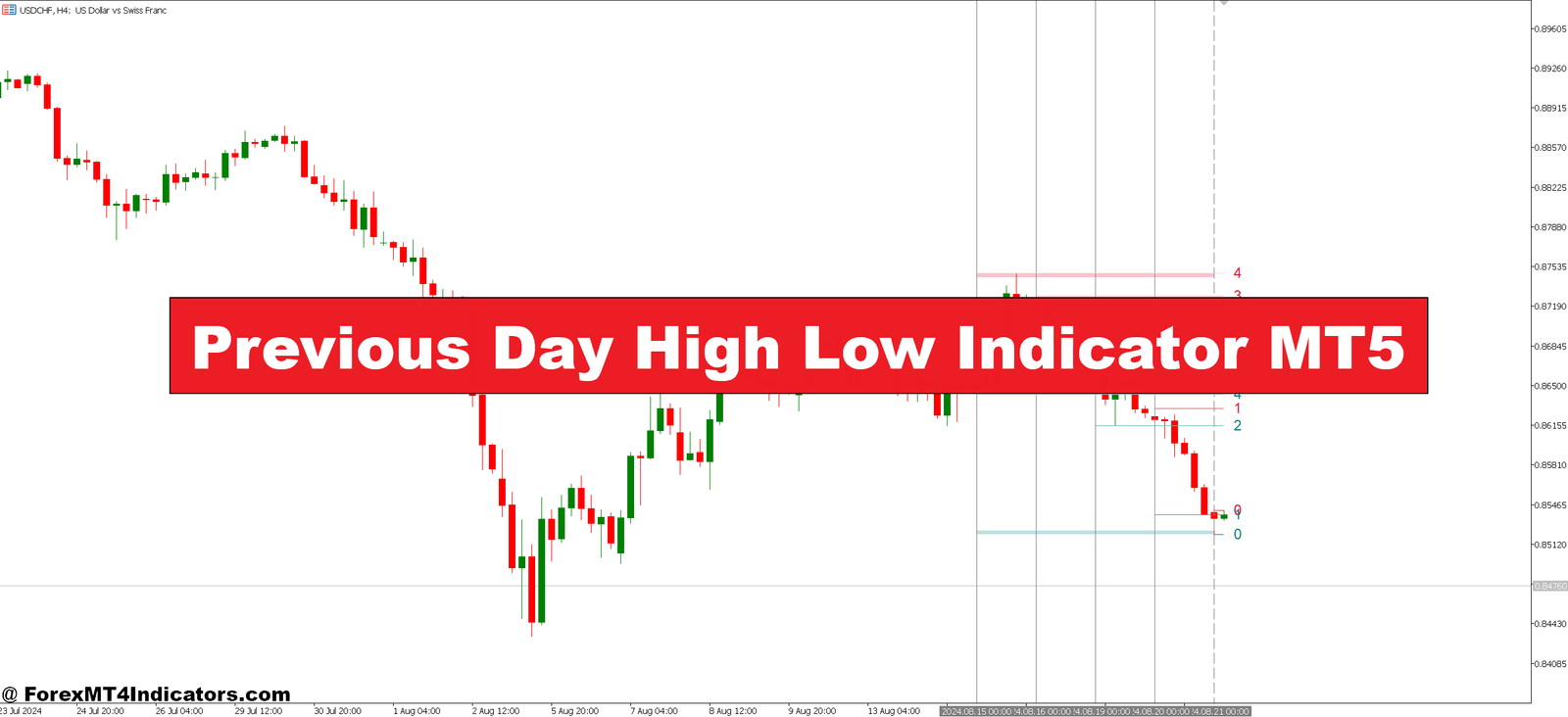
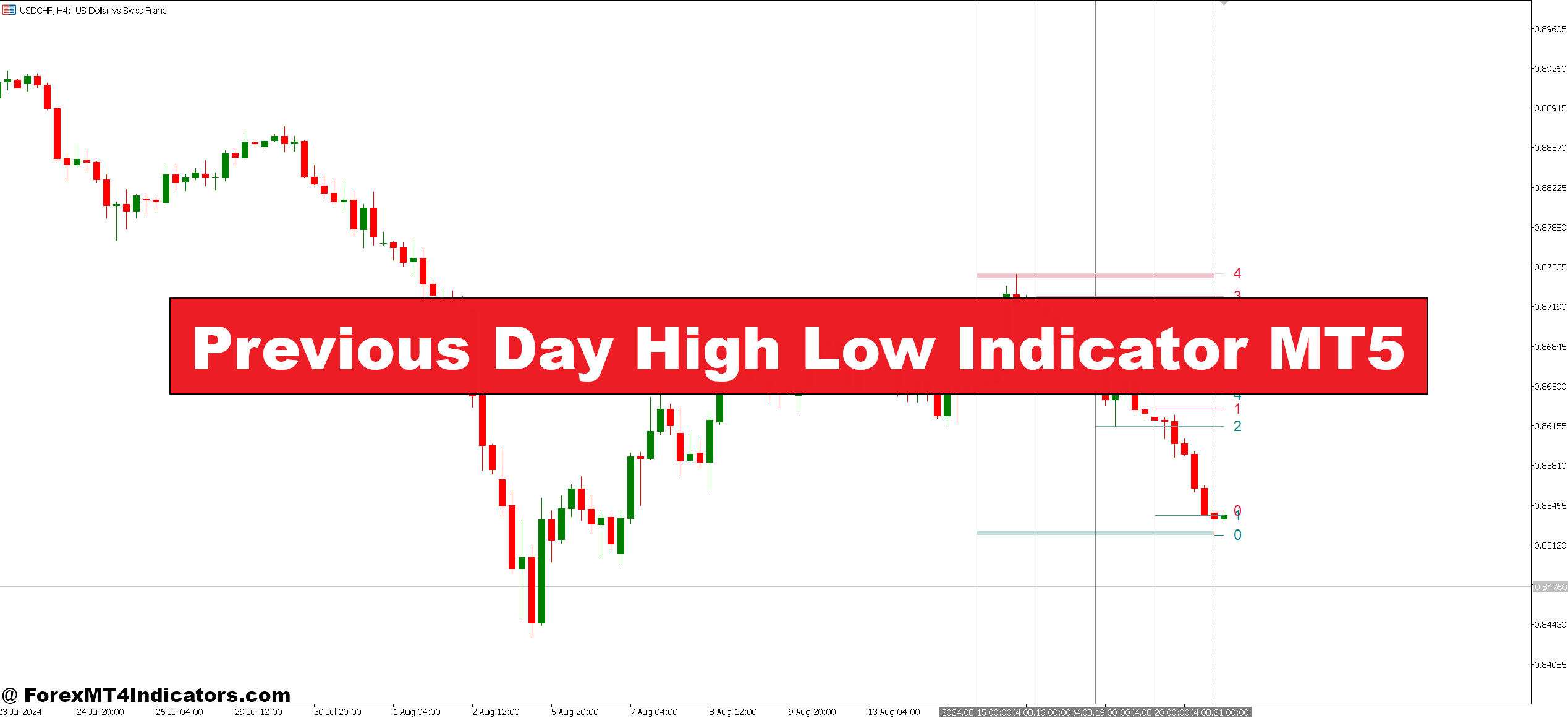
This indicator plots three horizontal lines on your MT5 chart: yesterday’s high, yesterday’s low, and yesterday’s close. That’s it. No complex calculations, no lagging formulas just pure price reference points that reset at the start of each new trading day.
The simplicity is the strength here. These levels represent where price found its boundaries during the previous 24-hour session. When a new trading day begins, those boundaries don’t just disappear from traders’ memories. Institutional traders, algorithmic systems, and seasoned retail traders all watch these levels because they’ve proven to influence price behavior consistently.
The Technical Logic Behind the Levels
Here’s how it works mechanically. The indicator scans the completed previous day’s candlestick data and identifies three values: the highest price reached (high), the lowest price reached (low), and the final closing price (close). It then draws these as horizontal reference lines that extend into the current trading session.
The high represents yesterday’s supply zone where sellers overwhelmed buyers. The low marks yesterday’s demand zone where buyers stepped in. The close shows where equilibrium settled after all the day’s trading activity. These aren’t arbitrary numbers. They’re battle-tested levels where real money changed hands.
When price approaches yesterday’s high in today’s session, traders start asking: Will it break through or reject? That hesitation alone often creates predictable reactions. The same thing happens at yesterday’s low. Price tends to respect these levels until it decisively breaks them, which then signals a potential trend shift.
Real Trading Scenarios That Actually Work

Let’s get specific. On a volatile NFP Friday, GBP/USD closed at 1.2650 after ranging between 1.2580 (low) and 1.2710 (high). Monday morning, London session opens and price quickly rallies to test that 1.2710 level. What happens next? In many cases, price stalls right there sometimes for hours. Traders who had that level marked could’ve taken short positions with tight stops just above, targeting a move back toward the midpoint or even yesterday’s low.
But here’s where it gets interesting. If price breaks cleanly above 1.2710 with strong volume and momentum, that previous resistance often flips to support. Traders who understand this concept wait for a retest of 1.2710 from above, then enter long positions with stops below the level. This is textbook price action trading, and the Previous Day High Low Indicator makes it dead simple to spot these setups.
The 1-hour and 4-hour charts work best for this approach. Day traders might use the 15-minute chart to fine-tune entries around these levels, but the levels themselves come from the daily timeframe, so they’re most reliable on higher timeframes.
Currency pairs that trend well like EUR/JPY or USD/CAD during commodity moves show cleaner reactions at these levels compared to choppy pairs. During Asian session, when volume dries up, price often gravitates toward yesterday’s close and consolidates. That’s when range traders shine, buying near yesterday’s low and selling near yesterday’s high until a breakout occurs.
Customization and Settings for Different Trading Styles
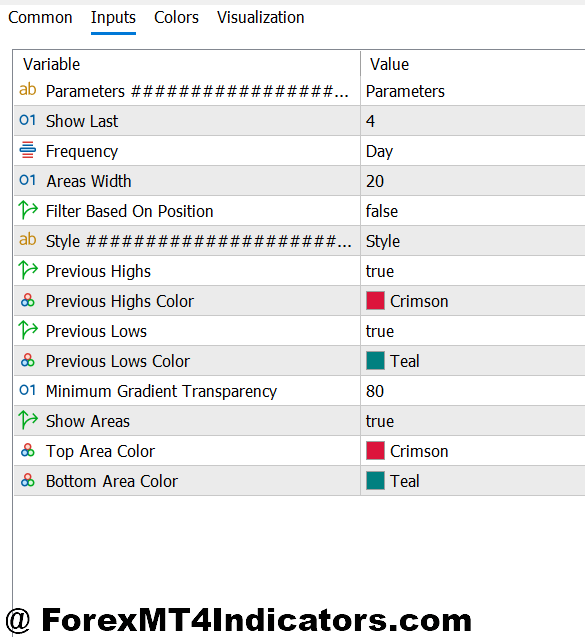
Most MT5 versions of this indicator let you adjust line colors, thickness, and whether to display all three levels or just the high and low. Some traders prefer muted colors that don’t clutter the chart grey or dotted lines work well. Others want bright colors for quick visual reference.
Scalpers might only care about yesterday’s high and low, turning off the close line entirely. They’re hunting for quick bounces off these levels during liquid sessions. Swing traders often keep all three lines visible because yesterday’s close can act as a pivotal level for multi-day trends.
One useful customization: extending the lines forward by a limited number of candles rather than across the entire chart. This keeps your workspace clean while still providing the reference you need for the current session.
The indicator works on all timeframes technically, but its real value emerges on the 1-hour chart and above. Below that, you’re getting too granular, and the significance of yesterday’s levels gets diluted by intraday noise.
The Honest Advantages and Real Limitations
The biggest advantage? Simplicity meets effectiveness. You don’t need a PhD in quantitative analysis to understand why yesterday’s extremes matter. Price has memory, and these levels reflect recent sentiment. They’re also universal every trader can calculate them, which creates self-fulfilling prophecy effects when price approaches them.
These levels work particularly well during trending markets. When EUR/USD is in a clear uptrend, breakouts above yesterday’s high often lead to continuation moves. The indicator helps you catch these momentum shifts early.
That said, the limitations are real. During ranging, choppy markets which honestly make up 60-70% of trading conditions these levels can get hit multiple times with no decisive action. You’ll see whipsaws around yesterday’s high or low, with price breaking through only to reverse minutes later. This is where the indicator alone isn’t enough; you need volume analysis, momentum indicators, or candlestick patterns to confirm whether a break is legitimate.
Another limitation: the indicator doesn’t account for fundamental events. If the ECB announces a surprise rate decision, yesterday’s levels on EUR pairs become temporarily irrelevant as price gaps and trends based on new information. The levels eventually regain importance, but not immediately.
Compared to indicators like moving averages or Bollinger Bands, the Previous Day High Low Indicator offers less dynamic adjustment. Those tools adapt to changing volatility; this one simply marks historical reference points. That’s not necessarily bad it’s just a different approach. Some traders prefer the objectivity of fixed levels over the subjectivity of adaptive indicators.
Combining with Other Tools for Better Confirmation

Smart traders don’t use this indicator in isolation. Pairing it with RSI helps filter false breakouts. If price breaks above yesterday’s high but RSI is already overbought above 70, that’s a warning sign. The breakout might fail.
Volume is another crucial filter. A breakout above yesterday’s high on weak volume usually doesn’t hold. But when volume spikes as price clears that level, the probability of continuation increases significantly.
Support and resistance from weekly or monthly timeframes should also be considered. If yesterday’s high happens to align with a weekly resistance zone, that level becomes even more significant. The confluence of multiple timeframe levels creates higher-probability setups.
Wrapping This Up
The Previous Day High Low Indicator MT5 gives traders clear, objective reference points for planning entries and exits. It works because these levels represent recent price memory zones where supply and demand found temporary balance. When used on 1-hour or 4-hour charts for trending pairs, the indicator helps identify high-probability breakout and bounce scenarios. That said, it’s not a crystal ball. Choppy markets will test your patience with false signals, and no indicator replaces proper risk management.
Trading forex carries substantial risk. No indicator guarantees profits, and past performance of price levels doesn’t ensure future reactions.
The real value here is simplicity. Instead of cluttering your chart with dozens of lines and calculations, you get three clean levels that actually matter. Test it on demo first, note how your preferred pairs react to these levels, and build a trading plan around confirmed patterns. The indicator marks the battlefield; you still need to choose your battles wisely.
Recommended MT4/MT5 Broker
XM Broker
- Free $50 To Start Trading Instantly! (Withdraw-able Profit)
- Deposit Bonus up to $5,000
- Unlimited Loyalty Program
- Award Winning Forex Broker
- Additional Exclusive Bonuses Throughout The Year
- Exclusive 90% VIP Cash Rebates for all Trades!

Already an XM client but missing out on cashback? Open New Real Account and Enter this Partner Code: VIP90