


You might expect that when the Federal Reserve leaves interest rates exactly where they were, nothing much happens. Same rates. Same policy. No drama.
But this week, the Fed held rates unchanged — and stocks still fell to session lows, Treasury yields jumped, and the U.S. Dollar Index surged back above 100.
Traders weren’t reacting to what the Fed did. They were reacting to what the Fed said.
That’s the power of forward guidance, and understanding it is one of the most useful things a trader can learn.
What Happened: The March 2026 FOMC Decision
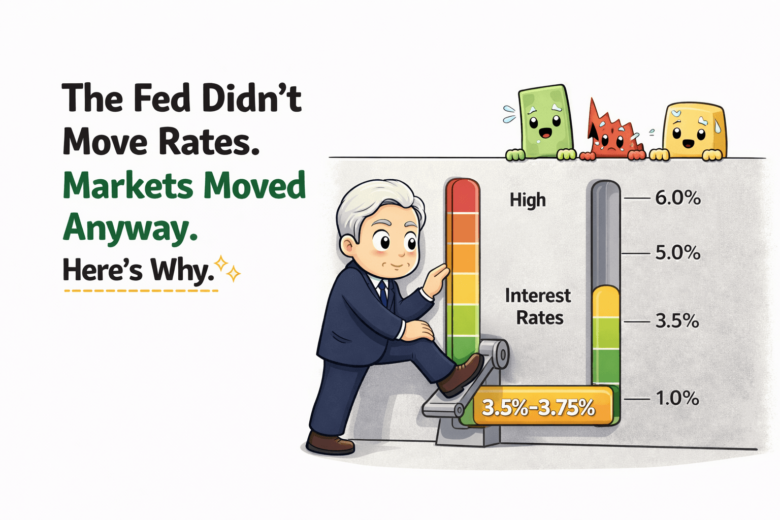
The Federal Open Market Committee, the Fed’s rate-setting body, voted 11-1 to keep its benchmark federal funds rate unchanged at 3.5%–3.75%. That part was fully expected. Futures markets had priced a hold at over 99% probability heading into the meeting.
So why did markets move?
To understand the Fed’s decision, you have to understand its primary mission: keeping prices stable. Think of interest rates like the brakes on a car. When the economy (and inflation) is moving too fast, the Fed slams on the brakes by raising rates. When the economy stalls, they hit the gas by lowering them.
By holding rates at 3.5%–3.75%, the Fed is effectively keeping its foot firmly on the brake pedal. They aren’t pressing harder, but they aren’t letting off either. This “hold” confirms that while we aren’t in a crisis, the Fed isn’t convinced that the “inflation monster” is back in its cage. In other words, the era of “cheap money” isn’t coming back just yet.
Two things drove the market reactions: the dot plot and Powell’s press conference.
FOMC Dot Plot Projections
The dot plot (officially called the Summary of Economic Projections or SEP) is a chart the Fed publishes four times a year. Each of the 19 FOMC participants places a dot indicating where they expect interest rates to be at the end of each coming year. Think of it as the Fed’s collective rate forecast, made anonymous.
The March dot plot kept the median projection at one rate cut in 2026, unchanged from December. On the surface, no change. But dig into the details, and the picture got a bit darker: seven officials now expect zero cuts this year, up from six in December.
The longer-run “neutral rate” estimate also ticked up to 3.1% from 3.0% — a small but meaningful signal that the Fed sees rates staying higher for longer, even after the current cycle ends.
Powell’s press conference
The Fed chair acknowledged that the U.S. had made “some progress on inflation, not as much as we had hoped.” He flagged that near-term inflation expectations had risen due to surging oil prices from the U.S.-Iran conflict, and said it was “too soon to know” the full economic impact. He also noted growing unease about the labor market, pointing to near-zero net job creation over recent months.
Why It Matters: What Markets Heard
Here’s the thing about forward guidance: markets don’t trade what happened. They trade what’s expected to happen. When those expectations shift, even just slightly, prices move fast.
Before this meeting, traders had been pricing in roughly two rate cuts in 2026. After Powell’s press conference, that repricing was complete: the market now expects a maximum of one cut, likely pushed to late in the year.
That shift rippled across asset classes:
- Equities sold off. Stocks don’t like higher-for-longer rates because they raise borrowing costs and compress the value of future earnings. The S&P 500 fell 0.7%, and the Dow dropped about 470 points.
- Treasury yields climbed. Fewer expected rate cuts mean bond yields stay elevated. The 10-year yield rose roughly 5 basis points to 4.23%.
- The U.S. dollar surged. The DXY broke back above 100 — a key psychological level — as a hawkish-leaning Fed means the dollar stays comparatively attractive to foreign investors chasing yield.
- Gold faced headwinds. A stronger dollar and higher yields make gold, which pays no interest, less appealing.
The market wasn’t caught off guard by the rate decision itself. It was recalibrating to a new reality: the Fed is in no hurry to cut, and the reasons (sticky inflation + an oil shock from the Iran war) aren’t going away quickly.
Promoted: Stop Risking Your Own Capital on Unpredictable Trade Policies.
You’ve seen how the repricing of interest rate expectations can cause sharp U.S. dollar price swings, but playing big macro shifts requires serious capital. With FundingPips, you trade a simulated account and can earn up to 100% of your rewards. Whether you’re looking for a 2 Step PRO evaluation starting at just $26 or seeking funding options up to $300K, you have the flexibility to trade your way.
Learn more about FundingPips and use code HELLO to get 20% OFF your first purchase!
Disclosure: We may earn a commission from our partners if you sign up through our links, at no extra cost to you.
Key Lessons for Traders
Words move markets, not just actions. The Fed left rates unchanged, but Powell’s comment that inflation hasn’t fallen “as much as hoped” was enough to send stocks to session lows. Central bank communication (press conferences, statements, even the phrasing of a single sentence) is a market-moving event in itself. Always watch how a central bank talks, not just what it does.
The dot plot is a mood ring, not a crystal ball. The median dot showed one cut, the same as December. But seven officials now see zero cuts, up from six. That one-dot shift changed the tone of the entire meeting. The dot plot doesn’t lock the Fed into anything; it shows the distribution of thinking. Wide disagreement among officials, like we’re seeing now, signals genuine uncertainty — and uncertainty breeds volatility.
Rate expectations drive currencies more than rate levels. The dollar didn’t surge because rates went up — they didn’t. It surged because the market now expects rates to stay higher for longer relative to other central banks. That yield differential is what drives currency flows. When the Fed delays cuts while other central banks are easing, the dollar tends to strengthen.
“Wait and see” is its own policy stance. Powell used the phrase “wait and see” repeatedly, and that’s not nothing. A Fed that refuses to commit is a Fed that can surprise in either direction. That two-way uncertainty creates volatility. Traders who position aggressively for rate cuts (or hikes) in an environment like this tend to get punished.
Context changes everything. The dot plot looked similar to December on paper. But the backdrop of an Iran war, oil just under $100 a barrel, above-target inflation entering year five made an unchanged dot plot feel more hawkish than before. Same signal, very different context.
The Bottom Line
Between a hawkish dot plot shift, revised inflation forecasts (now 2.7% for 2026, up from 2.5%), and Powell’s cautious press conference, markets got a clear message: don’t expect relief anytime soon.
The next FOMC meeting is in May, which also happens to be when Powell’s term as Fed chair expires. Kevin Warsh, Trump’s nominee to replace him, is generally expected to be more open to rate cuts. That leadership transition adds another layer of uncertainty to an already complicated picture.
Watch the oil price. Watch the labor market. And watch how Powell’s successor talks — because in this environment, words are policy.
Promoted: Master Your Execution During Macro Shocks
When the U.S. dollar makes sharp moves from central bank updates, does your execution stay clinical or get emotional? TradeZella’s trade replay tool lets you revisit your past trades tick-by-tick. See exactly where your entry slipped or why you hesitated, so you can dominate the next volatility spike with a data-driven playbook.
Start Your Journal with Tradezella and use code “PIPS20” to save 20% on your first purchase!
Disclosure: To help support our free daily content, we may earn a commission from our partners if you sign up through our links, at no extra cost to you.
