


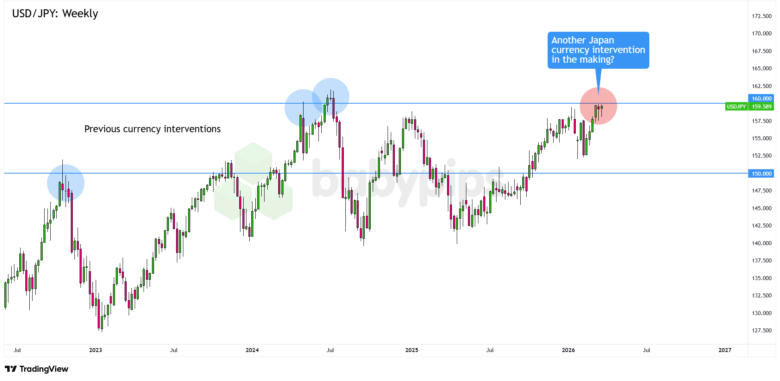
If you’ve been watching the yen lately, you’ve noticed that USD/JPY, the currency pair that tells you how many yen one dollar buys, has risen to a number that makes Japanese officials nervous: 160.
Right now, the pair is trading around ¥159–159.54. Traders consider this an “Intervention Zone,” an area where the Japanese government has previously said, “Enough is enough,” and spent billions of dollars to manually prop up its currency.
Here’s what’s happening, and what currency intervention actually means for traders watching the Japanese yen.
Why Does the Yen Keep Sliding?
The short answer is the interest rate gap between Japan and the rest of the world.
Earlier this month, the Bank of Japan (BOJ) held its benchmark rate at 0.75% on an 8–1 vote — meaningful progress for a country that had negative interest rates just a few years ago, but still far below the
- U.S. Federal Reserve’s 4.25–4.5%
- Bank of England’s 3.75%
- European Central Bank’s 2.15%, and
- Reserve Bank of Australia’s 4.10%
That gap feeds what’s known as the carry trade: investors borrow cheaply in yen, convert it into other higher-yielding currencies, and collect the difference in interest rates.
As long as the U.S.-Japan interest rate differential stays wide, there’s a persistent structural force pulling USD/JPY higher.
On top of that, escalating conflict in the Middle East has pushed safe-haven demand toward the dollar while driving oil prices higher. Since Japan imports nearly all of its energy, that’s a particularly painful combination — a weaker yen and rising oil costs hitting the economy from both sides at once.
What Is Currency Intervention?
Under normal conditions, a currency rises and falls with supply and demand, just like any other asset. Currency intervention is when a government decides to stop watching and start pushing its currency in a direction.
When the yen slides far enough that it starts causing real domestic pain — costlier imports, higher fuel bills, faster inflation — Japanese authorities launch a yen-buying intervention.
This usually works in three steps:
Step 1: The War Chest – Japan taps its foreign exchange reserves, a large stockpile of U.S. dollars built up over decades of trade surpluses.
Step 2: The Swap – They sell those dollars on the open market and simultaneously buy yen — sometimes tens of billions of dollars’ worth in a single session.
Step 3: The Result – That sudden surge of yen demand drives USD/JPY lower, meaning the yen has strengthened. Quickly.
In Japan, it’s not the Bank of Japan making the call. The Ministry of Finance (MOF) decides when to intervene; the BoJ executes the trade on its behalf. The MOF is the decision-maker, the BOJ is the one pulling the trigger.
Promoted: Capitalize on Currency Intervention Risks Without Risking Your Own Funds.
With BOJ currency intervention odds rising, market volatility can rise quickly. Why risk your personal capital during extreme volatility?
Most proprietary firms terminate your evaluation account if you execute a trade during a major macroeconomic release, but FundedNext permits news trading across all models. Test your stagflation thesis with up to $300,000 in simulated capital, and take advantage of their Free Trial to experience the platform risk-free.
Explore FundedNext and Start Your Free Trial!
Disclosure: We may earn a commission from our partners if you sign up through our links.
Why ¥160 Makes Everyone Nervous
Markets have long memories, and the ¥159.50 – ¥162.00 range is one that traders have learned to treat with genuine caution — because Japan has repeatedly acted within it.
In 2022, as USD/JPY pushed toward and beyond ¥150, Japan carried out multiple rounds of intervention, spending roughly ¥9.2 trillion (~$60 billion). Then, in late April to May 2024, when the pair surged toward ¥160, Japan stepped in more aggressively, deploying a record ¥9.8 trillion (~$62 billion) in just one month, exceeding its total intervention in 2022. An additional intervention followed in July as USD/JPY later climbed above ¥161.
USD/JPY Currency Interventions Chart Faster with TradingView
What makes this zone psychologically powerful is that Japan rarely announces its interventions in real time — the MOF confirms them weeks later in data releases.
So when USD/JPY suddenly drops several hundred pips for no obvious reason, the market usually has a pretty good idea what just happened. That pattern of stealth and scale is exactly what keeps traders nervous about pushing too hard through ¥160.
Key Lessons for Traders
Intervention is a bandage, not a cure. Every time Japan has intervened in recent years, the yen eventually weakened again — because the underlying carry trade math never changed. Intervention slows the move and sends a message, but it doesn’t fix the rate differential. A genuine BOJ hiking cycle is what changes the equation over the medium term.
Verbal warnings are the first card Japan plays. Real intervention almost never arrives without escalating rhetoric beforehand. If Finance Ministry officials start describing currency moves as “excessive” or “disorderly,” treat it as a signal, not background noise.
Japan responds to speed, not just price levels. The intervention zone isn’t a hard floor. A rapid lurch from ¥155 to ¥162 over two weeks looks very different to Tokyo than a slow grind to the same level over two months — and is far more likely to prompt a response.
Surprise is the whole point. No advance notice, confirmation only weeks later — Japan’s opacity is deliberate, because surprise maximizes the shock to short-sellers and creates the most impact per dollar spent. Traders heavily short yen near the intervention zone are the most exposed to a sudden, violent reversal.
The Bottom Line
USD/JPY has been circling one of the most politically charged price levels in forex for months, and with the pair hovering at ¥159–159.50, that tension isn’t going away. Japan has shown that it’s willing to act when moves get fast enough or go far enough.
The April 28 BOJ meeting is the next real inflection point. A rate hike could let Japan sidestep the intervention question entirely by strengthening the yen through policy rather than reserves. A hold, especially if USD/JPY is already pushing through ¥161, puts Tokyo’s resolve back in the spotlight.
Either way, this is a pair where global market forces and government will are actively competing for control. That’s an unstable equilibrium — and one that demands careful risk management from anyone trading it.
When a government draws a line in the currency market, it doesn’t always hold. But the cost of testing it can be severe.
Promoted: Master Your Execution During Macro Shocks
When the odds of a central bank currency intervention rises, does your execution stay clinical or get emotional? TradeZella’s trade replay tool lets you revisit your past trades tick-by-tick. See exactly where your entry slipped or why you hesitated, so you can dominate the next volatility spike with a data-driven playbook.
Start Your Journal with Tradezella and use code “PIPS20” to save 20% on your first purchase!
Disclosure: To help support our free daily content, we may earn a commission from our partners if you sign up through our links, at no extra cost to you.

