


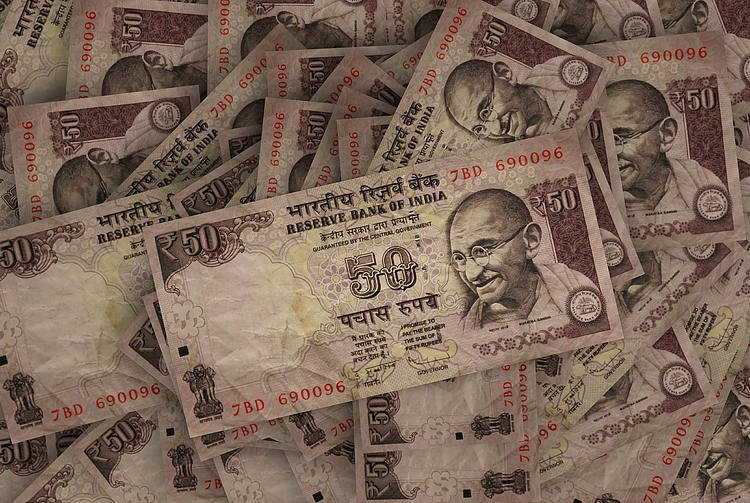
- The Indian Rupee trades within a tight range of 84.00-84.10.
- Indian PM Modi and Chinese President Xi Jinping agreed to enhance communication and cooperation during the BRICS summit on Wednesday.
- India’s HSBC Composite PMI increased to 58.6 in October due to expansions in both the manufacturing and services sectors.
The Indian Rupee (INR) steadies against the US Dollar (USD) on Thursday, with the USD/INR pair hovering within the 84.00-84.10 range. Market interventions by the Reserve Bank of India (RBI) helped limit downside risks for the INR, despite continued outflows from Indian equities.
India’s HSBC Composite Purchasing Managers Index (PMI) increased to 58.6 in October, up from 58.3 in the previous month. This indicates continued strong growth in India’s private sector, supported by expansions in both the manufacturing and services sectors.
The Rupee received downward pressure as Foreign Institutional Investors (FII) were net sellers of Indian stocks for the 18th consecutive session on Wednesday, shifting funds to China due to stimulus measures and more attractive valuations. The Nifty 50 has fallen 1.7% over the past three sessions this week and is down about 6% from last week’s record highs, weighed down by disappointing earnings results.
Indian Prime Minister Narendra Modi and Chinese President Xi Jinping held their first formal talks in five years on the sidelines of the BRICS summit in Russia. During their meeting on Wednesday, the two leaders agreed to enhance communication and cooperation between India and China, aiming to resolve ongoing conflicts and improve relations that were strained following a deadly military clash in 2020, according to Reuters.
Daily Digest Market Movers: Indian Rupee resists downward pressure due to potential RBI intervention
- The US Dollar faced downward pressure following the release of the Federal Reserve’s (Fed) Beige Book on Wednesday. The latest report indicated that economic activity was “little changed in nearly all Districts,” in contrast to August’s report, where three Districts reported growth and nine showed flat activity.
- According to the CME FedWatch Tool, there is an 88.9% probability of a 25-basis-point rate cut, with no expectation of a larger 50-basis-point cut.
- The preliminary estimates reveal that India’s HSBC Manufacturing PMI rose to 57.4 in October, up from 56.5 in the previous month. Meanwhile, the Services PMI edged higher to 57.9 in October, recovering from a one-year low of 57.7 in September. This marks the 39th consecutive month of expansion in services activity.
- Jim O’Neill, the former Goldman Sachs economist who coined the term BRIC in 2001, told Reuters that the notion of the BRICS group challenging the US Dollar is unrealistic as long as China and India remain divided and unwilling to cooperate on trade.
- In the minutes from the October meeting, members of the rate-setting panel stated that the Monetary Policy Committee (MPC) must take a cautious approach to lowering interest rates, as India cannot afford to face another bout of inflation.
- In a speech at the New York Fed Central Banking Seminar, RBI Deputy Governor Michael Patra stated, “We believe that the best defense against global risks is to strengthen the macroeconomic fundamentals and build adequate buffers, supported by prudent macroeconomic policies.” He highlighted that India’s central bank has been strategically increasing its foreign exchange reserves, which are now equivalent to or nearly equal to 12 months’ worth of imports.
- In a post on the social media platform X, Federal Reserve Bank of San Francisco President Mary Daly stated that the economy is clearly in a better position, with inflation having fallen significantly and the labor market returning to a more sustainable path.
- Federal Reserve Bank of Minneapolis President Neel Kashkari highlighted on Monday that the Fed is closely monitoring the US labor market for signs of rapid destabilization. Kashkari cautioned investors to anticipate a gradual pace of rate cuts over the coming quarters, suggesting that any monetary easing will likely be moderate rather than aggressive.
Technical Analysis: USD/INR finds support around 84.00, nine-day EMA
The USD/INR pair holds steady above 84.00 on Thursday. An analysis of the daily chart shows that the pair is hovering within an ascending channel pattern, suggesting a bullish bias. The 14-day Relative Strength Index (RSI) is nearing the 70 mark, which further reinforces the current bullish momentum.
In terms of resistance, the pair may face obstacles at its all-time high of 84.14, reached on August 5. A breakout above this level could enable the USD/INR pair to test the upper boundary of the ascending channel, which is around 84.20.
On the support side, immediate backing is located at the nine-day Exponential Moving Average (EMA) near the 84.02 level, coinciding with the lower boundary of the ascending channel and the psychological level of 84.00.
USD/INR: Daily Chart
US Dollar PRICE Today
The table below shows the percentage change of US Dollar (USD) against listed major currencies today. US Dollar was the strongest against the Euro.
| USD | EUR | GBP | JPY | CAD | AUD | NZD | CHF | |
|---|---|---|---|---|---|---|---|---|
| USD | 0.04% | -0.27% | -0.44% | -0.12% | -0.33% | -0.31% | 0.00% | |
| EUR | -0.04% | -0.32% | -0.49% | -0.15% | -0.37% | -0.36% | -0.06% | |
| GBP | 0.27% | 0.32% | -0.18% | 0.15% | -0.07% | -0.06% | 0.26% | |
| JPY | 0.44% | 0.49% | 0.18% | 0.35% | 0.12% | 0.11% | 0.45% | |
| CAD | 0.12% | 0.15% | -0.15% | -0.35% | -0.21% | -0.20% | 0.11% | |
| AUD | 0.33% | 0.37% | 0.07% | -0.12% | 0.21% | 0.03% | 0.33% | |
| NZD | 0.31% | 0.36% | 0.06% | -0.11% | 0.20% | -0.03% | 0.31% | |
| CHF | -0.00% | 0.06% | -0.26% | -0.45% | -0.11% | -0.33% | -0.31% |
The heat map shows percentage changes of major currencies against each other. The base currency is picked from the left column, while the quote currency is picked from the top row. For example, if you pick the US Dollar from the left column and move along the horizontal line to the Japanese Yen, the percentage change displayed in the box will represent USD (base)/JPY (quote).
RBI FAQs
The role of the Reserve Bank of India (RBI), in its own words, is “..to maintain price stability while keeping in mind the objective of growth.” This involves maintaining the inflation rate at a stable 4% level primarily using the tool of interest rates. The RBI also maintains the exchange rate at a level that will not cause excess volatility and problems for exporters and importers, since India’s economy is heavily reliant on foreign trade, especially Oil.
The RBI formally meets at six bi-monthly meetings a year to discuss its monetary policy and, if necessary, adjust interest rates. When inflation is too high (above its 4% target), the RBI will normally raise interest rates to deter borrowing and spending, which can support the Rupee (INR). If inflation falls too far below target, the RBI might cut rates to encourage more lending, which can be negative for INR.
Due to the importance of trade to the economy, the Reserve Bank of India (RBI) actively intervenes in FX markets to maintain the exchange rate within a limited range. It does this to ensure Indian importers and exporters are not exposed to unnecessary currency risk during periods of FX volatility. The RBI buys and sells Rupees in the spot market at key levels, and uses derivatives to hedge its positions.
