







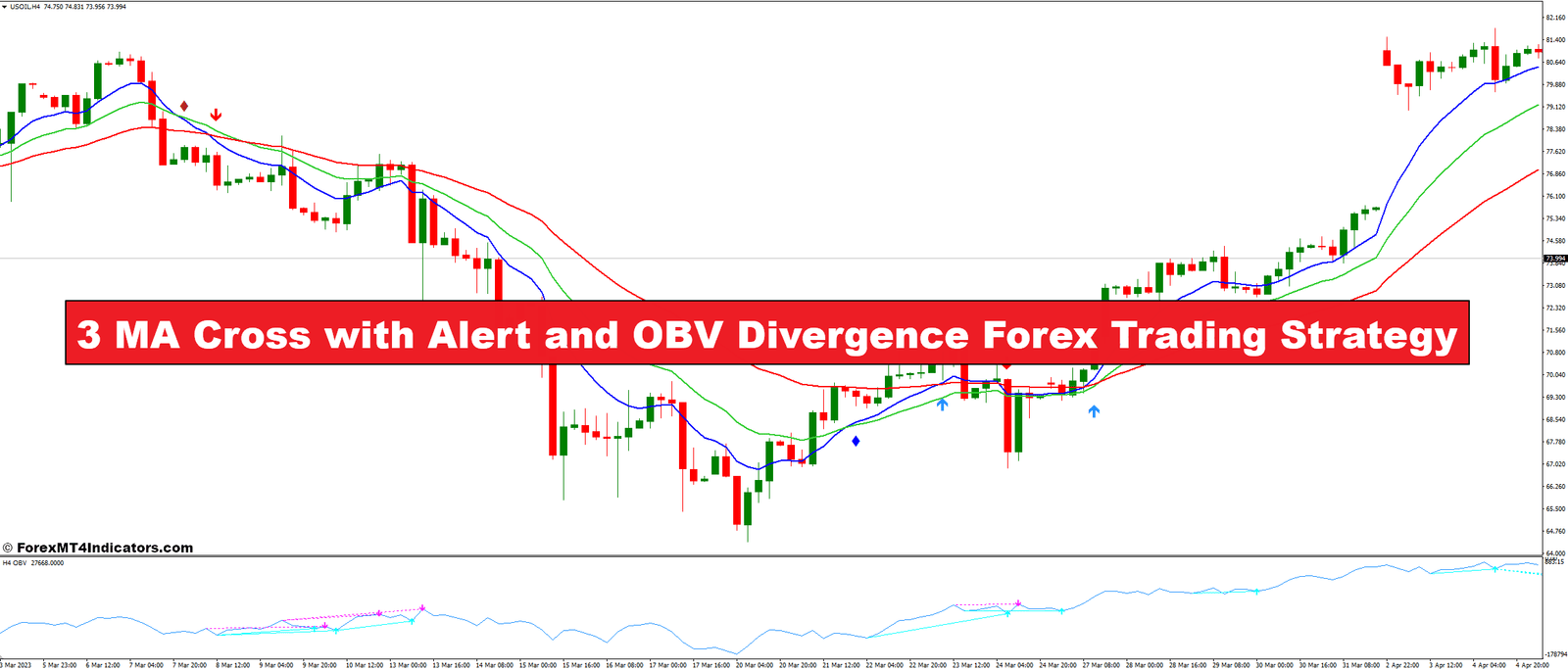
3 MA Cross with Alert
The 3 MA Cross with Alert is a foundational component of this forex trading strategy, leveraging the power of three moving averages (MAs) to identify potential trends and trading opportunities. Moving averages smooth out price data over a specified period, making it easier to discern underlying market trends. In this strategy, traders typically use three different MAs, each representing a different timeframe (e.g., short-term, medium-term, and long-term). The core principle behind the 3 MA Cross strategy is based on the intersections or crossings of these moving averages. Specifically, a bullish crossover occurs when a shorter-term MA crosses above a longer-term MA, indicating potential upward momentum and signaling a buying opportunity. Conversely, a bearish crossover occurs when a shorter-term MA crosses below a longer-term MA, signaling potential downward momentum and suggesting a selling opportunity.
What makes the 3 MA Cross strategy effective is its ability to provide clear signals of trend reversals or continuations. By incorporating alerts into this strategy, traders receive real-time notifications when these critical MA crossovers occur. This feature is particularly valuable in fast-moving markets, enabling traders to act swiftly and decisively based on objective technical analysis rather than emotional impulses. In summary, the 3 MA Cross with Alert indicator within the 3 MA Cross with Alert and OBV Divergence strategy serves as a robust tool for trend identification and signal generation. By systematically analyzing MA crossovers and leveraging timely alerts, traders can enhance their trading decisions with greater precision and confidence in dynamic forex markets.
OBV Divergence Indicator

The On-Balance Volume (OBV) indicator plays a pivotal role in the 3 MA Cross with Alert and OBV Divergence strategy, providing supplementary insights into market momentum and trend confirmation. Developed by Joseph Granville, OBV measures cumulative buying and selling pressure by adding volume on up days and subtracting it on down days. This results in a line that reflects volume flow relative to price movements. In the context of this strategy, traders use OBV to detect divergences between OBV and price action. A bullish divergence occurs when OBV moves upwards while prices are stagnant or declining, suggesting potential accumulation and indicating a possible bullish trend reversal. Conversely, a bearish divergence occurs when OBV declines while prices continue to rise, signaling potential distribution and suggesting a bearish trend reversal.
By integrating OBV alongside the 3 MA Cross strategy, traders gain a more comprehensive view of market dynamics. OBV divergences provide additional confirmation of potential trend changes identified by MA crossovers, thereby reinforcing trading signals and increasing the strategy’s reliability. This dual approach not only enhances the accuracy of entry and exit points but also helps traders navigate market volatility with greater clarity and confidence. In conclusion, the OBV Divergence indicator enhances the effectiveness of the “3 MA Cross with Alert and OBV Divergence” strategy by offering valuable insights into market sentiment and momentum. By identifying divergences between OBV and price movements, traders can make informed trading decisions, aligning their strategies with objective technical analysis for improved trading outcomes in the dynamic forex market.
How To Trade With 3 MA Cross with Alert and OBV Divergence Forex Trading Strategy
Buy Entry

- Entry Signal: Wait for the short-term moving average (MA) to cross above the medium-term and long-term MAs.
- Confirmation: Ensure that the On-Balance-Volume (OBV) indicator is trending upwards or showing bullish divergence with price.
- Entry Point: Enter the trade at the close of the candle where the bullish MA crossover and OBV confirmation occur.
- Stop-Loss: Set the stop-loss below the recent swing low or below the lowest point of the candle where the crossover occurred.
- Take-Profit: Target the next significant resistance level or use a risk-reward ratio of at least 1:2.
Sell Entry

- Entry Signal: Wait for the short-term MA to cross below the medium-term and long-term MAs.
- Confirmation: Ensure that the OBV indicator is trending downwards or showing a bearish divergence with price.
- Entry Point: Enter the trade at the close of the candle where the bearish MA crossover and OBV confirmation occur.
- Stop-Loss: Set the stop-loss above the recent swing high or above the highest point of the candle where the crossover occurred.
- Take-Profit: Target the next significant support level or use a risk-reward ratio of at least 1:2.


