




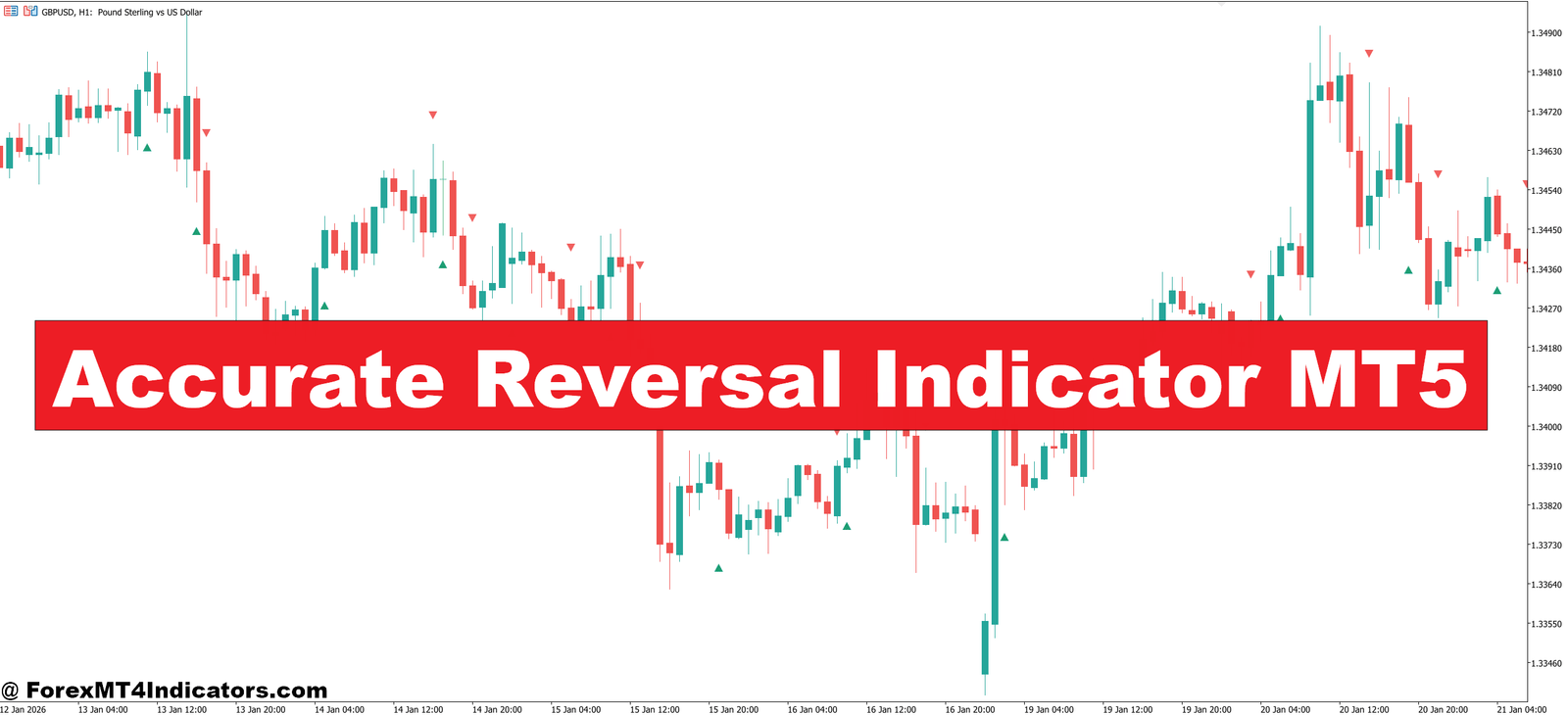
The Accurate Reversal Indicator MT5 was designed to tackle this exact problem. This tool combines price action analysis with momentum calculations to identify potential turning points before they fully develop. It doesn’t eliminate the guesswork entirely—no indicator can—but it gives traders a systematic way to spot high-probability reversal zones without relying purely on gut feeling.
What the Accurate Reversal Indicator Actually Does
At its core, this indicator analyzes price momentum shifts and volume-weighted pressure to detect when buying or selling exhaustion is setting in. Unlike simple moving average crossovers that lag behind price, it looks for specific patterns in how candlesticks form relative to recent highs and lows.
The calculation involves tracking the relationship between closing prices and the range of recent candles. When price repeatedly fails to push beyond a certain threshold while showing weakening momentum, the indicator flags a potential reversal. It’s similar to how RSI identifies overbought and oversold conditions, but with added context about price structure.
What makes it different from standard oscillators is its focus on exhaustion rather than just levels. A market can stay overbought for weeks during a strong trend. This tool tries to identify when that overbought condition is actually running out of steam.
How Traders Apply It in Real Markets

The indicator works best when combined with basic support and resistance concepts. Say you’re trading GBP/JPY on the 1-hour timeframe. Price has been rallying hard, and you spot a clean resistance zone around 185.50 where it previously rejected twice. The Accurate Reversal Indicator starts showing red arrows (sell signals) right as price tests that zone again.
That’s your confluence. The indicator alone might generate signals in the middle of nowhere, but when it aligns with a structural level, the probability improves significantly. Traders often wait for two confirmations: the indicator signal plus a candlestick pattern like a shooting star or engulfing formation.
Here’s the thing—timing matters more than most people think. On the 15-minute chart, this indicator can produce frequent signals, many of which won’t pan out. That’s normal whipsaw behavior in choppy conditions. But on the 4-hour or daily chart, when it fires off a signal at a major support or resistance level, it deserves attention.
One trader I know uses it specifically for cryptocurrency pairs like BTC/USD during high volatility periods. He sets it to slightly more sensitive parameters on the 30-minute chart, watching for divergences between the indicator and price. When Bitcoin makes a new high but the indicator shows weakening momentum, that’s his cue to start looking for short entries.
Accurate Reversal Indicator MT5 Adjusting Settings

The default settings usually include a lookback period (often 14 or 21 candles) and a sensitivity threshold that determines how aggressive the signals are. Swing traders typically increase the lookback period to 30 or even 50 to filter out noise and focus on bigger picture reversals.
Scalpers do the opposite. They might drop it down to 8 or 10 periods on a 5-minute chart to catch quick momentum shifts. But fair warning—the shorter your timeframe and period setting, the more false signals you’ll deal with. It becomes a volume game where you need higher win rates to offset increased transaction costs.
For currency pairs with different volatility profiles, adjustments make sense. EUR/USD tends to move slower than GBP/JPY. You might use standard settings on EUR pairs but tighten the sensitivity on the Yen crosses to avoid getting shaken out by their wider swings.
Some versions of the indicator include alert functions. These can be useful, but don’t let them replace actual analysis. An alert just means the conditions are met mathematically. Your job is still to evaluate whether the market structure supports the signal.
Where This Indicator Excels and Where It Struggles
The strength of the Accurate Reversal Indicator shows up most clearly during range-bound markets. When price is bouncing between defined levels, the indicator catches those turns at the extremes pretty reliably. On a day when USD/CAD is trading sideways between 1.3650 and 1.3720, it’ll often nail the reversals at both boundaries.
It also performs well during trend exhaustion phases. That final push where price makes one more high before rolling over—the indicator frequently catches that because it’s measuring momentum decay, not just price level.
But strong trending markets expose its limitations. During a powerful NFP-driven rally, the indicator might flash reversal signals three or four times as price keeps climbing. Each signal looks legitimate in isolation, but the overall trend momentum is too strong. That’s when traders get chopped up trying to pick tops.
Another weakness: sudden news events. If a central bank surprise hits the wires, price can gap through a reversal signal without hesitation. Technical indicators process historical data—they don’t predict black swan events.
Trading forex carries substantial risk. No indicator guarantees profits, and this one is no exception. It’s a tool that can improve your timing when used properly, but it won’t turn a bad trading plan into a good one.
How It Compares to Common Alternatives
Stochastic oscillators and RSI are the typical go-to tools for reversal trading. Both measure momentum, but they approach it differently. RSI calculates the ratio of up moves to down moves, while Stochastics compares the close to the recent range.
The Accurate Reversal Indicator incorporates elements of both but adds price structure analysis. It’s not just asking “is momentum high or low?” It’s asking “is momentum shifting in a way that suggests exhaustion?” That’s a subtle but important difference.
MACD is another popular choice, especially for spotting divergences. The advantage MACD has is showing momentum trends visually through histogram bars. The downside is lag—by the time MACD confirms a reversal, you’ve often missed the optimal entry.
Bollinger Bands work well for mean reversion traders who want to see when price is extended from its average. But Bands don’t tell you when that extension will actually reverse. Price can ride the upper band for days during strong trends.
The Accurate Reversal Indicator sits somewhere in the middle of these tools in terms of responsiveness. It’s quicker than MACD, more context-aware than pure RSI, and more focused than Bollinger Bands.
How to Trade with Accurate Reversal Indicator MT5
Buy Entry

- Wait for the green arrow at support – Don’t chase buy signals in the middle of nowhere; only act when the indicator flashes green within 10-15 pips of a confirmed support zone on EUR/USD or GBP/USD.
- Confirm with candlestick patterns – Look for a bullish engulfing or hammer candle on the same bar as the signal, especially on 1-hour and 4-hour charts where these patterns carry more weight.
- Check the higher timeframe trend – If the daily chart shows a downtrend, skip the buy signal entirely; reversal indicators work best when catching pullbacks in the direction of the larger trend.
- Set stops below the signal candle low – Place your stop loss 5-10 pips beneath the low of the candle that triggered the indicator, giving enough room for normal price fluctuation without being reckless.
- Avoid buying during high-impact news – If NFP, CPI, or central bank announcements hit within the next 2 hours, step aside; news-driven volatility will invalidate technical signals fast.
- Look for momentum divergence – When price makes a lower low but the indicator shows weakening downside momentum, that’s your strongest buy setup, particularly on the 4-hour timeframe.
- Target previous swing highs – Aim for the nearest resistance level 30-50 pips away as your first profit target, then trail your stop if price keeps climbing.
- Skip signals in tight ranges – When EUR/USD is bouncing in a 20-pip box, reversal signals become noise; wait for clearer directional structure before entering.
Sell Entry

- Take red arrows at resistance zones – Only sell when the indicator signals within 10-15 pips of a tested resistance level; random signals in uptrends are traps waiting to happen.
- Confirm with bearish price action – Look for shooting stars, evening stars, or bearish engulfing patterns on the same candle as the red arrow, especially on 4-hour and daily charts.
- Verify the bigger picture is bearish – If the daily trend is bullish, ignore short signals on lower timeframes; you’re fighting the current and will likely get stopped out.
- Place stops above the signal high – Set your stop loss 5-10 pips above the high of the reversal candle, protecting against false breaks while keeping risk controlled.
- Don’t sell into major announcements – Before Fed decisions, employment data, or GDP releases, close any open positions; these events can gap price through your stop without hesitation.
- Watch for bearish divergence – When GBP/USD prints a higher high but momentum on the indicator weakens, that’s a premium sell signal worth taking with proper position sizing.
- Target recent swing lows for exits – Identify support levels 40-60 pips below your entry and take profit there, or use a trailing stop to lock in gains if momentum continues.
- Ignore signals during Asian session chop – Between 11 PM and 3 AM EST, thin liquidity produces false reversals; stick to London and New York session signals for better reliability.
Making It Work in Your Trading Plan
The real value comes from integration, not isolation. Successful traders treat this indicator as one piece of evidence in a larger case. They’re building a thesis: “Price is at resistance, momentum is weakening, candlestick pattern confirms seller presence, and the reversal indicator agrees.”
One practical approach: use higher timeframe structure to identify key levels, then drop down to a lower timeframe with the indicator active. When the 4-hour chart shows major resistance, switch to the 15-minute chart and wait for the indicator to flash a signal near that level. Enter with a tight stop above the resistance zone.
Risk management still matters more than signal accuracy. Even with a 65% win rate, poor position sizing or wide stops can sink your account. The indicator helps with entries, but you still need to know where you’re wrong and how much you’re willing to lose.
That said, when you catch a clean reversal—the kind where you enter near the top and ride it down 80 pips—there’s real satisfaction in knowing you didn’t just get lucky. You followed a process, and the process worked.
The Accurate Reversal Indicator MT5 won’t solve all your trading problems. It won’t make losing trades disappear or guarantee consistent profits. What it does offer is a systematic way to identify potential turning points with better timing than pure guesswork. For traders who struggle with reversal entries, especially in ranging or exhaustion scenarios, it’s worth testing on a demo account to see if it fits your style. Just remember: the indicator suggests opportunities. You still make the final call.
Recommended MT4/MT5 Broker
XM Broker
- Free $50 To Start Trading Instantly! (Withdraw-able Profit)
- Deposit Bonus up to $5,000
- Unlimited Loyalty Program
- Award Winning Forex Broker
- Additional Exclusive Bonuses Throughout The Year
- Exclusive 90% VIP Cash Rebates for all Trades!


Already an XM client but missing out on cashback? Open New Real Account and Enter this Partner Code: VIP90
(Free MT4 Indicators Download)