







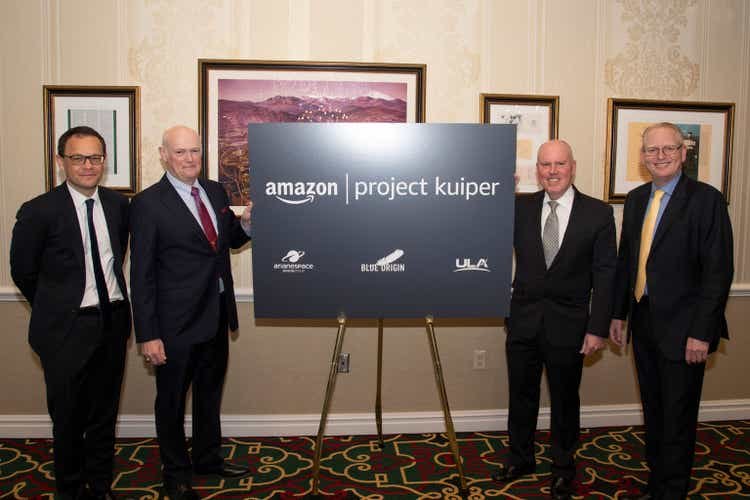
Tom Cooper/Getty Images Entertainment
Amazon (NASDAQ:AMZN) on Thursday said that its prototype Project Kuiper internet satellites had achieved a “100% success rate” on their first test mission dubbed “Protoflight.”
Amazon (AMZN) in October launched the two satellites – KuiperSat-1 and KuiperSat-2 – into space aboard an Atlas V rocket, and said that they were operating as designed. The company’s Project Kuiper is aimed at increasing global broadband access through a constellation of 3,236 satellites in low Earth orbit.
“Every major system and subsystem on board the two prototypes—from flight computers and solar arrays to our propulsion system and advanced radio frequency (RF) communications payload—demonstrated nominal or better performance following launch,” Amazon (AMZN) said in Thursday’s statement.
“With initial testing complete, Project Kuiper is on track to begin mass satellite production ahead of a full-scale deployment starting in the first half of 2024, before entering beta testing with select customers later in the year,” the company added.
Amazon (AMZN) added that it would begin beta testing in H2 of 2024, and early partners such as Vodafone (VOD) and Verizon (VZ) would be among the first to participate in those service pilots.
On the Protoflight tests, Amazon (AMZN) conducted 4K video streaming and two-way video calls over the network during the mission. The mission also involved deploying a combination of parabolic antennas and phased array antennas to send customer data traffic across the network.
Rajeev Badyal, vice president of technology for Project Kuiper, weighed in with his thoughts: “Kuiper was an idea on a piece of paper a few years ago, and everything we’ve learned so far from our Protoflight mission validates our original vision and architecture.”
“We still have a lot of hard work ahead, and scaling for mass production won’t be easy,” Badyal added.


