

Australian Bureau of Statistics (ABS) showed that Australia’s economy grew 0.3% in Q1 2026, falling short of the 0.5% gain markets had anticipated and slowing sharply from the 0.9% pace recorded in the December quarter.
Annual growth held at 2.5% (y/y), also below the 2.6% consensus, as a record surge in data centre imports, weather-driven disruptions to mining exports, and the expiry of household energy subsidies all weighed on the result.
Key Takeaways
- Annual GDP growth: 2.5% (y/y) (expected 2.6%, prior 2.6%)
- Quarterly GDP growth: 0.3% (q/q) (expected 0.5%, prior 0.9%)
- Private investment: Rose 3.6%, led by a 16.3% surge in machinery and equipment tied to data centre construction
- Household consumption: Rose 0.5%, driven by essential spending; the saving ratio fell to 6.2% from 7.0%
- Government consumption: Fell 0.2% as electricity rebates expired and defence spending eased
- Net trade: Detracted 0.8 percentage points from growth, with exports falling 1.1% and imports rising 2.1%
- Mining output: Fell 1.5% as Cyclone Koji disrupted coal production
Business investment was the bright spot, with private investment up 3.6% and machinery and equipment surging 16.3%, the strongest quarterly jump in three decades. Big data center projects in New South Wales and Victoria drove record imports of AI server racks and data processing equipment.
Household spending rose 0.5%, but mostly because essentials got more expensive. Electricity, gas, and fuel costs jumped after energy rebates expired, while discretionary spending barely moved. The saving ratio slipped to 6.2% from 7.0% as spending outpaced income growth.
Government spending fell 0.2%, weighed down by the end of electricity relief and lower defense outlays, though public investment in defense, transport, and health infrastructure helped cushion the blow.
Trade was the biggest drag, subtracting 0.8 percentage points from GDP and pushing Australia into its first goods and services trade deficit since December 2017. Exports fell as Cyclone Koji disrupted coal production and port operations, while imports rose on data center equipment, fuel, and services demand.
Mining contracted 1.5%, hit by cyclone disruptions across coal, copper, and bauxite output. With the Reserve Bank of Australia (RBA) interest rates at 4.35% and energy costs still elevated by Middle East tensions, the growth outlook looks softer from here.
Per capita GDP also slipped 0.1% for the quarter, and some economists warned that an outright contraction in the June period remained possible given the mounting headwinds from the energy shock and rate tightening. Outside of the pandemic, Australia had not recorded a technical recession in nearly 35 years.
Link to official ABS Australian GDP (Q1 2026)
The weak GDP print strengthened expectations that the RBA will keep rates at 4.35% in June, with markets fully pricing in a pause after three straight hikes earlier this year.
The miss gives the RBA room to see how tighter policy and the Middle East energy shock are feeding into domestic demand.
Still, another hike later in 2026 isn’t off the table, with inflation still elevated and productivity weakening. Swap markets now price in just a 7% chance of a July hike, though odds still point to a possible final move before year-end.
Promoted: Australia’s weaker Q1 GDP print, trade drag, and cyclone hit to exports gave AUD traders a fresh reminder: news driven moves can get messy fast.
FundedNext gives disciplined traders a way to test their edge with simulated trading accounts up to $200K, no artificial time limits on challenges, and the flexibility to trade CFDs or Futures, even during major news events.
You can also earn a unique 15% profit share during your evaluation, then keep up to a 95% profit split once funded, with guaranteed 24 hour payouts. Because when markets move fast, your capital situation should not be the thing holding you back.
Learn More About FundedNext!
Disclosure: We may earn a commission from our partners if you sign up through our links, at no extra cost to you.
Market Reactions
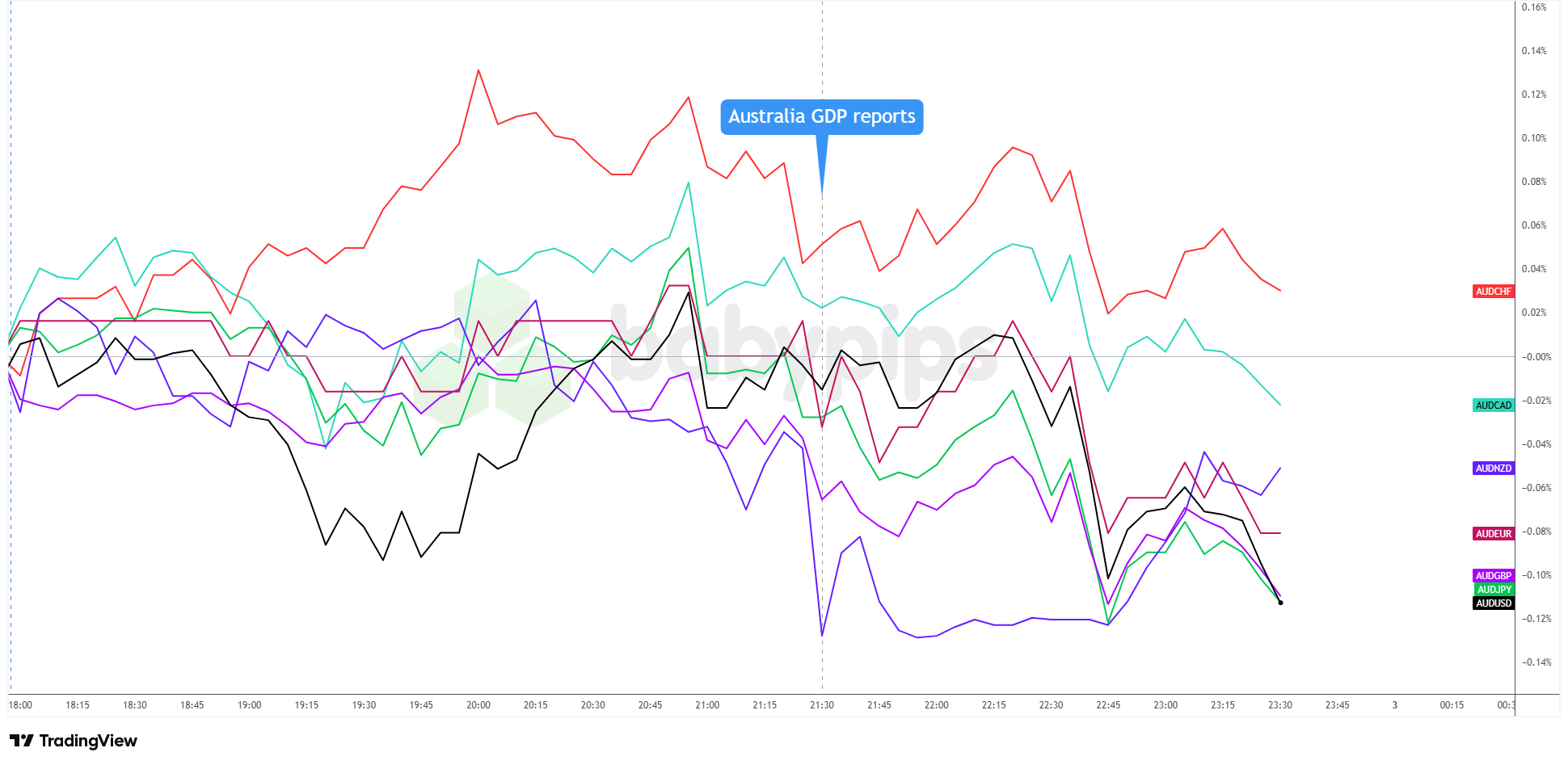
Australian Dollar vs. Major Currencies: 5-min
Overlay of AUD vs. Major Currencies Chart Faster with TradingView
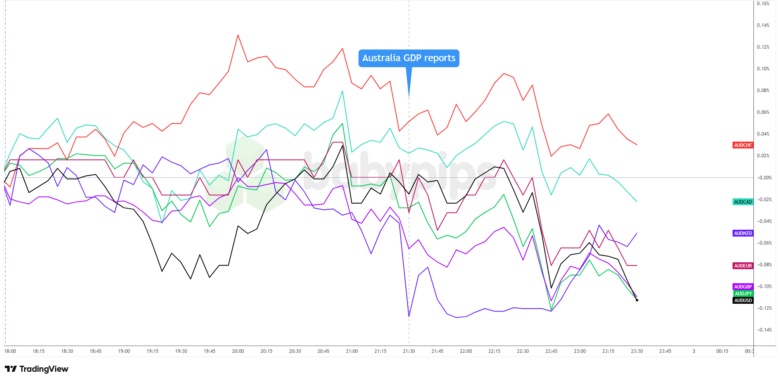
The Australian dollar was modestly supported before the release, with most AUD pairs trading slightly higher as Asia got underway. AUD/CHF led the group, while AUD/USD lagged near the flat line.
The GDP miss triggered a quick broad selloff, sending all tracked AUD pairs lower within minutes. AUD/NZD took the sharpest initial hit as traders reacted to the quarterly miss, weaker trade backdrop, and stronger case for an RBA hold in June.
A brief recovery attempt faded as sellers returned through the session. AUD/CHF was the most resilient, closing slightly higher around 0.04%, while AUD/GBP and AUD/JPY were the weakest at roughly 0.11% lower.
Australia’s Q1 2026 GDP miss surprised markets, but if you’re not familiar with how the RBA operates and what drives the Aussie, the currency reaction can be hard to put in context. Premium members can read our lesson:
Reading this helps you understand RBA policy behavior, Australia’s key economic indicators, and what typically moves AUD pairs.
And if you’re not a Premium subscriber yet, now’s a good time to sign up.
With Babypips Premium, you get full access to School of Pipsology lessons that help you understand not just what the data shows, but the RBA dynamics and economic structure driving AUD price action.