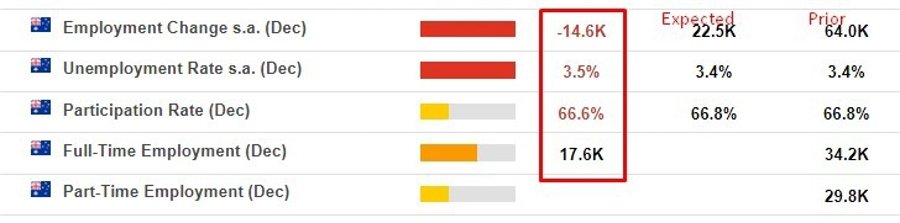
Australian jobs report for December 2022
The labour market has been on a rip, but a net jobs loss in this December report.
JObs and jobless graphs:
Some slowing is no surprise given the series of Reserve Bank of Australia rate hikes. One of the intended aims of these hikes, harsh as it sounds, is a slowing of demand. this involves job losses and the tick higher in the jobless rate shows this. The November jobless rate was revised higher to 3.5% also. ‘
Inflation
Inflation
Inflation is defined as a quantitative measure of the rate in which the average price level of goods and services in an economy or country increases over a period of time. It is the rise in the general level of prices where a given currency effectively buys less than it did in prior periods.In terms of assessing the strength or currencies, and by extension foreign exchange, inflation or measures of it are extremely influential. Inflation stems from the overall creation of money. This money is measured by the level of the total money supply of a specific currency, for example the US dollar, which is constantly increasing. However, an increase in the money supply does not necessarily mean that there is inflation. What leads to inflation is a faster increase in the money supply in relation to the wealth produced (measured with GDP). As such, this generates pressure of demand on a supply that does not increase at the same rate. The consumer price index then increases, generating inflation.How Does Inflation Affect Forex?The level of inflation has a direct impact on the exchange rate between two currencies on several levels.This includes purchasing power parity, which attempts to compare different purchasing powers of each country according to the general price level. In doing so, this makes it possible to determine the country with the most expensive cost of living.The currency with the higher inflation rate consequently loses value and depreciates, while the currency with the lower inflation rate appreciates on the forex market.Interest rates are also impacted. Inflation rates that are too high push interest rates up, which has the effect of depreciating the currency on foreign exchange. Conversely, inflation that is too low (or deflation) pushes interest rates down, which has the effect of appreciating the currency on the forex market.
Read this Term in Australia is still way, way above the RBA target band and I expect the Bank will hike its cash rate target again in February (the 7th is the meeting date) by 25bp.