








The Australian Dollar (AUD) rode a rollercoaster in the first half of the year, hitting a four-year high and then correcting. The currency enters the second half with an outlook full of uncertainty due to renewed hostilities in the Middle East, which clouds the inflation outlook and interest rates. While Australia’s economic fundamentals will remain important, the Aussie’s next move is likely to be driven by decisions made in Washington (and maybe China) rather than in Canberra.
AUD/USD trades around 0.7000 after a first half marked by a sharp rally followed by a strong correction. The Aussie continues to benefit from one of the highest interest rate differentials among the G10 currencies, a relatively resilient domestic economy and generally elevated commodity prices. However, the pair is struggling to extend its gains against the US Dollar (USD), which remains supported by tensions between the United States (US) and Iran, persistent inflation and the possibility of another US interest rate increase.
The second half of the year is therefore unlikely to depend on a single factor. The interaction of three key forces will likely drive the Australian Dollar’s trajectory: the ability of the Australian economy to withstand high interest rates, the response of central banks to the energy shock and the evolution of US politics ahead of the November midterm elections.
The Australian Dollar has already covered much of its ground
The first half of the year can be divided into two distinct phases. AUD/USD initially rallied strongly, climbing from around 0.6670 at the start of the year to a high of 0.7278 in May. This gain of around 9% is driven by a weaker US Dollar, continued Reserve Bank of Australia (RBA) rate hikes and persistently high prices for several industrial metals.
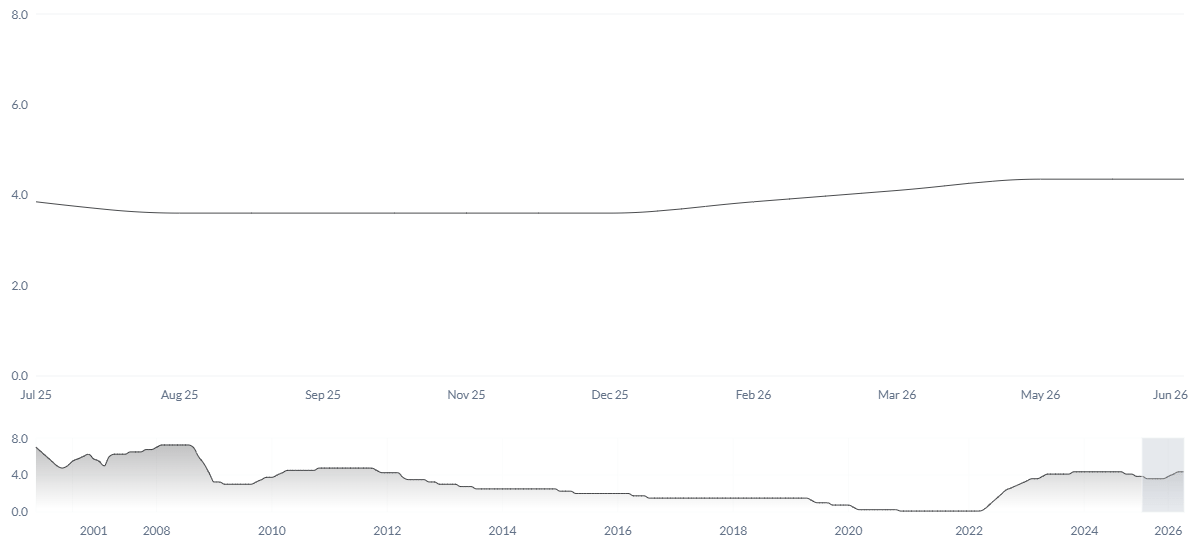
The RBA raised its cash rate three times during the first part of the year, by a total of 75 basis points, before leaving it unchanged at 4.35% in June. This sequence makes Australia one of the highest-yielding developed markets.

However, momentum fades after the May peak. Investors gradually reduced expectations for additional Australian rate hikes while beginning to price in the possibility of tightening by the Federal Reserve (Fed). The correction in energy prices, a slowing Australian housing market and concerns over Chinese growth also remove part of the support for the Aussie.
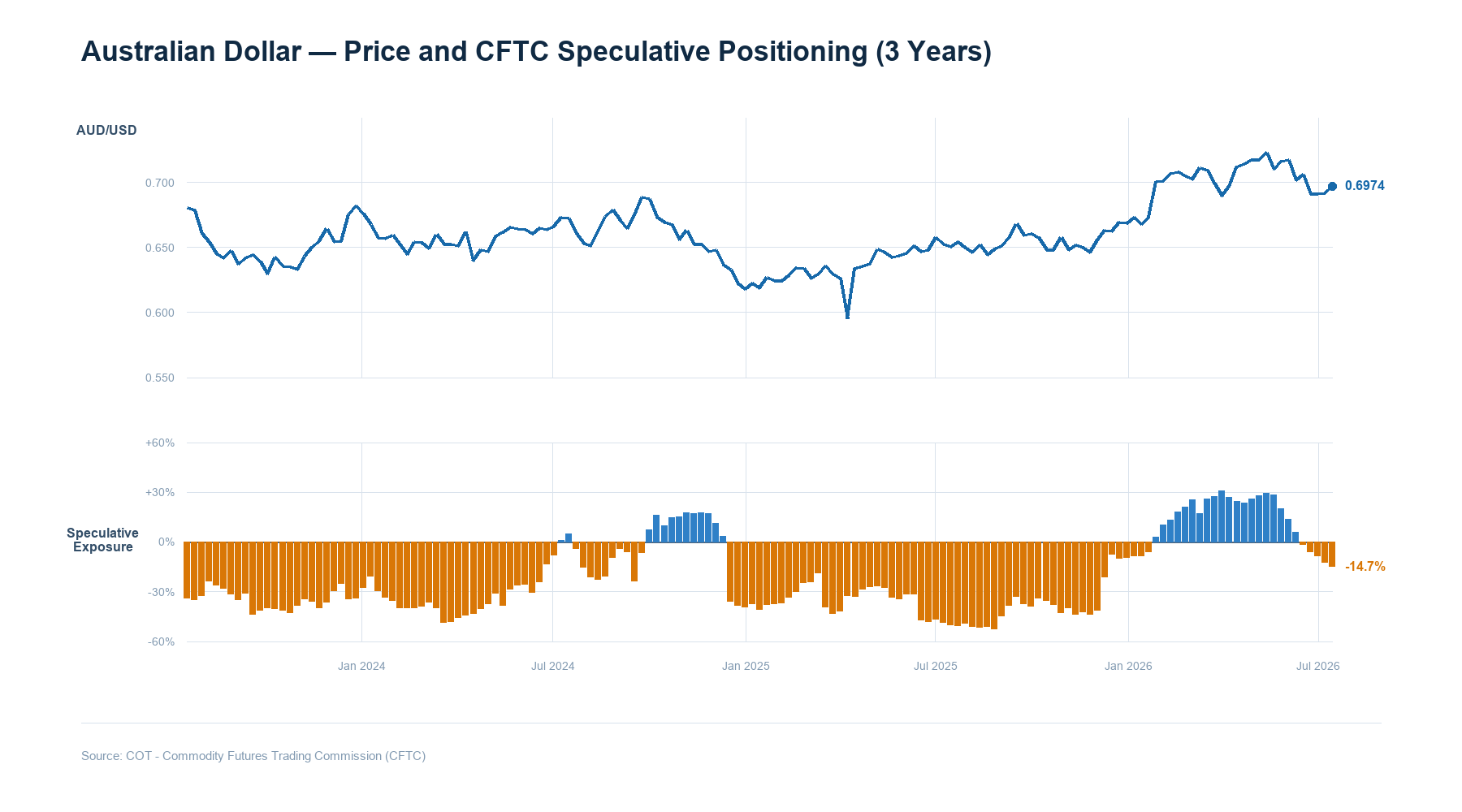
Speculative positioning reflects this shift in sentiment. Commodity Futures Trading Commission (CFTC) data show that net short positions on the Australian Dollar increased to 30.7K contracts in the week ending July 14. However, bearish positioning appears much more mature than earlier in the summer, suggesting that much of the pessimism has already been priced into the market.
Australia’s economy remains resilient, but momentum is fading
Australia enters the second half without falling into recession, but with limited room for error. Gross Domestic Product (GDP) grew by 0.3% QoQ in the first quarter after expanding by 0.9% in the previous quarter. Annual growth reached 2.5%, but that figure masks weakening consumer spending and growing dependence on investment in data centres.
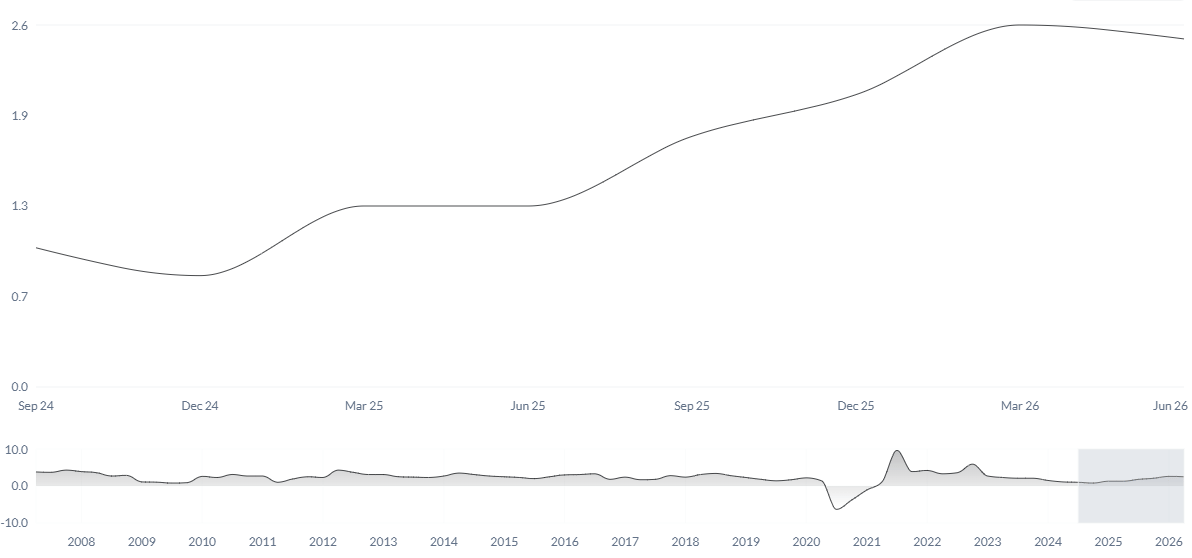
The International Monetary Fund (IMF) forecasts growth of 1.9% this year. The Organisation for Economic Co-operation and Development (OECD) shares the same estimate, while CommBank expects growth to slow to 1.5% by year-end. Deloitte Access Economics is even more cautious, forecasting annual growth of just 1.1%.
Stephen Smith, Partner at Deloitte Access Economics, summarises the changing environment: “The economy continues to grow, but growth has slowed and the outlook has become more fragile. Inflation has accelerated again, interest rates have increased and the Oil shock triggered by the Middle East conflict has not yet fully played out.”
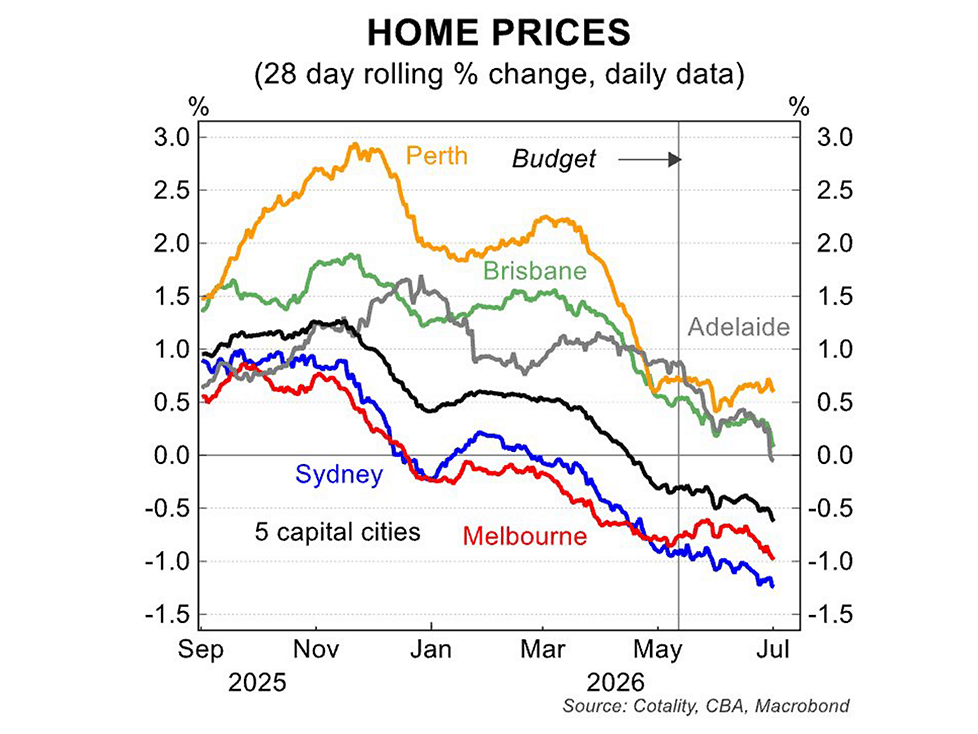
The housing market has become one of the main domestic risks as the three rate hikes delivered this year increase monthly repayments on an average mortgage by around AU$350, according to Deloitte. At the same time, falling house prices in Sydney and Melbourne reduce household wealth, encouraging consumers to save more and spend less.
Belinda Allen, Head of Australian Economics at CommBank, says the source of the slowdown has changed: “It’s really the housing market that’s going to create that slowdown in the Australian economy, rather than higher Oil prices.”
The labour market still provides an important cushion. The Unemployment Rate steadied at 4.4% in June while the economy added 76.3K jobs, up from a revised 44K in May and well above the 15K expected. However, forecasts point to gradual deterioration. Commonwealth Bank expects unemployment to peak at 4.8%, Deloitte sees it around 5%, while the OECD projects an increase of roughly half a percentage point by year-end.
Growth may therefore remain positive while becoming insufficient to improve living standards on a per capita basis. This environment is not particularly supportive for a sustained appreciation of the Australian Dollar unless high interest rates continue to attract foreign capital.
Inflation leaves the RBA facing an uncomfortable choice
Inflation remains the main reason why the RBA cannot quickly shift towards supporting the economy. The Consumer Price Index (CPI) slowed to 4% YoY in May from 4.2% in April. However, the less volatile Trimmed Mean CPI, a gauge of core inflation, rose to 3.6% from 3.4%.
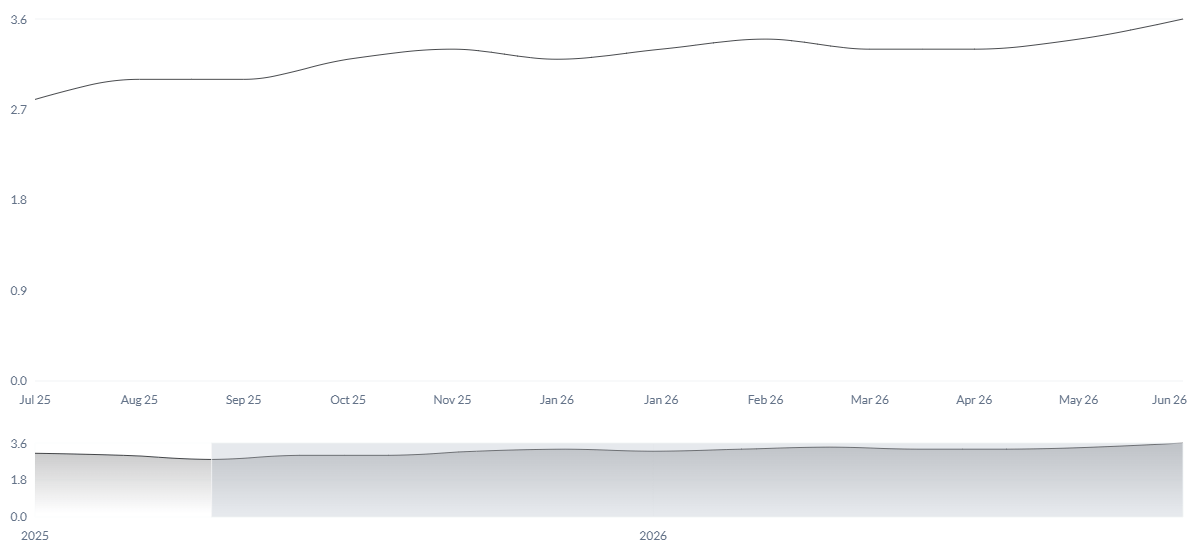
This divergence is significant. The moderation in headline inflation partly reflects movements in energy prices, while the increase in the underlying measure suggests that inflationary pressures continue to spread across services, wages and production costs.
The RBA expects inflation to return sustainably to its 2%-3% target range only around the middle of 2028. The central bank therefore maintains a restrictive bias despite pausing its tightening cycle in June. With hostilities in the Middle East returning and international Oil prices back to $90-$100, this hawkish stance is likely to continue.
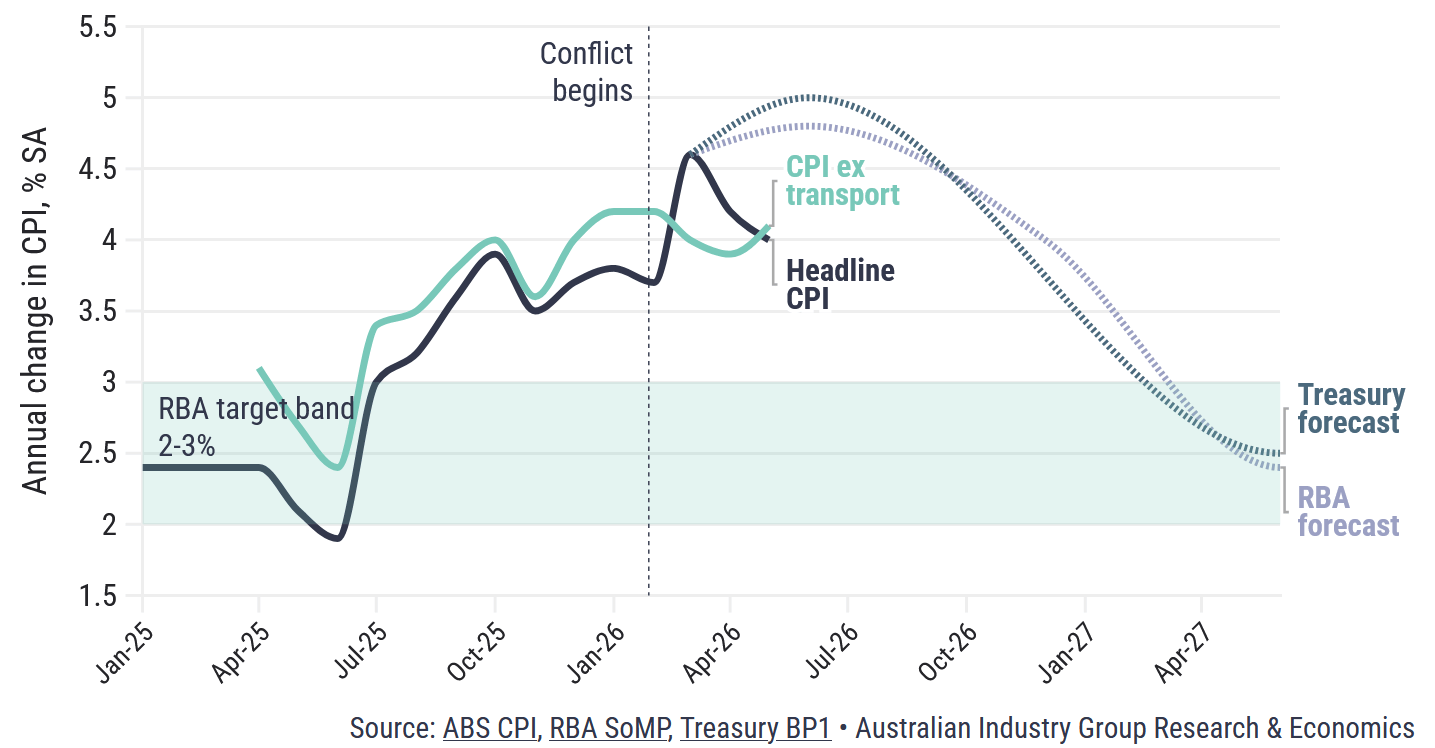
The Minutes of the June meeting state that financial conditions are now “probably somewhat restrictive.” Policymakers also acknowledged that the housing market is slowing more sharply than expected and that the full impact of previous rate hikes has yet to be felt.
The ASX 30-Day Interbank Cash Rate Futures Implied Yield Curve suggests that the RBA’s interest rate could reach 4.6% by the end of the year, implying a further rate rise of 25 basis points.
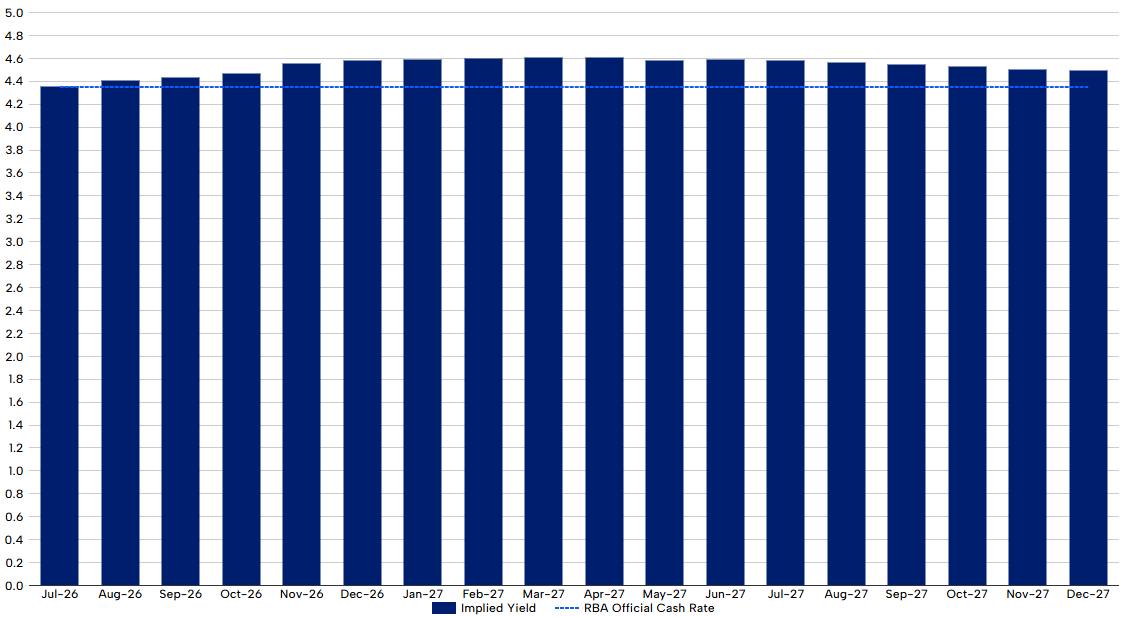
However, when you look at the forecasts from the major institutions, it’s clear that a rate rise this year is far from a done deal.
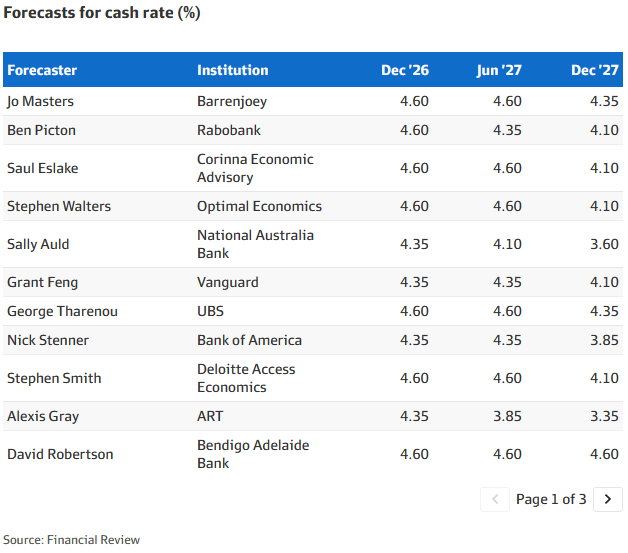
As long as another rate increase remains possible, investors are likely to continue demanding a yield premium for Australian assets. Conversely, the currency could lose that advantage if weaker labour market, housing or consumption data force the RBA to acknowledge that the next policy move is more likely to be a rate cut.
The China card doesn’t work as it used to
China remains Australia’s largest trading partner, accounting for around one-third of Australian exports. Its performance is therefore critical for demand for Iron Ore, Coal, Liquefied Natural Gas (LNG), tourism and education services.
China’s economy expanded by 4.3% YoY in the second quarter, its weakest pace in more than three years. Industrial Production nevertheless rose by 5.3%, while exports remain solid. By contrast, Retail Sales increased by only 1% and Fixed Asset Investment slowed, confirming continued weakness in domestic demand.
This environment is neutral to slightly supportive for the Australian Dollar. Chinese industrial production continues to support demand for commodities, but the absence of a meaningful property market recovery limits the upside for Iron Ore. China therefore prevents a significant deterioration in Australia’s outlook without delivering the powerful growth impulse seen during previous cycles.
For the Aussie, a sustained rally would probably require a genuine recovery in Chinese domestic demand rather than continued strength in exports alone.
Three scenarios for the Australian Dollar in the second half
1. Base case: A fragile peace in the Middle East keeps AUD/USD around 0.7000
The most likely outcome is a partial de-escalation between the United States and Iran, accompanied by the gradual reopening of the Strait of Hormuz. Shipping activity could take six to eight weeks to return to pre-conflict levels. Oil prices would probably remain above pre-war levels because of inventory rebuilding, higher insurance costs and lingering risks to energy infrastructure.
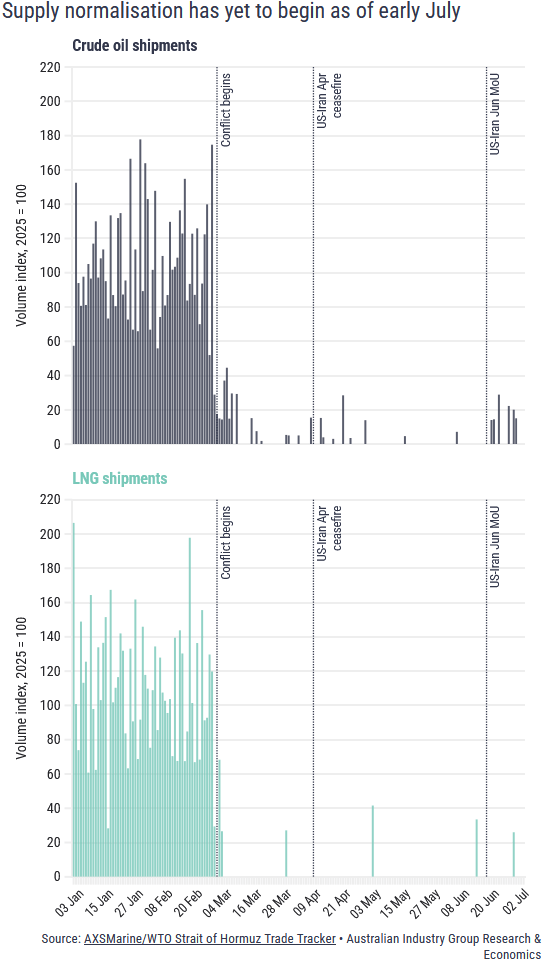
In this scenario, headline inflation remains elevated during the second half, but investors increasingly anticipate lower inflation in 2027. The Fed keeps rates unchanged while the RBA maintains a restrictive bias without necessarily delivering another rate hike.
This combination would preserve Australia’s yield advantage but would not represent a sufficiently large shift to drive a sustained AUD/USD rally. The pair could therefore remain within a broad 0.6900-0.7300 range, frequently moving around the 0.7000 level.
Australia’s economy would continue slowing under the weight of high interest rates and housing weakness while avoiding a severe contraction. At the same time, improving global risk sentiment and gradual US Dollar weakness would provide support for the Australian Dollar.
This is the scenario I consider the most likely. It implies modest gains for the Australian Dollar rather than another rally comparable to the one seen earlier this year.
2. Bullish scenario: US disinflation unleashes the Australian Dollar
The most optimistic scenario assumes a lasting agreement between Washington and Tehran, a rapid normalisation in the Strait of Hormuz and continued declines in energy prices. US inflation would then slow enough to eliminate expectations of further Fed tightening.
US June inflation data already provide a glimpse of this outcome. The CPI grew by 3.5% YoY, down from 4.2% in May, while core inflation fell to 2.6% from 2.9%. These figures push back expectations of further rate hikes, although Fed Chair Kevin Warsh warns that the battle against inflation is not yet over.
A Fed that remains on hold while the RBA keeps rates at 4.35% would improve interest rate differentials in favour of Australia. HSBC believes Australia’s relatively high cash and bond yields already make the AUD attractive for G10 carry trades.
They also believe AUD/USD may have already found its lows: “We continue to see upside potential for AUD/USD heading into 2027, supported by Australia’s relatively high yield levels,” noted the bank.
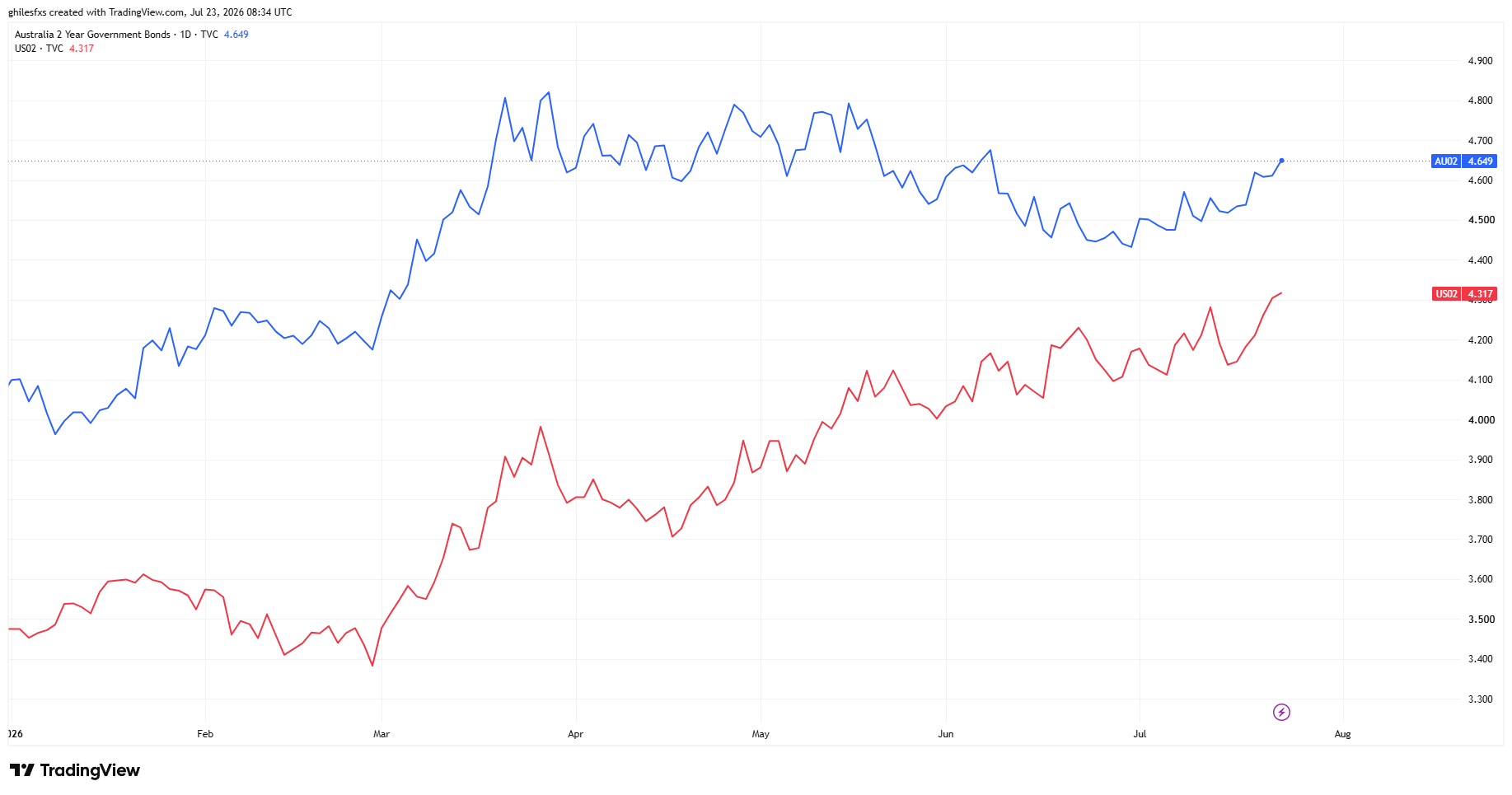
AMP estimates the Australian Dollar’s fair value at around 0.7200 based on Purchasing Power Parity (PPP). The institution expects the pair to trade between 0.7000 and 0.7500 over the coming months while acknowledging that a temporary overshoot towards 0.7500-0.8000 cannot be ruled out.
However, a sustained move above 0.7200 would probably require several developments simultaneously: lower US inflation, the complete removal of Fed hike expectations, a stabilising Chinese economy and stronger global risk appetite.
3. Bearish scenario: War revives inflation and the Fed case for hikes
The most negative scenario would involve renewed military escalation accompanied by a prolonged closure of the Strait of Hormuz or significant damage to Gulf energy infrastructure. Under this scenario, higher Oil and Natural Gas prices would feed through into transportation, fertilisers, food prices and industrial production costs. Central banks would face a stagflationary shock, with inflation rising while economic growth slows.
Initially, central banks might raise interest rates to prevent inflation expectations from becoming unanchored. They could later be forced to ease policy if demand destruction, corporate defaults or financial stress become severe.
The impact on the Australian Dollar would be mixed from a trade perspective but negative in the foreign exchange market. Australia is a net energy exporter and would benefit from improved terms of trade through Coal and LNG exports. However, it remains heavily dependent on imported Crude Oil and highly exposed to Asia, the region most vulnerable to disruptions in Gulf energy supplies.
Risk aversion would probably become the dominant factor. During periods of severe market stress, investors typically favour the liquidity of the US Dollar over the yield advantage offered by the Australian Dollar.
Oil prices remaining sustainably above $100 per barrel could also keep Australian inflation above 4%, increase the probability of additional RBA tightening and place further pressure on housing and household consumption.
Another Australian rate hike would therefore not necessarily support the currency. If tightening were driven by a supply shock while simultaneously increasing recession risks, its positive yield effect could be outweighed by deteriorating growth expectations.
In this scenario, AUD/USD could fall back below 0.6900. A sustained break beneath that area would call into question the recovery seen since 2025 and shift attention towards the lower levels reached before the RBA resumed tightening.
US elections could reshape the US Dollar’s outlook
The US midterm elections on November 3 will add another layer of uncertainty during the second half of the year. All 435 House seats and 33 Senate seats will be contested. JP Morgan believes Democrats have a credible chance of regaining control of the House while Republicans remain favoured to retain the Senate. A divided Congress would limit the Trump administration’s ability to pass additional tax cuts or large fiscal spending packages.
Reduced fiscal expansion could lower expectations for US growth and interest rates, weighing on the US Dollar and supporting AUD/USD. However, the outcome would not necessarily be entirely positive for the Australian Dollar. Political gridlock could increase volatility surrounding the debt ceiling while temporarily boosting safe-haven demand for the US Dollar.
Moreover, the US administration would still retain broad authority over tariffs, immigration and foreign policy even with a Democratic House. Greater reliance on executive action could keep inflationary and geopolitical risks elevated.
Higher tariffs would slow global trade and could weigh on China, creating a negative spillover for Australia. At the same time, tighter immigration policies could restrict US labour supply and prolong inflationary pressures, making it harder for the Fed to ease monetary policy.
The election outcome will therefore matter less because of the winning party than because of its implications for fiscal deficits, trade, inflation and US policy towards Iran.
The US Dollar remains the key variable
Australian fundamentals explain why the Australian Dollar remains resilient, but US developments are likely to determine the magnitude of its next move.
The US economy continues to grow close to potential, supported by investment in artificial intelligence and technology infrastructure. Commonwealth Bank estimates that the five largest technology companies could invest nearly $800 billion this year, representing annual growth of between 80% and 85%.
This investment boom supports both the US economy and cyclical currencies, but it also strengthens the US Dollar if it keeps growth and inflation above expectations.
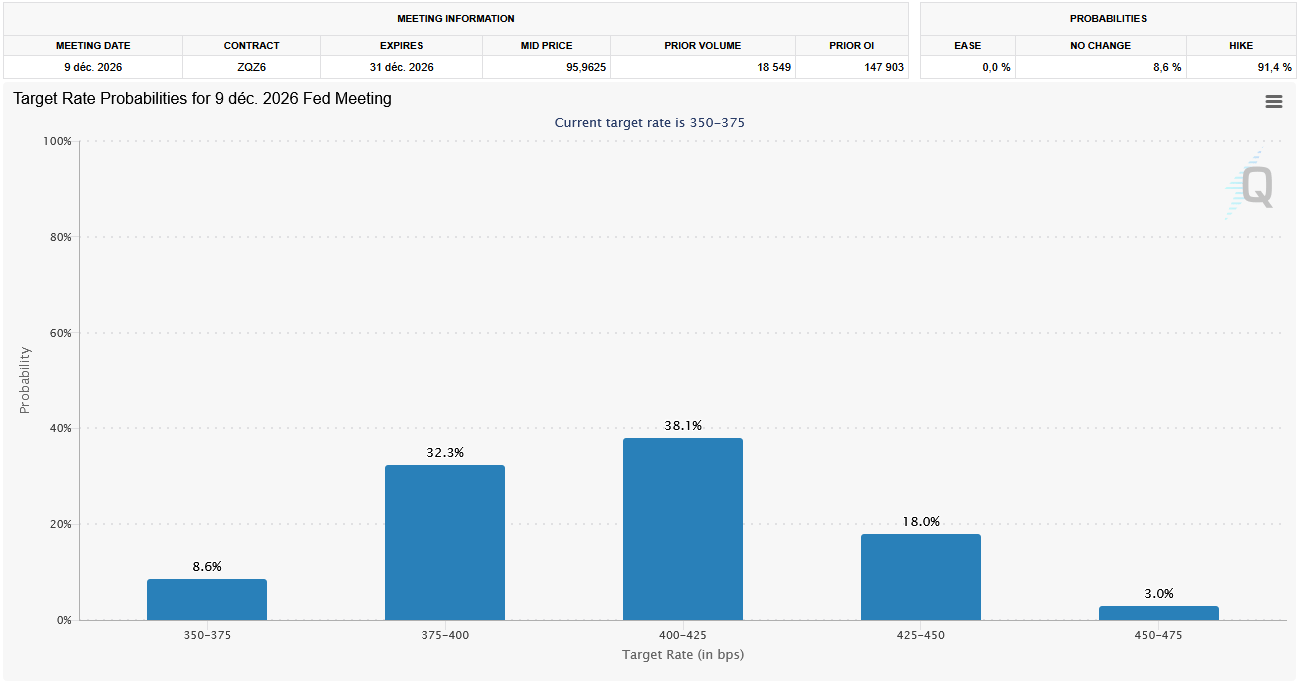
Moreover, the difference between a Fed on hold and a Fed delivering another rate hike is probably the single most important driver for AUD/USD in the second half of the year. The RBA can support the Australian Dollar by maintaining restrictive policy, but it will struggle to offset rising US yields combined with stronger global risk aversion.
According to the CME Group FedWatch tool, markets are currently pricing in over a 90% chance that the Fed will hike interest rates by the end of this year, with more than 55% chance for a move as early as September.
My take: The Aussie retains upside potential, but it is becoming more limited
My base case remains moderately constructive for the Australian Dollar. The currency continues to benefit from attractive yields, strong institutions, Australia’s AAA sovereign credit rating and an economy that has so far avoided recession. At the same time, already elevated speculative short positioning limits the scope for another wave of purely speculative selling.
However, the environment is less favourable than it was earlier this year. The housing market is slowing, consumer spending is weakening, productivity remains subdued and China is stabilising rather than accelerating. Meanwhile, the US Dollar is regaining support from geopolitical risks and renewed expectations of higher US interest rates.
The 0.7000 area is therefore likely to remain a centre of gravity rather than simply another resistance level. A sustained move towards 0.7200-0.7500 becomes increasingly plausible if US inflation continues to cool and tensions with Iran ease. Conversely, another surge in Oil prices, combined with Fed tightening, could drag the pair back below 0.6900.
The main risk for investors would be to assume that Australia’s attractive yield advantage alone is sufficient to support the currency. In a stable environment, carry trades can underpin the Australian Dollar. In a stagflationary environment characterised by heightened risk aversion, the liquidity and safe-haven appeal of the US Dollar could once again dominate.
Upcoming Australian inflation releases, labour market data, energy prices and US inflation reports will determine which of these three scenarios begins to unfold. For now, the Australian Dollar remains resilient, but its next major move is likely to depend more on developments in Washington, Tehran and Beijing than in Canberra.
AUD/USD Technical Analysis: Consolidates within bullish weekly structure
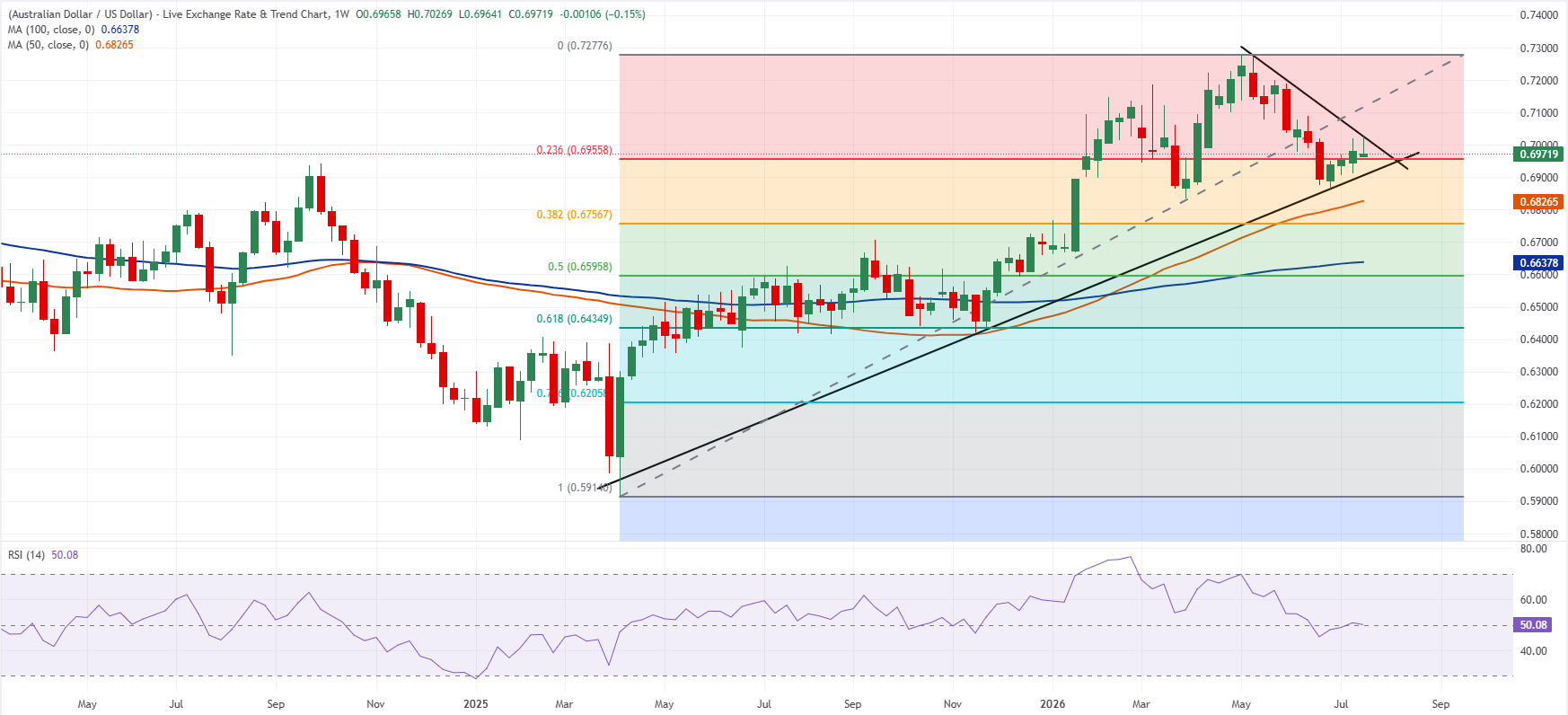
The AUD/USD pair holds above the 50-week simple moving average (SMA) at 0.6827 and the 100-week SMA at 0.6638, keeping the broader bias constructive while it consolidates just over the 23.6% Fibonacci retracement at 0.6956 and along the rising trend-line support around 0.6913.
The Relative Strength Index (RSI) near 50 suggests subdued but still mildly positive momentum as price remains below the descending resistance trend line at 0.7013, indicating that bulls are in control but face nearby overhead supply.
On the downside, initial support is seen at the 23.6% retracement at 0.6956, followed by the uptrend support line at 0.6913, while deeper floors emerge at the 38.2% retracement at 0.6757 and the 50.0% retracement at 0.6596.
On the topside, immediate resistance is provided by the downward-sloping trend line at 0.7013, with a more significant barrier at the cycle high at 0.7278, where a break would open the way for a stronger continuation of the weekly uptrend.
(The technical analysis of this story was written with the help of an AI tool. Know more.)


