





Most of the major markets are still out on banking holidays but that doesn’t mean we shouldn’t start hunting for trading opportunities!
Today we’re looking at EUR/AUD ahead of China’s Caixin manufacturing PMI and a bunch of inflation reports from the Eurozone.
Before moving on, ICYMI, I’ve listed the potential economic catalysts that you need to watch out for this week. Check them out before you place your first trades today!
And now for the headlines that rocked the markets in the last trading sessions:
Fresh Market Headlines & Economic Data:
Japan, China, Switzerland, and the U.K. out on bank holidays
China manufacturing contracts sharply from 48.0 to 47.0 as COVID infections soar in December
Asian stocks mixed in holiday trade
European natural gas prices extended losses to €73/MWh, a new low since February 2022
France’s manufacturing PMI revised higher from 48.9 to 49.2 in December (vs. 48.9 in November)
Eurozone’s manufacturing PMI confirmed at 47.1 in December, the softest downturn since September
Germany’s manufacturing PMI revised lower from 47.4 to 47.1 in December
Germany’s BDI: ECB’s 2% inflation target only possible “by the middle of the decade” if monetary policy takes effect
U.S. and Canada out on New Year’s Day holidays
Caixin manufacturing PMI at 1:45 am GMT (Jan 3)
Australia’s commodity prices out during the Asian session (Jan 3)
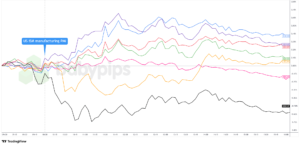
Use our new Currency Heat Map to quickly see a visual overview of the forex market’s price action! ? ?️
What to Watch: EUR/AUD
Is EUR/AUD ready for a fresh leg higher?
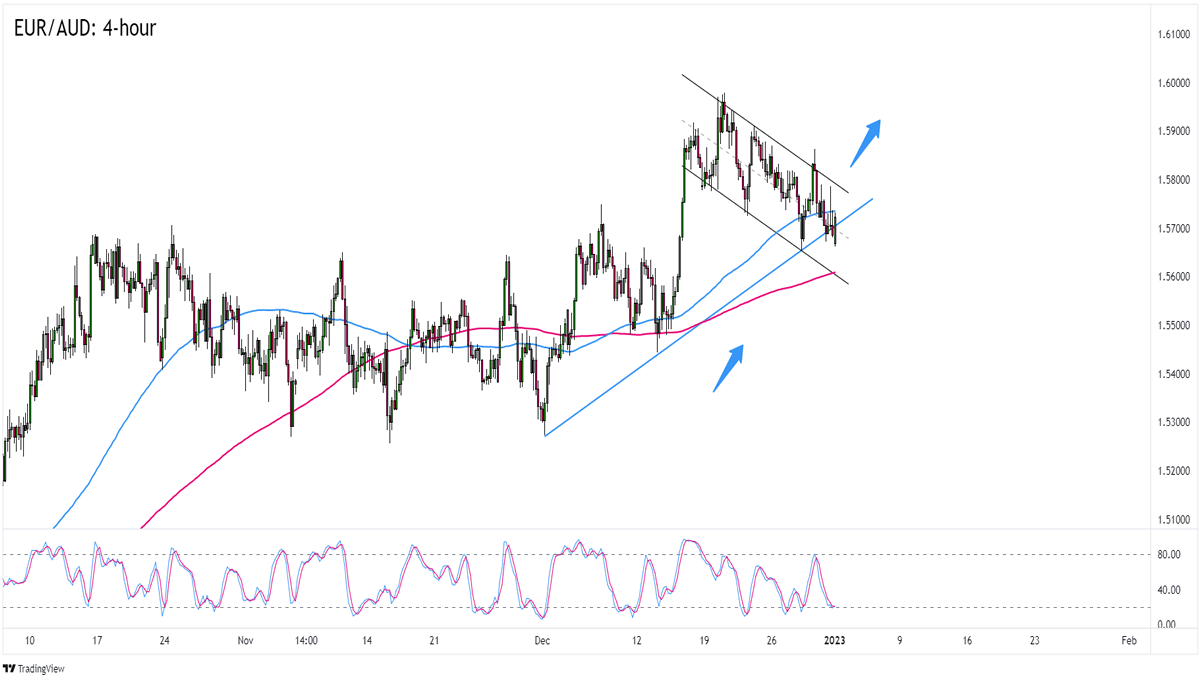
As you can see, EUR/AUD has trended lower after hitting resistance at the 1.6000 psychological area.
EUR bulls have a chance to extend EUR/AUD’s December uptrend as the pair tests the 1.5700 area that lines up with a trend line support AND the broken October-November range resistance.
Both the U.S. and Canadian markets will be out on New Years Day holidays today but we could see increased volatility when China prints its Caixin manufacturing PMI.
If the official manufacturing PMI is any clue, manufacturers had a hard time in December as COVID cases rose in China.
Meanwhile, Germany will be releasing its inflation and jobs numbers. Germany’s BDI has already warned that we won’t see dramatic inflation decelerations. If prices decline by less than 0.7% as markets are expecting, then traders could price in a more aggressive tightening by the ECB.
Watch out for a bounce from the current levels, which could complete a bullish flag pattern on he 4-hour time frame. A bounce could send EUR/AUD to 1.5900 or the 1.6000 previous highs.
If EUR/AUD extends its downswing, though, then you might want to look at the 1.5500 or 1.5300 previous support zones as targets.
Whichever bias you choose to trade, make sure you leave enough room in your stop losses for sentiment changes!


