


- The Euro tumbled against the high-stepping US Dollar on Tuesday.
- ECB’s Senteno, Villeroy, and Nagel reiterate familiar policy stance.
- ZEW Economic expectations in Germany improved, because of rate cut hopes.
The Euro (EUR) mixed on Tuesday, holding mostly steady against its peers but seeing steep declines against the US Dollar (USD). European Central Bank (ECB) officials continue to tow the company line, reiterating that it’s too soon for the ECB to pivot into rate cuts.
Euro area data was thin on Tuesday, and markets will be focusing on headlines from the World Economic Forum (WEF) in Davos, Switzerland where policymakers are meeting for a five-day retreat.
Daily digest market movers: Euro tumbles against US Dollar as policymakers talk down markets
- The euro area’s ZEW Economic Sentiment Survey in January declined slightly from 23.0 to 22.7, but beat the forecast decline to 21.9.
- Germany’s ZEW Economic Sentiment Survey improved in January, jumping from 12.8 to 15.2 versus the forecast 12.0.
- Germany’s ZEW Current Situation Survey deteriorated further, dropping from -77.1 to 7.3 versus the expected uptick to -77.0.
- ECB’s Valimaki: ECB will continue to be data-dependent, better to wait longer than to cut too early.
- Can’t jump the gun too early on rate changes.
- Restrictive monetary policy still called for according to ECB’s Valimaki.
- ECB’s Centeno: Inflation is coming down sustainably, shouldn’t be worried about a resurgence in inflation rate.
- ECB needs to be prepared for all topics, including rate cuts, according to ECB’s Centeno.
- ECB’s Villeroy: Still too early to declare victory over inflation.
- ECB’s Villeroy reaffirms that the ECB’s next move will be a rate cut sometime this year, but inflation outlook needs to see 2% first.
- The ECB is more patient on rate cut outlook than markets, according to ECB’s Villeroy.
Euro price today
The table below shows the percentage change of Euro (EUR) against listed major currencies today. Euro was the strongest against the Japanese Yen.
| USD | EUR | GBP | CAD | AUD | JPY | NZD | CHF | |
| USD | 0.70% | 0.56% | 0.34% | 0.95% | 0.95% | 0.83% | 0.66% | |
| EUR | -0.71% | -0.13% | -0.35% | 0.25% | 0.25% | 0.13% | -0.05% | |
| GBP | -0.58% | 0.12% | -0.25% | 0.40% | 0.36% | 0.25% | 0.05% | |
| CAD | -0.37% | 0.36% | 0.21% | 0.58% | 0.58% | 0.46% | 0.29% | |
| AUD | -0.96% | -0.25% | -0.37% | -0.61% | -0.01% | -0.12% | -0.30% | |
| JPY | -0.95% | -0.25% | -0.37% | -0.61% | 0.01% | -0.10% | -0.31% | |
| NZD | -0.87% | -0.12% | -0.25% | -0.49% | 0.12% | 0.12% | -0.17% | |
| CHF | -0.66% | 0.07% | -0.06% | -0.30% | 0.34% | 0.30% | 0.19% |
The heat map shows percentage changes of major currencies against each other. The base currency is picked from the left column, while the quote currency is picked from the top row. For example, if you pick the Euro from the left column and move along the horizontal line to the Japanese Yen, the percentage change displayed in the box will represent EUR (base)/JPY (quote).
Technical Analysis: Euro sheds weight against firmer US Dollar, mixed on Tuesday
The Euro (EUR) slid around six-tenths of a percent against the US Dollar on Tuesday, also declining about a third of a percent against the Canadian Dollar (CAD) while gaining about a quarter of a percent against both the Australian Dollar (AUD) and Japanese Yen (JPY).
The EUR/USD fell to its lowest bids since mid-December, knocking below the 1.0900 handle and testing into 1.0870 as bearish pressure builds enough to knock the pair out of near-term consolidation.
The EUR/USD is approaching the 200-day Simple Moving Average (SMA) near 1.0850, cutting cleanly through the 50-day SMA at 1.0900 as the pair heads into a technical congestion zone. Short-sellers will be looking for a continued push into December’s bottom bids near 1.0750, while a price action rebound from here will keep a higher-lows pattern intact and allow bidders to push for a rebound into the 1.1000 major handle.
EUR/USD Hourly Chart
EUR/USD Daily Chart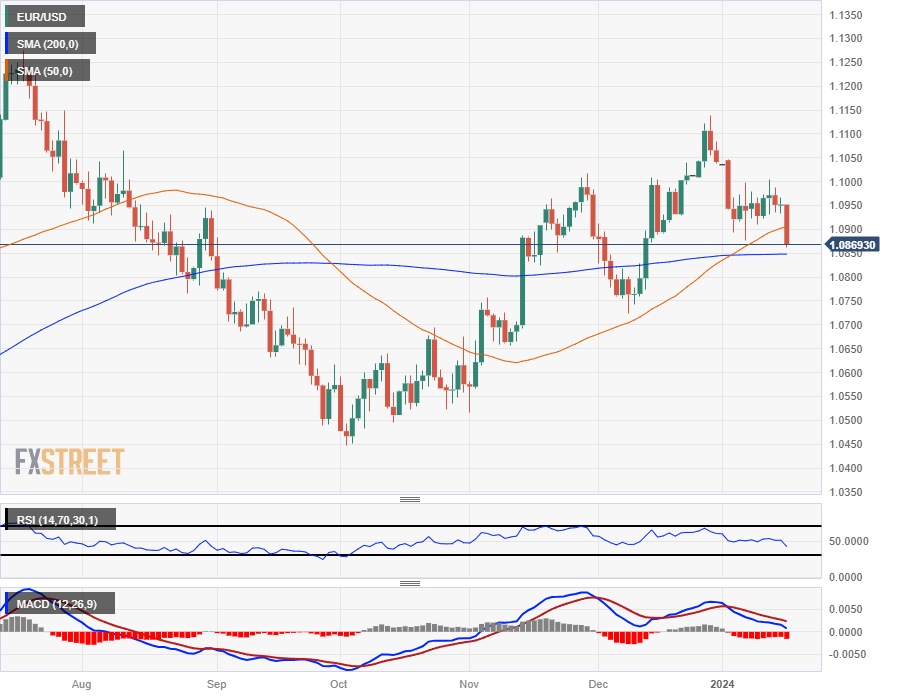
Davos 2024 FAQs
The World Economic Forum (WEF) is a not-for-profit organization that brings together global leaders from commerce, academia, philanthropy, and politics in an annual meeting in Davos, Switzerland, with the aim of jointly solving the global economic, social, and political challenges of the day. The WEF was started by Economist Klaus Schwab in 1971. The principle of stakeholder capitalism, in which corporations are not just accountable to shareholders but also to the wider public and the environment, is central to the WEF’s ethos, as is the use of Public-Private Partnerships (PPP) to achieve better outcomes.
In the words of the organizers, one of the major themes of Davos 2024 is “Rebuilding Trust,” which relates primarily to finding solutions to geopolitical fractures, such as the conflicts in Gaza and Ukraine. Another key theme is that of how AI can be a driving force for the economy and society. Hammering out a long-term strategy for climate and energy is high on the list of priorities, as is facing the threat of a potential economic slowdown.
The World Economic Forum’s board of trustees are drawn from all four corners of the globe. They consist of leaders from the worlds of business, politics, academia, philanthropy, the arts, and civil society. These include the CEOs of major corporations, heads and former heads of state, professors, and musicians to name but a few.
The World Economic Forum’s (WEF) main achievements have probably been in the realm of conflict resolution. The “Davos Declaration” of 1988 prevented the outbreak of a war between Greece and Turkey. The WEF led to the first ministerial-level meeting between North and South Korea. Davos was the meeting place for the first face-to-face meeting between Nelson Mandela and South African President F.W. de Klerk, which started off the dismantling of apartheid, and it sowed the seeds of the “Cairo Agreement” between Israel and Palestine in 1994.
Davos has been criticized for being a meeting of the elite that disenfranchises poorer nations through the promotion of global capitalism. It has been criticized for not representing the very stakeholders it purports to support, nor including in discussions those most affected by the problems being tackled by the World Economic Forum. Two examples are developing countries and lower-income groups. Other criticisms are that it is not sufficiently diverse and is merely a “talking shop” devoid of action and relevance.
