Oil and Treasury yields pushed higher on Wednesday as the U.S.-Iran conflict ran into an 11th straight night of strikes, sending fresh risk premium through energy and rates. Gold held a firm safe-haven bid while U.S. equities finished close to flat, with traders holding back ahead of after-hours results from Alphabet and Tesla. The dollar drifted through a choppy, mixed session against the majors.
Check out the forex news and economic updates you may have missed in the latest trading session!
Forex News Headlines & Data:
- The U.S. and Iran signaled they aren’t ready to return to talks after both sides escalated attacks, with oil rising and bond yields climbing on inflation concerns, per Bloomberg
- API Crude Oil Stock Change for July 17, 2026: 2.6M (-0.06M previous)
- Japan Balance of Trade for June 2026: -406.9B (-200.0B forecast; -378.7B previous)
- Australia Westpac Leading Index for June 2026: 0.0% m/m (-0.2% m/m forecast; 0.0% m/m previous)
- New Zealand Credit Card Spending for June 2026: 3.1% y/y (4.5% y/y forecast; 5.1% y/y previous)
-
U.K. CPI Growth Rate for June 2026: 2.6% y/y (2.6% y/y forecast; 2.8% y/y previous)
- U.K. Core Inflation Rate for June 2026: 2.6% y/y (2.5% y/y forecast; 2.6% y/y previous)
- U.K. Retail Price Index for June 2026: 3.0% y/y (2.9% y/y forecast; 3.1% y/y previous)
- U.K. PPI Output for June 2026: 2.6% y/y (2.3% y/y forecast; 2.3% y/y previous)
- U.K. PPI Input for June 2026: 7.3% y/y (9.0% y/y forecast; 8.7% y/y previous)
- U.S. MBA 30-Year Mortgage Rate for July 17, 2026: 6.69% (6.65% previous)
- U.S. MBA Mortgage Applications for July 17, 2026: 1.9% (-2.7% previous)
- EIA Crude Oil Stocks Change for July 17, 2026: 2.01M (-1.69M previous)
Broad Market Price Action:
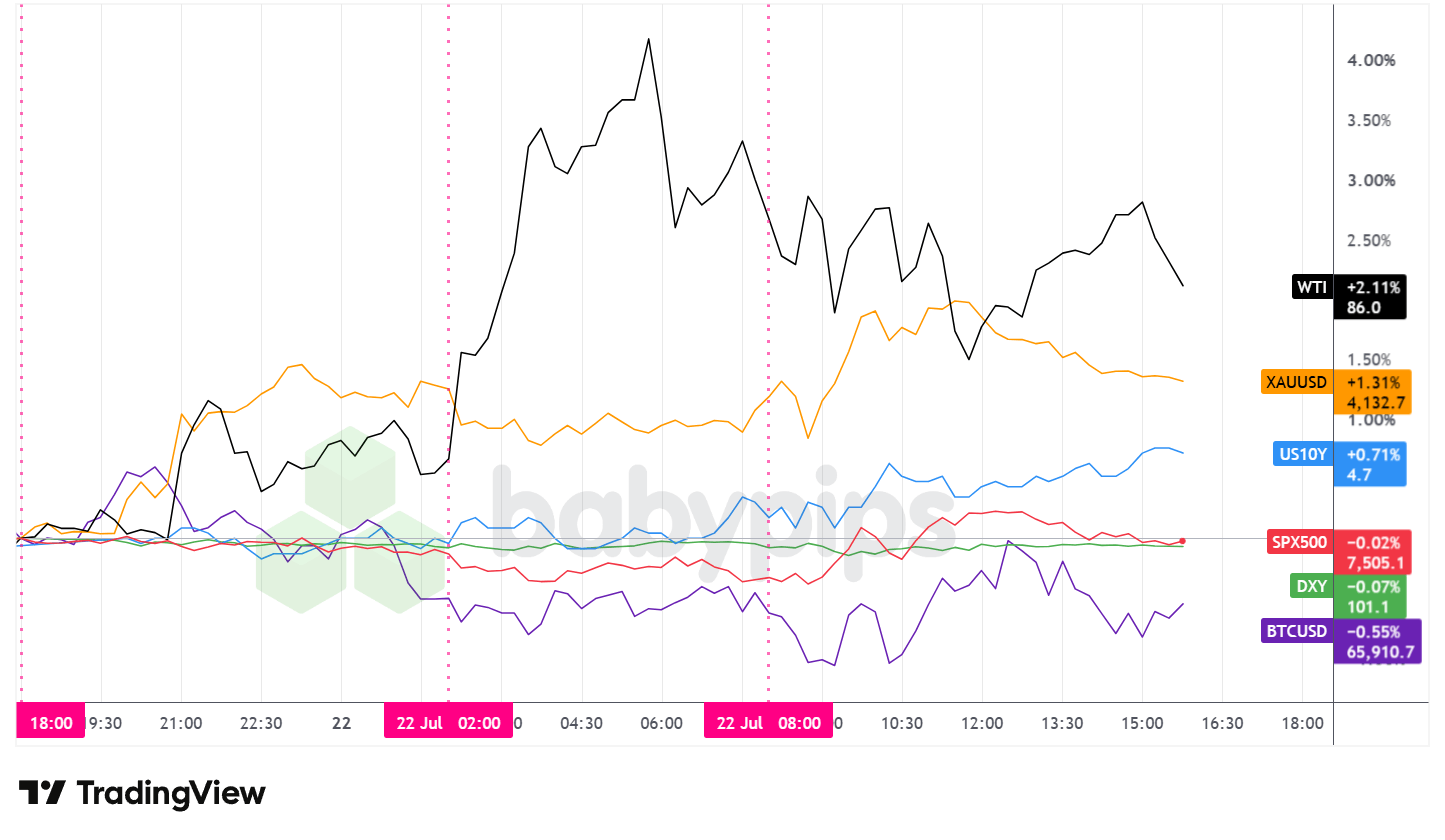
Dollar Index, Gold, Oil, S&P 500, U.S. 10-yr Yield, Bitcoin Overlay – Chart Faster With TradingView
Wednesday ran on a single dominant driver. The escalating conflict between the U.S. and Iran pushed energy and rates higher, gold caught a safe-haven bid, and equities stalled as traders waited on big-tech earnings.
WTI crude led the majors, closing up around 2.1% near $86 a barrel. The move built through the Asian and early European hours, peaking close to $87.90 around 06:00 GMT before easing back and trading in a lower range through the U.S. afternoon. The advance tracked the 11th consecutive night of U.S.-Iran strikes, which hit military, energy, and gas infrastructure across several Iranian cities, alongside fresh threats to shipping through the Strait of Hormuz and the Red Sea.
Gold gained roughly 1.3% to trade near $4,133. Bullion climbed steadily into the London morning, ran up to about $4,166 around midday, then gave back part of the move into the close. With no gold-specific catalyst on the tape, the bid likely reflected safe-haven demand tied to the conflict and to central bank buying that has underpinned the metal in recent months.
The 10-year Treasury yield rose about 0.7% to trade near 4.66%, its firmest in roughly two months. Yields tracked the climb in crude as traders priced in the risk that higher energy costs feed through to inflation, likely weighing on the Treasury market. The pressure lands a week before the Federal Reserve’s policy meeting, with money markets showing roughly a 30% chance of a hike and a 70% chance of a hold.
The S&P 500 finished close to flat, off a touch on the day near 7,505. The index sagged overnight to around 7,470, rallied through the New York morning to about 7,526 by midday, then faded back through the afternoon. Losses in most megacaps offset a rebound in chipmakers, with Nvidia up about 3%. Traders held positions light ahead of after-hours results from Alphabet, Tesla, and IBM, results that carry extra weight as pressure builds on the group to justify heavy AI spending.
Bitcoin slipped around 0.5% to trade near $65,900. It sold off overnight toward $65,480, then chopped sideways in a wide band for the rest of the session without a clear catalyst. The subdued, range-bound tone fit a market leaning cautious on risk while equities waited on earnings and the geopolitical picture stayed live.
Promoted: Keep Your Automated Edge Running 24/7.
Your algorithmic strategy shouldn’t rely on your home Wi-Fi. In high-volatility events, execution speed and uptime are what separate a winning backtest from a live market success. ForexVPS provides ultra-low latency, dedicated trading servers that keep your algos executing trades around the clock without interruption. Stop letting connectivity issues erode your edge.
Explore VPS plans at ForexVPS!
Disclosure: To help support our free daily content, we may earn a commission from our partners if you sign up through our links, at no extra cost to you.
FX Market Behavior: U.S. Dollar vs. Majors
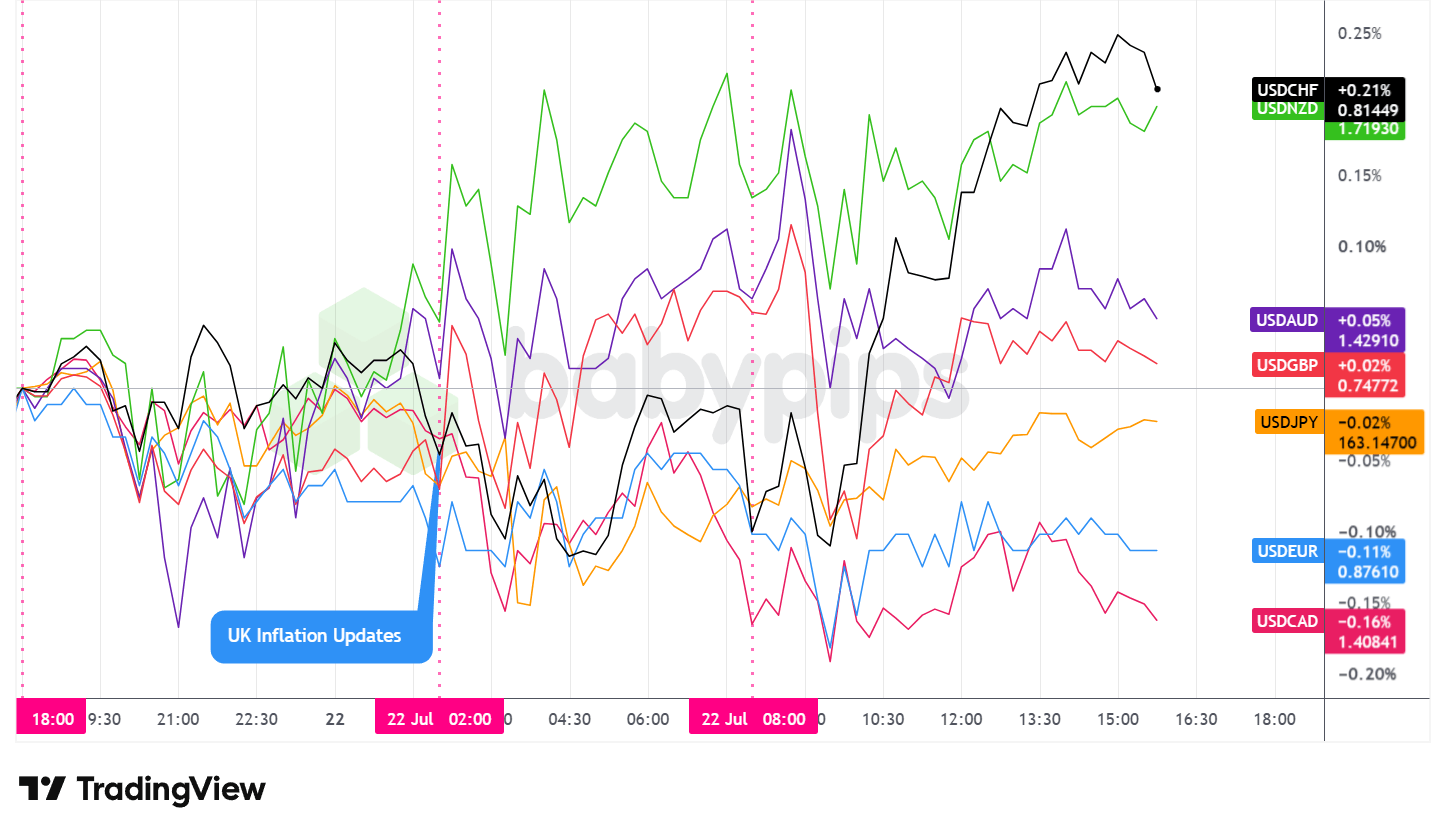
Overlay of USD vs. Majors – Chart Faster With TradingView
The U.S. dollar traded choppy and mixed on Wednesday, ending arguably net neutral to slightly bearish against the majors. It firmed against the Swiss franc and New Zealand dollar, held roughly flat versus the Aussie and pound, and softened against the euro and a Canadian dollar that drew support from stronger crude.
During the Asian session, the dollar traded choppy with arguably a net bearish lean against the majors, with no single regional catalyst setting direction.
After the London open, the dollar continued to trade choppy and mostly sideways. The U.K. inflation report landed as the session’s main data point, with headline CPI holding at 2.6% year-over-year and core steady at 2.6%. The in-line readings gave sterling little to run with, and the dollar drifted without committing to a direction.
After the U.S. session opened, the dollar saw a pickup in volatility and some sharper up-and-down swings, though it mostly settled back into choppy, sideways trade for the rest of the day. Rising Treasury yields offered the greenback some underlying support, yet firmer crude and steadier European yields kept the euro and the Canadian dollar resilient, capping any clean dollar rally.
By the close, the picture stayed mixed. An argument could be made that the day’s tilt leaned slightly against the dollar, with its softest showing against the commodity-linked Canadian dollar and the euro, while its firmest came against the franc and the kiwi.
Promoted: Navigating Geopolitical Shocks Isn’t Reserved for Institutional Traders.
When oil, gold, and Treasury yields are all spiking on conflict headlines, it’s easy to get chopped up in the crosscurrents. Most traders quietly wonder if consistent profitability is actually achievable in such complex intermarket environments. Jack Schwager’s newest book, “Market Wizards: The Next Generation,” answers that question directly.
The legendary author behind the original Market Wizards series interviews a new generation of successful traders—many self-taught—who built real wealth by navigating unpredictable global events. Their common thread isn’t genius or insider access to central bank data. It’s a deliberate process, disciplined risk management during volatile sessions, and the conviction to take trading seriously as a pursuit worth mastering.
Get Market Wizards: The Next Generation on Amazon!
Disclosure: We may earn a commission from our partners if you sign up through our links, at no extra cost to you.
Upcoming Potential Catalysts on the Economic Calendar
- Australia Employment Situation Update for June 2026 at 1:30 am GMT
- U.K. CBI Industrial Trends Orders & Business Optimism Index for July 2026 at 10:00 am GMT
- Canada CFIB Business Barometer for July 2026
-
ECB Interest Rate Decision for July 23, 2026 at 12:15 pm GMT
- ECB Press Conference at 12:45 pm GMT
- Canada Retail Sales Prel for June 2026 at 12:30 pm GMT
- U.S. Chicago Fed National Activity Index for June 2026 at 12:30 pm GMT
- U.S. Initial Jobless Claims for July 18, 2026 at 12:30 pm GMT
- Euro area Consumer Confidence Flash for July 2026 at 2:00 pm GMT
Thursday hinges on whether the energy-driven risk premium keeps building and on the European Central Bank. If U.S.-Iran strikes press on and crude stays bid, rates and safe havens could hold their lead, and the dollar’s mixed tone may keep hanging on the tug between higher U.S. yields and firmer oil-linked and European currencies.
The ECB decision stands as the session’s main event, with the accompanying press conference likely to set the tone for the euro, while Australian jobs and U.S. jobless claims round out the docket.
Stay frosty out there, forex friends!
When the U.S.-Iran conflict pushes oil to $87, gold to $4,166, and Treasury yields to 4.66%, it’s easy to watch the moves without understanding why each currency pair reacts the way it does. Premium members can read our lesson:
📖 Geopolitical Risk, Trade Policy, and Safe Haven Flows
Reading this helps you understand how geopolitical shocks systematically drive currencies, which safe havens traders reach for during conflict, and why commodity-linked pairs like CAD and the euro respond differently from the dollar and the franc when risk premium spikes.
And if you’re not a Premium subscriber yet, now’s a good time to sign up.
With Babypips Premium, you get full access to School of Pipsology lessons that help you understand not just what your chart is showing, but the geopolitical mechanisms and market flows behind every currency move during crisis events.