


The U.S. 10-year Treasury yield briefly punched through 5% for the first time since 2023 on Monday, as oil-fed inflation angst and swelling supply worries collided in the countdown to Wednesday’s Federal Reserve decision. A selloff in chipmakers dragged stocks lower after several AI industry leaders pressed for a slowdown in advanced model development, and gold slid while the dollar firmed against every major. Bitcoin went its own way and climbed, the one risk asset to shrug off the defensive mood.
Check out the forex news and economic updates you may have missed in the latest trading session!
News Headlines & Data:
- New Zealand Services PSI for August 2026: 51.2 (50.5 forecast; 50.6 previous)
- New Zealand Visitor Arrivals for July 2026: 8.5% y/y (4.0% y/y forecast; 8.1% y/y previous)
- Japan Industrial Production Final for July 2026: 3.9% y/y (4.1% y/y forecast; 4.9% y/y previous)
- Swiss Producer & Import Prices for August 2026: -0.7% y/y (-1.3% y/y forecast; -2.1% y/y previous)
- China Total Social Financing for August 2026: 1,660.0B (2,150.0B forecast; 1,410.0B previous)
- China M2 Money Supply for August 2026: 7.5% (7.7% forecast; 7.7% previous)
- China Outstanding Loan Growth for August 2026: 4.9% y/y (5.0% y/y forecast; 5.1% y/y previous)
- China New Loans for August 2026: 60.0B (450.0B forecast; -340.0B previous)
- Canada Inflation Rate for August 2026: 3.0% y/y (3.0% y/y forecast; 3.0% y/y previous)
- Canada Manufacturing Sales Final for July 2026: -0.4% m/m (-0.2% m/m forecast; 0.1% m/m previous)
- Canada Capacity Utilization Rate for July 2026: 80.7% (82.4% forecast; 82.3% previous)
Broad Market Price Action:
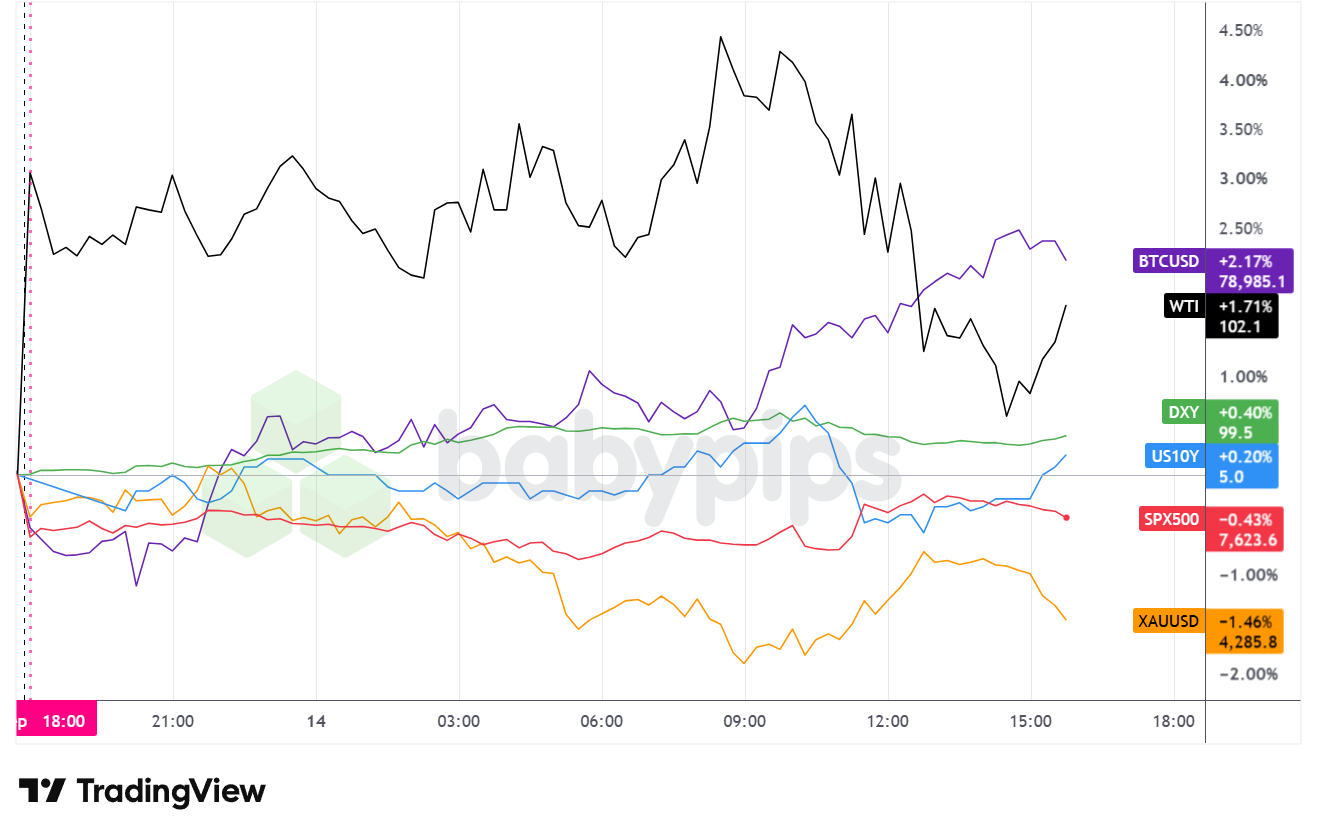
Dollar Index, Gold, Oil, S&P 500, U.S. 10-yr Yield, Bitcoin Overlay – Chart Faster With TradingView
The overlay shows yields and crude leaning higher while stocks and gold gave ground, with bitcoin the one risk asset to shrug off the mood. The split tracked the day’s inflation story, and it firmed once U.S. traders arrived to a wall of Fed-hike pricing and a semiconductor selloff.
The 10-year Treasury yield did the day’s heavy lifting. It rose to as high as 5.01% in the New York morning, the first print above 5% since 2023, before slipping back toward 4.97% as buyers returned at the milestone. Surging crude and hotter inflation expectations drove the early jump, and swelling government and corporate borrowing needs added to the pressure. Money markets now price better than a 90% chance that the Fed raises rates on Wednesday, which would be its first hike since 2023.
Oil extended its run. WTI crude finished up around 1.7% near $102, after trading as high as the mid-$104s during the London morning and then easing into the U.S. afternoon. The closure of a key Saudi East-West pipeline that bypasses the Strait of Hormuz kept a supply-risk premium in the price. Brent pushed toward $108 intraday before settling above $105.
The S&P 500 slipped around 0.4% to finish near 7,620. A rout in chipmakers set the tone after Anthropic chief Dario Amodei, in a widely circulated letter endorsed by OpenAI’s Sam Altman and Elon Musk, argued that development of the most advanced AI systems should slow to guard against loss of control. A semiconductor gauge dropped about 5%, and firmer yields gave equity buyers another reason to hang back ahead of the Fed.
Gold fell roughly 1.5% to trade near $4,286 and threatened a downside technical break. The metal leaked lower through Asia and London as a firmer dollar and rising real yields outweighed any haven pull from the Middle East, then clawed back part of the drop during the U.S. afternoon. A tense geopolitical backdrop did not translate into a gold bid this time.
Bitcoin bucked the mood, rising about 2.2% to trade near $79,000 and leading the overlay on a percentage basis. It climbed from the Asian reopen and pushed to session highs into the U.S. afternoon. No clean crypto-specific catalyst drove the move, so it likely reflected a pocket of risk appetite the rest of the tape lacked on a day owned by yields and the Fed countdown.
FX Market Behavior: U.S. Dollar vs. Majors
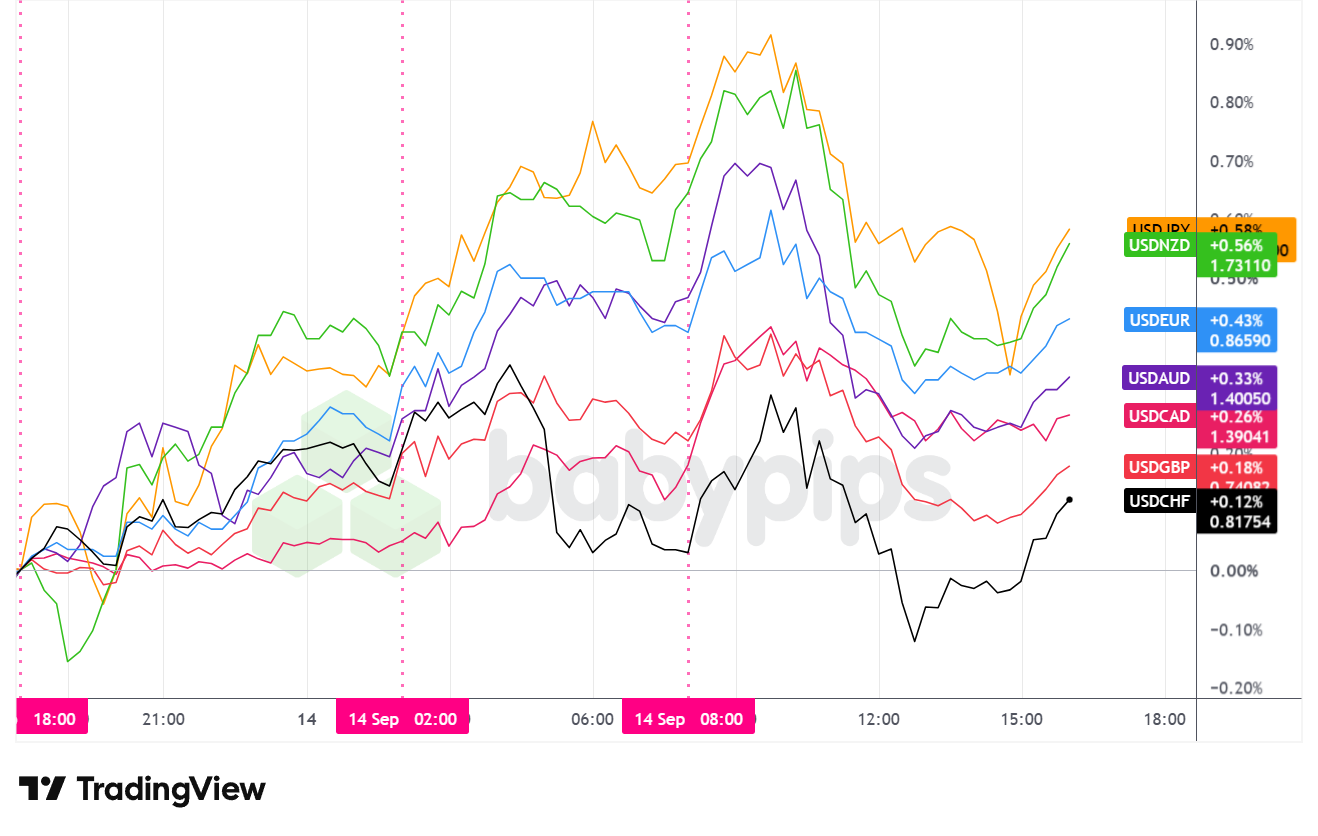
Overlay of USD vs. Major Currencies – Chart Faster With TradingView
The dollar firmed against every major on Monday, with the Dollar Index adding around 0.4% to trade near 99.5. Ramped-up Fed rate-hike bets and the climb in Treasury yields did most of the work, and the greenback carried a bid from the Asian reopen through the London morning before its advance stalled in the U.S. afternoon.
Through the Asian session, the dollar opened the week firm and kept grinding higher as traders pushed Fed-hike odds toward 90% on the weekend’s oil surge and the 10-year’s approach to 5%. An argument could be made that the greenback carried a gap-risk premium into the reopen given the run of hawkish headlines. USD/JPY climbed from near 153.5 toward the mid-154s, and the yen and Kiwi sat at the soft end of the board.
European hours pushed the move further. With Brent pressing toward $108 and yields grinding up, the dollar tagged its London session highs, and USD/JPY brushed roughly 154.9. The Swiss franc proved the exception, firming against the dollar through the European morning after Swiss producer and import prices printed less negative than expected, which lent it some relative support.
The rally lost steam once New York arrived for the U.S. session. As the 10-year slipped back from 5% and the AI-driven selloff kept risk sentiment heavy, most pairs eased off their highs into the close while holding the day’s gains. USD/JPY drifted from near 154.9 back toward 154.3. The Canadian dollar softened even with oil higher and an in-line inflation report: Canada’s headline CPI held at 3.0%, and with core measures near 2.0%, the read did little to force the Bank of Canada’s hand, leaving USD/CAD up around 0.3%.
By the close, the dollar had gained on every major, with the yen and Kiwi at the back of the field and the franc and pound the most resilient. The through-line ran beneath the currencies rather than within any one of them. Oil, yields, and the Fed countdown set the tone, and traders may stay reactive to that mix into Wednesday’s decision.
Upcoming Potential Catalysts on the Economic Calendar
- New Zealand Electronic Card Retail Sales for August 2026 at 10:45 pm GMT
- China House Price Index for August 2026 at 1:30 am GMT
- China Retail Sales for August 2026 at 2:00 am GMT
- China Industrial Production for August 2026 at 2:00 am GMT
- China Unemployment Rate for August 2026 at 2:00 am GMT
- Germany Wholesale Prices for August 2026 at 6:00 am GMT
- U.K. Employment Situation Update for July 2026 at 6:00 am GMT
- France Inflation Rate Final for August 2026 at 6:45 am GMT
- Germany ZEW Economic Sentiment Index for September 2026 at 9:00 am GMT
- Euro area ZEW Economic Sentiment Index for September 2026 at 9:00 am GMT
- U.S. ADP Employment Change Weekly for August 29, 2026 at 12:15 pm GMT
- Canada Wholesale Sales Final for July 2026 at 12:30 pm GMT
- U.S. NY Empire State Manufacturing Index for September 2026 at 12:30 pm GMT
- New Zealand Global Dairy Trade Price Index for September 15, 2026
- U.K. BoE Wilkins Speech at 3:00 pm GMT
- ECB Schnabel Speech at 5:00 pm GMT
The next session leans on second-tier data before Wednesday’s main event. China’s August activity dump overnight, followed by U.K. jobs and German and euro-area ZEW sentiment, will test whether the growth picture is softening even as inflation risk keeps yields elevated. None of it likely outweighs the Fed, so the oil tape and the long end of the Treasury curve probably stay in charge, and positioning may keep a cautious tilt into the decision.
The market was pricing in a 90% chance of a Fed rate hike before Wednesday’s decision, and the dollar firmed on that expectation. But most readers miss the key insight: currencies move on what traders expect, not what actually happens. Premium members can read our lesson:
Market Expectations: Why Good News Can Tank a Currency Reading this helps you understand why currencies respond to expected Fed action before the decision even arrives, how to read what the market has already priced in, and why the same data release can move a currency up or down depending on what traders were expecting.
And if you’re not a Premium subscriber yet, this is a good time to join.
With Babypips Premium, you get full access to School of Pipsology lessons that help you understand not just what central banks decide, but what the market has already expected and priced in before the announcement.