







Earlier this week, the UK’s 30-year government bond yield surged as much as 13 basis points to 5.78% — the highest level since 1998.
This is a symptom of a larger problem. In fact, from Tokyo to London to Washington, government bond yields have been climbing sharply.
When this happens, it doesn’t just affect bond investors. It ripples across currencies, stock markets, and — critically — the decisions of the world’s most powerful central banks.
If you want to understand why interest rate cuts keep getting pushed back, this is a big part of the answer.
The IOU and the See-Saw
A government bond is basically an IOU. When a government needs cash, it borrows from investors by issuing a bond and promising to pay it back later with interest. The yield is the effective annual return for holding it.
Say a $1,000 bond pays $50 a year. That is a 5% yield. But if the bond price falls to $900, the same $50 payment now works out to about 5.5% for a new buyer. So when investors dump bonds, prices fall, and yields rise.
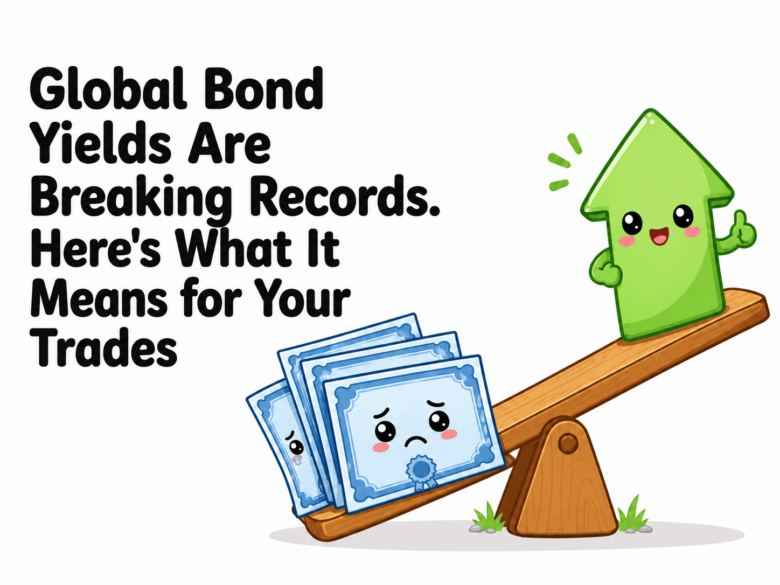
This is why bond prices and yields move in opposite directions, like a seesaw.
Naturally, higher yields attract foreign capital. The idea is that investors move money into a country to earn a better return, and to do that, they first need to buy that country’s currency, pushing it higher.
But yields rising from fiscal fear rather than economic strength can do the exact opposite: investors sell both the bonds and the currency at the same time.
So, knowing why yields are rising is just as important as knowing that they are.
Why the Ground Was Already Unstable
The current surge in yields stems from the U.S.-Iran conflict and the closure of the Strait of Hormuz, which triggered a simultaneous sell-off across every major global market. But while the 2026 numbers are striking, they represent the ignition of a fuse that had been laid long before the first shot was fired:
The inflation ghost. Inflation is a bond’s natural enemy. Lend money at 3% when inflation runs at 4%, and you’re losing purchasing power. Investors demand higher yields to compensate, and a surging oil price is the worst possible accelerant.
A glut of government debt. Governments worldwide are borrowing at historically elevated levels. Trump’s “Big Beautiful Bill” alone is estimated by the Congressional Budget Office to add nearly $4 trillion to the U.S. deficit over the next decade.
As Ed Yardeni of Yardeni Research put it: “Major governments are living deficits. They’ve accumulated a great deal of debt, and investors are starting to demonstrate that they’re not happy about that.”
The end of central bank support. For years, central banks hoovered up government bonds, suppressing yields artificially. More recently, central banks have signaled they will keep interest rates high to ensure inflation is truly dead. This expectation keeps upward pressure on the entire bond market.
Promoted: When bond markets get jumpy, disciplined traders need more than hot takes.
We’re breaking down how rising yields, inflation pressure, and central bank uncertainty can shake up currency markets. For traders looking to take those macro themes into a more structured trading environment, Lux Trading Firm offers funded trading programs with real capital, certified track records, and potential long-term opportunities for qualified performers.
Learn More at Lux Trading Firm
Disclosure: To help support our free daily content, we may earn a commission from our partners if you sign up through our links, at no extra cost to you.
Monetary Policy: The “Pivot” That Wasn’t
The most significant weight on the bond market is the sudden paralysis of global central banks. Entering 2026, markets had priced in a series of rate cuts; instead, the energy-driven inflation spike has forced a “higher-for-longer” reality.
Federal Reserve: In early May 2026, the Fed held interest rates steady at 3.50%–3.75%, stalling the anticipated easing cycle. Policymakers are now openly debating whether the next move should actually be a hike if the Hormuz blockade persists.
Japan’s Historic Shift: The Bank of Japan (BOJ) is witnessing a historic retreat from its decades-long stimulus. The 10-year JGB yield pushed to 2.496% on 13 April—a level not seen since 1997. With underlying inflation remaining above the 2% target, the BOJ held rates at 0.75% in April, signaling that the era of ultra-low rates has definitively ended.
The UK’s “Forceful” Warning: The UK remains the hardest-hit G7 nation. As of early May 2026, 10-year gilt yields are hovering near 5%. The Bank of England has kept rates at 3.75% but warned of “forceful” rises to come if inflation, which is already projected to double toward 6%, continues to climb.
The Euro Area Stance: The ECB has revised its 2026 inflation projections upward to 2.6%, citing the war’s impact on commodity markets. It has maintained its current restrictive rates, effectively ending any hopes for a spring stimulus.
The U.S. Treasury market has seen the most rapid reset. By late March, the 10-year Treasury yield had climbed to 4.46%, its highest level since July 2025. The move was part of a synchronized global bond selloff, as investors across major economies priced in supply shocks that monetary policy cannot really solve. It can only make them more painful.
What to Watch as a Forex Trader
Track yield differentials, not just yields. The spread between U.S. and Japanese 10-year yields drives USD/JPY. When JGB yields rise faster than Treasuries, expect yen strength and carry trade unwinding.
Ask why yields are rising. A hawkish central bank or strong growth tends to strengthen a currency. Fiscal panic or surging inflation tends to weaken it. Same move, opposite outcome.
The U.S. 10-year is the global floor. Every other rate is priced off Treasuries. Above 4.5%, it tightens financial conditions worldwide — pushing up emerging market borrowing costs and pressuring currencies with high external debt.
The Bottom Line
The U.K.’s record gilt yield may have grabbed the headline, but it is only one piece of a much bigger story. A war, an oil shock, and years of mounting deficits have pushed bond markets into territory that is now reshaping central bank decisions and currency moves in real time.
For forex traders, bond yields are not background noise. They are one of the clearest signals of shifting rate expectations, investor confidence, and capital flows. Learn how to read them, and you will have a better shot at understanding where currencies may head next.
This article covers a global bond selloff and what rising yields mean for currencies, but the mechanics behind yield differentials and how they drive exchange rates can be easy to miss. Premium members can read our lesson:
How Bond Yield Spreads Affect Currency Movements Reading this helps you understand why yield differentials between countries drive currency trends, how carry trades amplify those effects, and how to use spread monitoring as a practical trading signal.


