








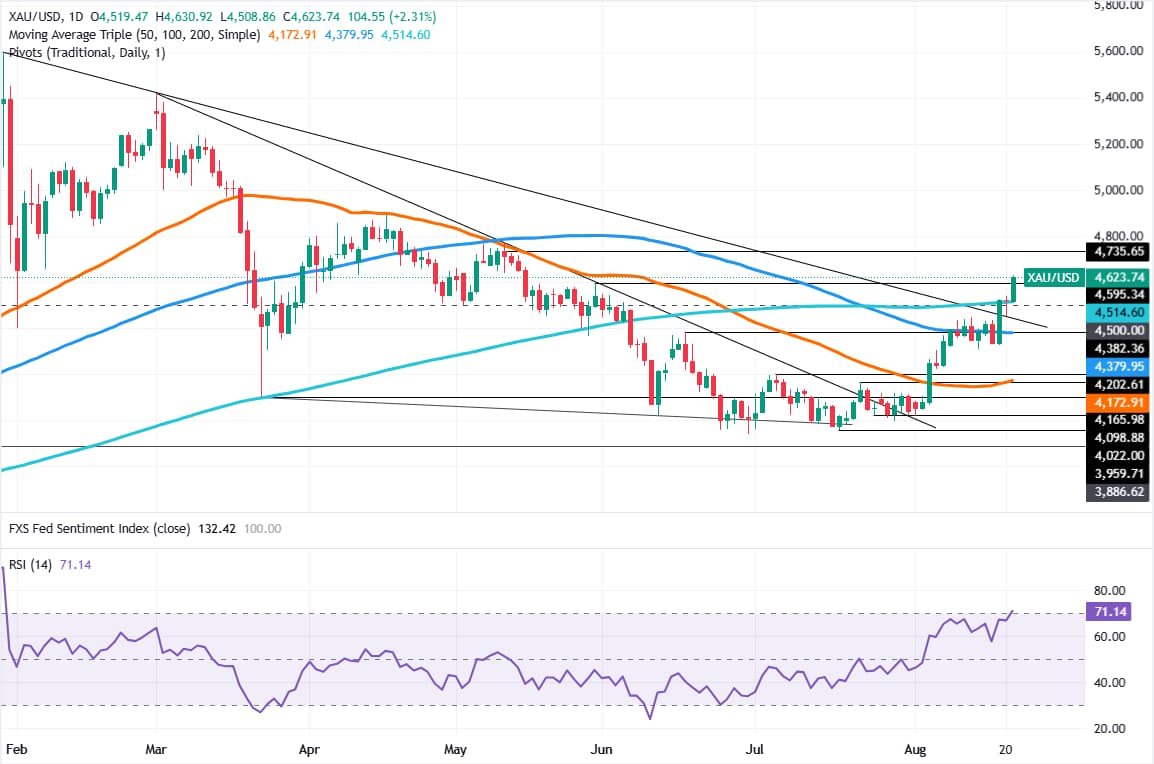
Gold price hits a three-month high and is poised to end the week with gains of over 5.6%, even though business activity in the services sector in the US was solid. Recent developments in the Middle East and a softer US Dollar underpin the yellow metal, which has surpassed the $4,600 threshold. The XAU/USD trades at $4,622, up over 2.3%.
XAU/USD hits three-month high despite strong US services data
The US S&P Global Services PMI in August exceeded estimates of 54 to reach 56.8, the highest since December 2024, and crushed the previous month’s 54.6 print. However, not all is good news: the Manufacturing PMI slowed from 53.9 to 53.2, a five-month low.
Chris Williamson, chief business economist at S&P Global Market Intelligence, said in a statement. “US business is booming, with firms reporting the fastest output growth for over four years so far in the third quarter as the expansion picked up further momentum in August.”
The data was mostly ignored by investors, who continued to digest the bond buyback plan of the US Treasury. Scott Bessent, the US Treasury Secretary, said “an increased focus on fiscal consolidation,” will be the administration’s next strategy.
Bessent added that the government could further expand Treasury buybacks, a day after the department unveiled plans to double buybacks of longer-dated securities.
In the meantime, the US Dollar Index, which tracks the buck’s performance against a basket of six currencies, is somewhat flat near 98.82 but fails to cap the non-yielding metal´s advance.
US Treasury yields have resumed their advance. The US 10-year T-note yield is up 0.8% at 4.75%.
Poland’s central bank slowed Gold buying to 7.8 metric tons in July, data showed on Friday.
Money markets had priced in a 60% chance that the Federal Reserve (Fed) would hold rates unchanged at the September meeting, down from 68% a day ago. The odds for a 25-basis-point rate hike remaining near 40%, revealed Prime Terminal.
XAU/USD technical outlook: Gold buyers eye $4,700 as rally extends
Gold’s trend shifted higher as buyers reclaimed the 200-day Simple Moving Average (SMA) at $4,514, thereby exacerbating a rally above $4,600. Momentum remains bullish as depicted in the Relative Strength Index (RSI). This means Bullion could extend its gains in the near term.
The XAU/USD first resistance is the $4,650 psychologcail level, ahead of $4,700. Once those two levels are taken out, the next stop would be the May 8 high of $4,749, followed by $4,800.
If Gold tumbles below $4,600, the first support is the 200-day SMA at $4,514, ahead of $4,500. Below the next support is the 100-day SMA at $4,379, ahead of $4,300. Below this area, the next support is the 50-day SMA at $4,164.

Gold FAQs
Gold has played a key role in human’s history as it has been widely used as a store of value and medium of exchange. Currently, apart from its shine and usage for jewelry, the precious metal is widely seen as a safe-haven asset, meaning that it is considered a good investment during turbulent times. Gold is also widely seen as a hedge against inflation and against depreciating currencies as it doesn’t rely on any specific issuer or government.
Central banks are the biggest Gold holders. In their aim to support their currencies in turbulent times, central banks tend to diversify their reserves and buy Gold to improve the perceived strength of the economy and the currency. High Gold reserves can be a source of trust for a country’s solvency. Central banks added 1,136 tonnes of Gold worth around $70 billion to their reserves in 2022, according to data from the World Gold Council. This is the highest yearly purchase since records began. Central banks from emerging economies such as China, India and Turkey are quickly increasing their Gold reserves.
Gold has an inverse correlation with the US Dollar and US Treasuries, which are both major reserve and safe-haven assets. When the Dollar depreciates, Gold tends to rise, enabling investors and central banks to diversify their assets in turbulent times. Gold is also inversely correlated with risk assets. A rally in the stock market tends to weaken Gold price, while sell-offs in riskier markets tend to favor the precious metal.
The price can move due to a wide range of factors. Geopolitical instability or fears of a deep recession can quickly make Gold price escalate due to its safe-haven status. As a yield-less asset, Gold tends to rise with lower interest rates, while higher cost of money usually weighs down on the yellow metal. Still, most moves depend on how the US Dollar (USD) behaves as the asset is priced in dollars (XAU/USD). A strong Dollar tends to keep the price of Gold controlled, whereas a weaker Dollar is likely to push Gold prices up.


