







Gold (XAU/USD) clings to modest intraday gains through the Asian session on Thursday, albeit the lack of follow-through buying warrants caution before positioning for any meaningful recovery from a fresh monthly low set the previous day. The US Dollar (USD) enters a bullish consolidation phase following Wednesday’s relatively hawkish Federal Reserve (Fed)-inspired rise to a two-and-a-half-week high and is seen as a key factor acting as a tailwind for the commodity.
As was widely expected, the US central bank held its key policy rate unchanged at 3.50%-3.75%. Notably, the decision saw the highest number of dissents since 1992, with three policymakers voting against the accommodative tone in the policy statement. In the post-meeting press conference, the outgoing Fed Chair Jerome Powell clarified that the debate was about the neutrality of the tone and not the need to hike interest rates. Traders, however, sharply reduced bets on any further easing by the Fed in 2026 and are now pricing in over a 10% chance of a rate increase by the year-end.
The decision comes at a time when the war-driven surge in energy prices has been fueling inflationary concerns amid stalled US-Iran peace talks and favors the USD bulls. In the latest development surrounding the Middle East crisis, US President Donald Trump rejected Iran’s new proposal to end the two-month conflict and reiterated that there will be no peace deal with the Islamic Republic unless it agrees to give up the nuclear program. Trump added that the naval blockade of Iranian ports is adding to the continued disruptions of energy supplies through the Strait of Hormuz.
This, in turn, continues to underpin the Greenback’s reserve currency status and keeps a lid on any meaningful appreciating move for the Gold price. Nevertheless, the XAU/USD pair now seems to have snapped a three-day losing streak and currently trades just above the $4,550 level, up 0.25% for the day. Traders now look forward to the US economic docket, featuring the release of the Advance Q1 GDP report and the Personal Consumption Expenditures (PCE) Price Index. This, along with the Bank of England and the European Central Bank policy updates, should infuse some volatility.
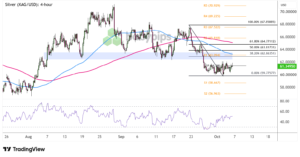
XAU/USD 4-hour chart
Gold seems vulnerable as breakdown below 38.2% Fibo. level remains in play
Against the backdrop of the recent failure to find acceptance above the 200-period Simple Moving Average (SMA) on the 4-hour chart, the overnight break below the 38.2% Fibonacci retracement level of the March-April upswing favors the XAU/USD bears.
Moreover, momentum indicators remain fragile, with the Relative Strength Index (RSI) hovering near 38 and the Moving Average Convergence Divergence (MACD) line still in negative territory. This, in turn, suggests that recovery attempts could struggle while the Gold price stays capped beneath these overhead levels.
On the downside, immediate support is seen at the 50.0% retracement region around $4,494.59, ahead of the deeper Fibonacci floors at $4,401.36 and $4,268.64, with the latter levels marking a broader corrective cushion if selling pressure resumes.
(The technical analysis of this story was written with the help of an AI tool.)
Fed FAQs
Monetary policy in the US is shaped by the Federal Reserve (Fed). The Fed has two mandates: to achieve price stability and foster full employment. Its primary tool to achieve these goals is by adjusting interest rates.
When prices are rising too quickly and inflation is above the Fed’s 2% target, it raises interest rates, increasing borrowing costs throughout the economy. This results in a stronger US Dollar (USD) as it makes the US a more attractive place for international investors to park their money.
When inflation falls below 2% or the Unemployment Rate is too high, the Fed may lower interest rates to encourage borrowing, which weighs on the Greenback.
The Federal Reserve (Fed) holds eight policy meetings a year, where the Federal Open Market Committee (FOMC) assesses economic conditions and makes monetary policy decisions.
The FOMC is attended by twelve Fed officials – the seven members of the Board of Governors, the president of the Federal Reserve Bank of New York, and four of the remaining eleven regional Reserve Bank presidents, who serve one-year terms on a rotating basis.
In extreme situations, the Federal Reserve may resort to a policy named Quantitative Easing (QE). QE is the process by which the Fed substantially increases the flow of credit in a stuck financial system.
It is a non-standard policy measure used during crises or when inflation is extremely low. It was the Fed’s weapon of choice during the Great Financial Crisis in 2008. It involves the Fed printing more Dollars and using them to buy high grade bonds from financial institutions. QE usually weakens the US Dollar.
Quantitative tightening (QT) is the reverse process of QE, whereby the Federal Reserve stops buying bonds from financial institutions and does not reinvest the principal from the bonds it holds maturing, to purchase new bonds. It is usually positive for the value of the US Dollar.


