



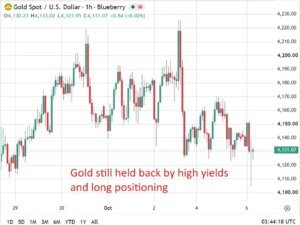



Gold (XAU/USD) edges lower on Friday after the US Nonfarm Payrolls (NFP) report beat expectations, boosting the US Dollar (USD) and reinforcing expectations that the Federal Reserve (Fed) will keep interest rates higher for longer. At the time of writing, XAU/USD is trading around $4,370, its lowest since March.
The US economy added 172K jobs in May, well above expectations of 85K. Meanwhile, April’s payroll figures were revised higher to 179K from 115K, while the Unemployment Rate held steady at 4.3%.
Following the data, the US Dollar Index (DXY), which tracks the Greenback’s value against a basket of six major currencies, climbs to around 99.81 from an intraday low of 99.16, marking its highest level since April 7. US Treasury yields also move higher, with the benchmark 10-year yield rising 8 basis points (bps) to 4.53%.
The stronger-than-expected NFP report supports the case for the Fed to keep rates unchanged – or even hike them – as officials assess the inflationary impact of higher energy prices.
This remains a major headwind for Gold, which tends to perform better in a lower interest-rate environment. According to the CME FedWatch Tool, traders expect the US central bank to keep interest rates in the 3.50%-3.75% range over the coming months, while pricing in a 42% chance of a 25-basis-point (bps) rate hike by the December meeting.
Cleveland Fed President Beth Hammack said on Friday that the latest jobs report “affirms the labor market is roughly in balance.” Hammack also said, “It’s reasonable to keep rates steady for now, but if recent trends continue, it may soon be appropriate to act against high inflation.”
Besides rate expectations, traders continue to monitor developments in the Middle East.
Gold has behaved more like a risk-sensitive asset since the US-Iran war began in late February, falling whenever geopolitical tensions escalate and rebounding whenever hopes of a peace deal gain traction.
Hopes for an imminent US-Iran peace deal appear to be fading after Iran-backed Hezbollah rejected the ceasefire between Israel and Lebanon, with both sides resuming exchanges of fire. Tehran has repeatedly stressed that any agreement with Washington must include a lasting ceasefire in Lebanon.
The metal is still down about 18% from pre-war levels. The drop in Gold has been accompanied by a sharp rise in Oil prices, which has fueled inflation concerns and prompted traders to price out Fed rate cuts this year.
Technical Analysis: XAU/USD breaks below 200-day SMA as bears tighten grip
On the daily chart, XAU/USD extends its bearish phase as spot slips beneath the 200-day Simple Moving Average (SMA) at $4,432 and remains well below the shorter-term 50-day and 100-day SMAs at $4,628 and $4,795, respectively.
The alignment of these major SMAs above price reinforces a downside bias, while the Relative Strength Index (14) near 35 hovers just above oversold territory and the Moving Average Convergence Divergence (MACD) remains in negative territory, both suggesting persistent but stretched bearish momentum.
On the topside, initial resistance is seen at the 200-day SMA around $4,432.A daily close above this area would ease immediate pressure but would still leave the 50-day SMA near $4,628 and the 100-day SMA at $4,795 as subsequent caps.
On the downside, the next notable cushion sits at the horizontal support zone near $4,100, where a break would open the way to deeper losses, while any stabilization above that floor would likely precede a corrective rebound rather than a sustained trend change as long as price trades under the key moving averages.
(The technical analysis of this story was written with the help of an AI tool.)
Gold FAQs
Gold has played a key role in human’s history as it has been widely used as a store of value and medium of exchange. Currently, apart from its shine and usage for jewelry, the precious metal is widely seen as a safe-haven asset, meaning that it is considered a good investment during turbulent times. Gold is also widely seen as a hedge against inflation and against depreciating currencies as it doesn’t rely on any specific issuer or government.
Central banks are the biggest Gold holders. In their aim to support their currencies in turbulent times, central banks tend to diversify their reserves and buy Gold to improve the perceived strength of the economy and the currency. High Gold reserves can be a source of trust for a country’s solvency. Central banks added 1,136 tonnes of Gold worth around $70 billion to their reserves in 2022, according to data from the World Gold Council. This is the highest yearly purchase since records began. Central banks from emerging economies such as China, India and Turkey are quickly increasing their Gold reserves.
Gold has an inverse correlation with the US Dollar and US Treasuries, which are both major reserve and safe-haven assets. When the Dollar depreciates, Gold tends to rise, enabling investors and central banks to diversify their assets in turbulent times. Gold is also inversely correlated with risk assets. A rally in the stock market tends to weaken Gold price, while sell-offs in riskier markets tend to favor the precious metal.
The price can move due to a wide range of factors. Geopolitical instability or fears of a deep recession can quickly make Gold price escalate due to its safe-haven status. As a yield-less asset, Gold tends to rise with lower interest rates, while higher cost of money usually weighs down on the yellow metal. Still, most moves depend on how the US Dollar (USD) behaves as the asset is priced in dollars (XAU/USD). A strong Dollar tends to keep the price of Gold controlled, whereas a weaker Dollar is likely to push Gold prices up.


