





Summary:
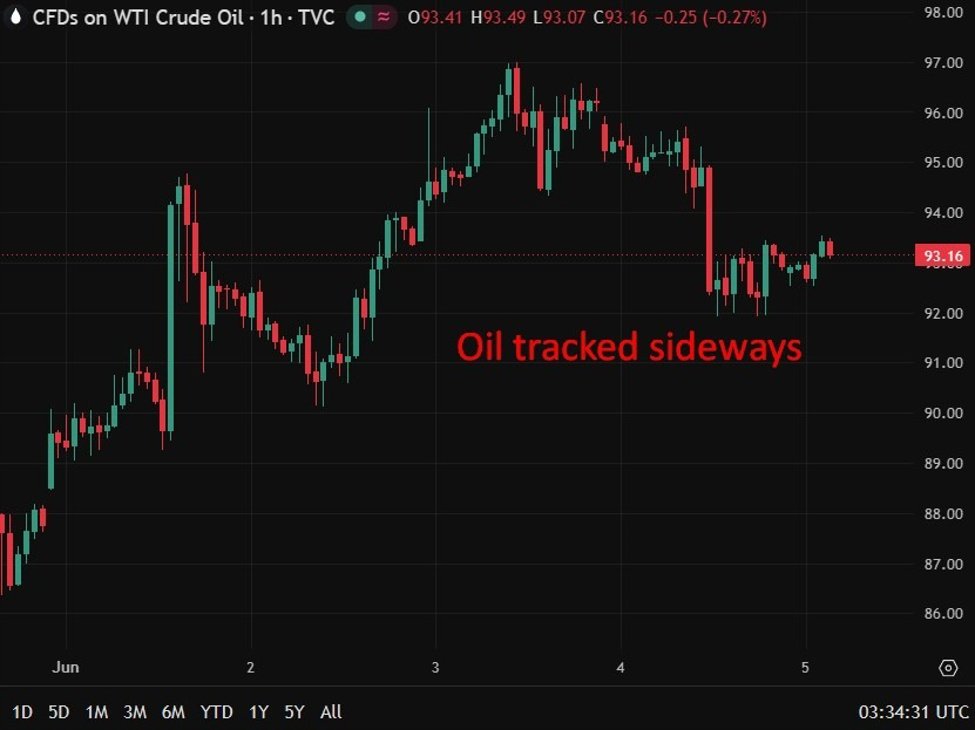
- Explosion reported near Oman’s Mina al Fahal crude terminal on the Gulf of Oman; cause unclear but an alleged drone attack has been cited, extending conflict risk beyond the Strait of Hormuz to open-water export infrastructure, oil tracked broadly sideways
- Japan April real wages rose for a fourth consecutive month, the longest such streak in five years; wages and household spending both beat forecasts, strengthening the BOJ’s case for a rate hike at its June 15-16 meeting
- Finance Minister Katayama renewed yen intervention warnings with USD/JPY around 160; the pair barely moved as dollar trading was broadly subdued ahead of US payrolls later Friday
- Japanese equities fell, with souring tech sentiment cited as the primary drag
- South Korea’s KOSPI deepened losses, falling 6+%, as the Korean won hit its weakest level against the dollar since March 2009; a Labour Minister suggestion that Samsung and AI-boom beneficiaries share excess profits with workers echoed the kind of official commentary that triggered a previous KOSPI slide
- Notus reported that senior Trump administration officials have held discussions with major AI companies including OpenAI about voluntarily ceding equity stakes to the government, with returns potentially distributed to American citizens as an AI dividend
- Hong Kong equities fell after Beijing moved to tighten cross-border capital outflow controls; mainland Chinese stocks held up better, supported by the PBOC resuming open market operations
Asian markets closed out the week on a cautious note, with South Korean equities bearing the sharpest losses as a confluence of domestic political signals and broader risk-off sentiment drove the KOSPI down >6% at one stage. The Korean won deepened its slide against the dollar, hitting its weakest level since March 2009, as selling pressure intensified through the session. The proximate trigger was a suggestion from South Korea’s Labour Minister that Samsung and other companies riding the AI boom should consider distributing a share of the excess profits those gains have produced. It was the kind of official commentary that has rattled Korean markets before, and traders did not wait to find out whether it would be followed by policy action.
The AI profit-sharing theme found an unlikely parallel in a report from US outlet Notus, which revealed that senior Trump administration officials have held preliminary discussions with major artificial intelligence companies, including OpenAI, about the government acquiring voluntary equity stakes in their firms. Under the concept as described, those shareholdings could eventually generate returns distributed directly to American citizens in the form of an AI dividend. The talks are at an early stage and the legal pathway remains unclear, but the emergence of the idea from both Washington and Seoul in the same session underlines how politically charged the distribution of AI wealth is becoming.
Elsewhere in the region, an explosion near Oman’s Mina al Fahal crude terminal added a new dimension to the conflict risk picture. The terminal sits on the Gulf of Oman, outside the Persian Gulf, and an alleged drone attack there, if confirmed, would mark a visible extension of infrastructure targeting beyond the Strait of Hormuz into open-water export facilities. Oman’s role as a back-channel intermediary in US-Iran negotiations gives the incident additional diplomatic weight, and it drew immediate scrutiny from energy traders, shipping markets, and analysts tracking the conflict’s geographic spread. Oil itself tracked broadly sideways, suggesting markets are still waiting for confirmation of cause and impact before repricing.
In Japan, the data flow was constructive. Real wages rose for a fourth consecutive month in April, the longest rising streak in five years, with both nominal earnings and household spending beating forecasts by a meaningful margin. The dataset strengthens the Bank of Japan’s hand ahead of its June 15-16 policy meeting, where a rate hike signal is increasingly in play. Finance Minister Katayama renewed her warning that Tokyo stands ready to take decisive action on the yen, with USD/JPY hovering around 160, though the pair barely moved as the dollar was broadly subdued in pre-payroll trade. Japanese equities fell, with tech sentiment souring in the wake of the KOSPI selloff and broader caution around the AI trade.
Hong Kong stocks declined after Beijing moved to tighten controls on cross-border capital outflows, while mainland Chinese markets held up more steadily, supported by the PBOC’s return to open market operations after a two-day pause that had been read as a deliberate push to redirect idle bank reserves toward the real economy.


