


Weekend:
Summary:
- Trump rejected Iran’s peace response as totally unacceptable; Iran’s counter-proposal demanded war compensation, Hormuz sovereignty and sanctions relief before nuclear talks can begin
- Iran laid out a three-phase framework with sweeping pre-conditions; the U.S. is demanding nuclear concessions upfront, leaving the two sides fundamentally opposed
- Netanyahu confirmed removal of Iranian nuclear material remains a war priority; reports indicate Trump told him he wants to go in on Iranian nuclear sites
- Saudi Aramco warned a Hormuz reopening would take months to normalise markets; Qatar sent its first LNG cargo through the strait since the war began
- China’s April PPI hit a 45-month high of 2.8%, well above forecasts, ending a 41-month deflationary streak; CPI rose 1.2%, both driven by Iran war energy costs
- Beijing confirmed Trump’s state visit to China from May 13 to 15 at Xi Jinping’s invitation
- The USD strengthened on higher oil prices; the yuan outperformed on firmer trade and inflation data
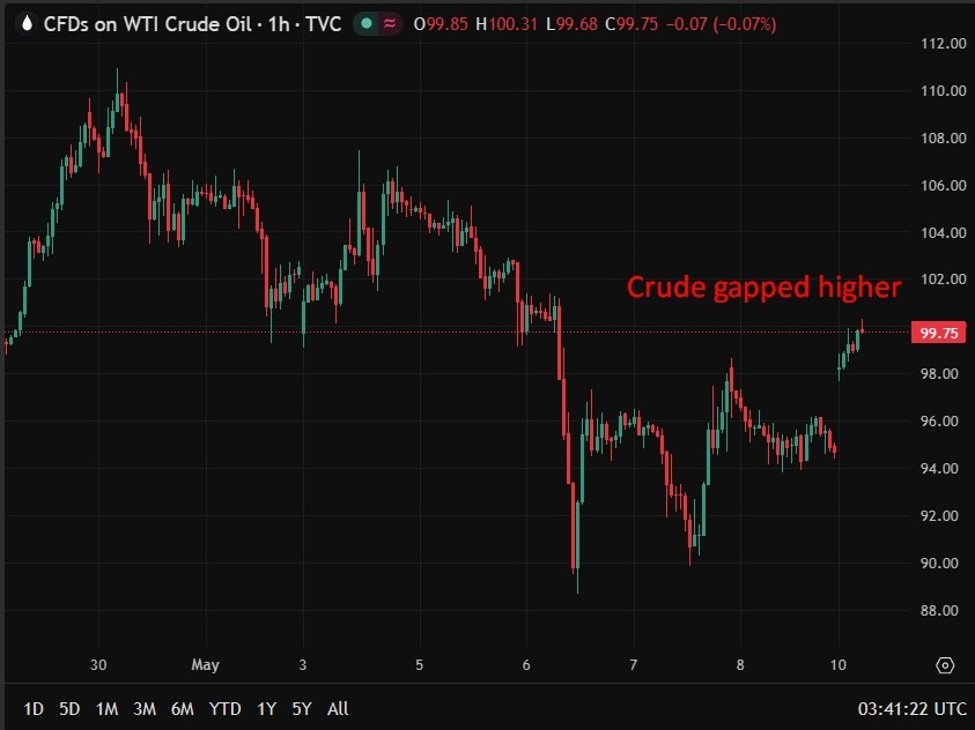
Oil futures pushed higher at the reopen as the U.S.-Iran diplomatic standoff deteriorated sharply, with Trump publicly rejecting Iran’s peace response in a characteristically blunt all-caps post declaring it totally unacceptable, while Tehran’s formal counter-proposal made clear the two sides remain miles apart on the fundamental structure of any potential agreement.
Iran’s response rejected any upfront dismantling of its nuclear facilities, instead proposing a three-phase framework that would require Washington to accept a sweeping list of pre-conditions before talks on war-ending terms could even begin. Those pre-conditions include ending the U.S. naval blockade, restoring Iran’s freedom to export oil, lifting sanctions, releasing frozen Iranian assets, recognising Iranian control of the Strait of Hormuz and treating a Lebanon ceasefire as a non-negotiable red line. Iran’s proposal also stressed the need for U.S. war damage compensation and framed nuclear issues as a matter for a separate post-war agreement, not an upfront concession. Washington’s position remains the opposite: nuclear concessions first, everything else second. The gap between the two frameworks is not a matter of detail but of sequencing and principle, leaving markets with little reason to price in an early resolution.
The escalation in rhetoric around Iran’s nuclear infrastructure added a further layer of risk. Israeli Prime Minister Benjamin Netanyahu confirmed that the removal of Iranian nuclear material remains an active war priority, and separate reports indicated that Trump told Netanyahu directly he wants to go in on Iranian nuclear sites. Neither claim has been independently verified, but their circulation reinforced the view that the conflict’s trajectory may be toward intensification rather than conclusion.
On the supply side, Saudi Aramco provided a sobering assessment of the market’s recovery timeline, warning that even an immediate reopening of the Strait of Hormuz would take months before normal market conditions could be restored, a reminder that the supply damage from the disruption is not simply a tap that can be turned back on. Against that backdrop, Qatar’s first LNG shipment through the strait since the war began offered a rare piece of constructive news, with Pakistan also reported to be in talks with Iran to facilitate further Qatari LNG transits through Hormuz.
China’s April inflation data provided the session’s most significant macro development outside the conflict. Producer prices jumped 2.8% year-on-year, a 45-month high that blew past forecasts, while consumer inflation came in at 1.2%, also above expectations. The data confirms the Iran war’s energy cost shock is transmitting directly and forcefully into the world’s largest manufacturing economy. The complication for Beijing is that this is cost-push inflation rather than the demand-pull variety it has been trying to engineer, narrowing the People’s Bank of China’s room for the aggressive monetary easing that policymakers had been hoping to deploy to address persistent domestic demand weakness.
Beijing also formally confirmed that Trump will make a state visit to China from May 13 to 15 at President Xi Jinping’s invitation, a development that has been anticipated for some time but now carries added weight given the Iran war’s centrality to global energy and geopolitical risk.
In currency markets, the dollar strengthened on the back of higher oil prices, while the yuan outperformed peers, supported by the firmer-than-expected trade and inflation prints released earlier in the day.
The USD was higher on the session, here against the euro.
Regional equites were mixed, a strong lead from Wall Street butting up against heightened concerns over the Gulf.
