





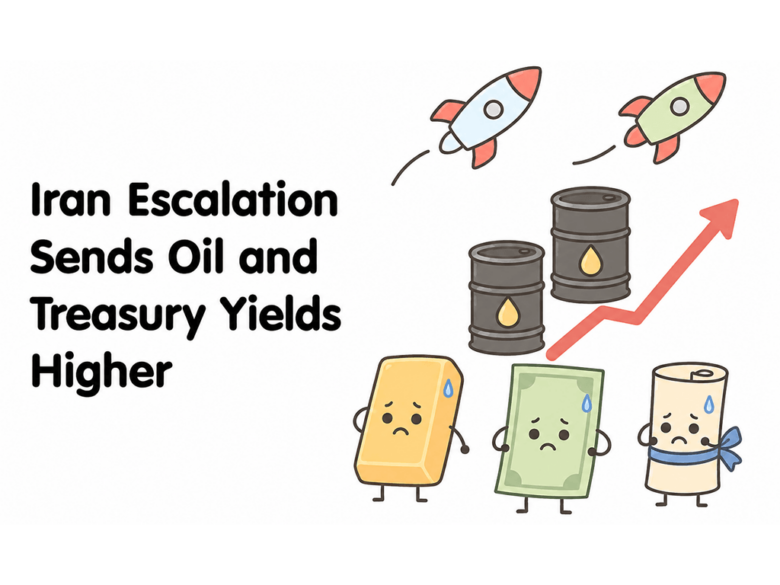
Fighting between the U.S. and Iran flared again this week, with renewed strikes, retaliation, and attacks on two supertankers carrying Saudi crude near Hormuz.
WTI jumped above $90, Treasury yields hit their highest since January 2025, and September Fed hike bets climbed as U.S. stocks slid.
Here’s how the escalation spread through oil, bonds, equities, and the broader market.
How Did the U.S.-Iran Conflict Escalate This Week?
The ceasefire between the U.S. and Iran, signed in June, expired in mid-August without being renewed. For about a week, markets had been betting on economic pressure instead of military escalation.
That changed Sunday, when U.S. forces struck two IRGC rocket launcher positions on Larak Island in the Strait of Hormuz. U.S. officials said Iranian forces were trying to lay new sea mines in waters the U.S. Navy had just cleared. Iran responded by firing missiles at two U.S. airbases in Jordan, though most were reportedly intercepted.
Then came the supertankers. The Sidr and Senegal Prosperity, each reportedly carrying about 2 million barrels of crude, were struck by unknown projectiles near Oman while exiting the Strait on Monday.
The conflict widened further on Tuesday. U.S. CENTCOM confirmed a second round of strikes targeting Iranian air defense systems, radar installations, maritime assets, and communications infrastructure across multiple sites. Iran fired back with missiles and drones aimed at U.S. bases in Jordan and Bahrain.
Speaking to Fox News correspondent Trey Yingst, Trump also warned: “If they do respond, they’ll be hit much harder. This is a very big hit today. If it goes a third time, they’re going to be totally wiped out as a country.”
Duhn duhn duhn.
Promoted: Stay Connected When Markets Move Fast.
When oil jumps above $90 and rate expectations shift within hours, losing your connection can be costly. ForexVPS provides low latency trading servers that keep your platform and automated strategies running around the clock, even when your home internet doesn’t cooperate.
Explore VPS plans at ForexVPS!
Disclosure: To help support our free daily content, we may earn a commission from our partners if you sign up through our links, at no extra cost to you.
An Oil Shock Doesn’t Stay in the Oil Market
Higher energy costs feed directly into inflation. With U.S. inflation already above the Fed’s 2% target, the oil shock raised the odds that interest rates will stay higher for longer.
Fed Governor Michael Barr reinforced that view, saying the Fed could raise rates if inflation doesn’t cool enough. The CME FedWatch Tool even showed September hike odds briefly reaching about 68%.
That repricing appeared first in Treasury yields, which reflect the U.S. government’s borrowing costs. The 10-year Treasury yield climbed to 4.796% Tuesday, its highest since January 2025, as traders prepared for interest rates to stay high or rise further. The U.S. dollar rallied alongside yields.
Stocks felt the pressure through the discount rate, which determines what future earnings are worth today. As that rate rises, growth stocks take the biggest hit because more of their expected earnings lie further in the future. The Nasdaq fell 1.03% Tuesday, while the Russell 2000 dropped 1.23%.
Gold was hit by the same rate repricing. It fell roughly 3% Tuesday after losing more than 3% following Warsh’s Friday speech, bringing its two-session decline to about 6%.
Normally, war risk and inflation fears support gold. But real yields, which are Treasury yields adjusted for expected inflation, were pulling the other way. Since gold pays no interest, Treasury yields near 5% made it less attractive to hold, outweighing its safe haven and inflation hedge appeal.
The Bottom Line
Two shocks are feeding each other, which is why the market moves look so large. The escalation with Iran sent oil and inflation expectations higher just as Warsh’s Friday remarks shifted rate hike bets toward September. Either force could’ve moved markets on its own. Together, they’ve pushed yields higher while dragging stocks and gold lower.
Risk premiums can unwind faster than they build. Late August made that clear when a single round of de-escalation headlines knocked crude down more than 5% in one session. Much of the latest move reflects fears of further disruption, not a complete shutdown of the Strait. That distinction matters when one diplomatic signal from Qatar could change the calculation overnight.
What Should Traders Watch This Week?
- EIA crude inventory report on Wednesday: If the report confirms the American Petroleum Institute’s estimated 2.6 million barrel draw, oil’s rally would gain support beyond the fear premium. A conflicting number would muddy the supply picture.
- Iran widening its attacks to Bahrain and Kuwait: The IRGC warned that it would “no longer exercise restraint” toward those countries. Any confirmed strike would meaningfully expand the conflict.
- Kharg Island: A U.S. strike on Iran’s main oil export terminal would threaten actual oil supplies, not just add a risk premium. Trump’s public remarks have turned that scenario from a theoretical risk into a named possibility.
- Qatar mediation: A credible ceasefire signal is the biggest potential trigger for lower oil prices. Iranian President Pezeshkian has offered to return to the June ceasefire framework. What matters now is whether the White House engages.
- Friday’s NFP report: A strong U.S. jobs report would raise the odds of a September rate hike and keep upward pressure on Treasury yields. That would remain a separate headwind for gold and growth stocks, regardless of what happens in the Strait.
This article traces how the U.S.-Iran escalation rippled through oil, Treasury yields, equities, and gold, but the gold move may not be immediately obvious. Premium members can read our lesson:
Reading this helps you understand real yield dynamics, the opportunity cost of holding gold when Treasury yields are elevated, and why geopolitical risk alone is not always enough to push gold higher.
And if you’re not a Premium subscriber yet, now’s a good time to sign up.
With Babypips Premium, you get full access to School of Pipsology lessons that help you understand not just what the headline number says, but the macro forces behind gold’s price, including how real yields, inflation expectations, and monetary policy interact to move the metal.


