






If you checked trading platforms Sunday evening expecting panic, you saw something stranger: oil up, stocks barely down, bonds falling, Bitcoin rising. Markets don’t follow textbooks when nobody knows what happens next. Here’s what happened this weekend and why mixed signals matter more than clean crashes.
What Happened This Weekend
Over February 28 to March 1, 2026, the U.S. and Israel launched joint strikes on Iran, killing Supreme Leader Ayatollah Ali Khamenei in the largest American military action in the region since the 2003 Iraq invasion.
Iran retaliated massively, striking over 20 U.S. bases across Qatar, Kuwait, Bahrain, Jordan, Saudi Arabia, the UAE, and Iraq. Attacks hit civilian infrastructure including Dubai’s international airport, forcing major Gulf airport closures. Three U.S. service members were killed, at least five seriously wounded.
The biggest market concern? The Strait of Hormuz.
Why a Narrow Waterway Controls Global Oil Prices
The Strait of Hormuz—a 33-kilometer-wide channel between Iran and Oman—might not sound impressive, but about 20 million barrels of oil transit through daily, representing roughly 20% of global supply. Saudi Arabia, Iraq, Kuwait, Qatar, and the UAE all funnel their oil exports through this chokepoint, with 84% heading to Asian markets like China, India, Japan, and South Korea.
Iran didn’t officially close the strait, but commercial operators, oil companies, and insurers withdrew anyway. Ships receive radio warnings from Iran’s Revolutionary Guard, and tanker traffic has effectively stopped. No formal blockade needed—fear did the work.
Promotion:Was your execution clinical or emotional when the oil gap hit?
When markets gap over a weekend, the difference between a pro and an amateur is how they handle the volatility. TradeZella’s trade replay tool lets you revisit your entries tick-by-tick to see if you stuck to your plan or succumbed to “panic-trading.” Identify your behavioral leaks before the next geopolitical shock hits.
Click on the link and use code “PIPS20” to save 20%!
Disclosure: To help support our free daily content, we may earn a commission from our partners if you sign up through our links, at no extra cost to you.
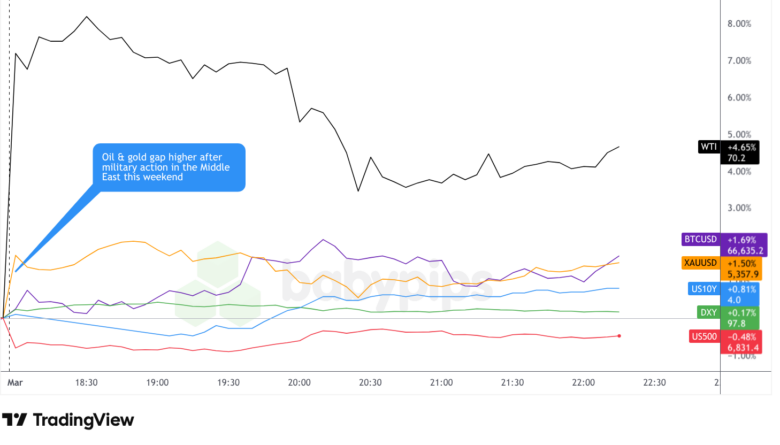
Reading the Chart: A Classic Risk-Off Move
Dollar Index, Gold, S&P 500, Oil, U.S. 10-yr Yield, Bitcoin Overlay – Chart Faster With TradingView
Look at Sunday evening’s price action. This is NOT the clean panic you’d expect from major war. Instead, markets are stuck in uncomfortable limbo. Here’s what each asset reveals:
Oil (WTI – Black Line): +4.65% – That steady grind higher, holding gains after the shock, means traders believe the supply disruption is real and sustained. When oil doesn’t spike and reverse, the market is potentially pricing in prolonged problems.
Gold (XAUUSD – Orange Line): +1.50% – During major crises, gold can jump 3-5%. This modest gain says cautious concern, not panic. Investors want some protection but aren’t scrambling.
S&P 500 (Red Line): -0.48% – Half a percent down during a war that shut the Strait of Hormuz? Suspiciously calm. Markets are either betting on quick resolution or have become numb to geopolitical risk.
Bitcoin (BTCUSD – Purple Line): +1.69% – The real curveball. Bitcoin UP during war completely contradicts the “just a risk asset” narrative. Maybe decentralized assets appeal when nation-states bomb each other. Or crypto traders just buy any volatility.
10-Year Treasury Yield (US10Y – Light Blue): +0.81% – Rising yields mean bonds sold off—backwards for a crisis. Either markets fear oil-driven inflation more than recession, or military spending concerns are building. The traditional safe haven isn’t working.
Dollar Index (DXY – Green Line): +0.17% – Barely-there gains when money should flood into dollars. But the U.S. is directly fighting this war, and oil threatens domestic inflation. The market can’t decide if dollars mean safety or risk.
The Danger of Mixed Signals
This confused reaction is MORE dangerous than a clean crash. When markets tank in unison—stocks, bonds, everything—at least you know what they’re thinking. But oil climbing while stocks barely move, bonds selling off while gold inches up, Bitcoin rallying? That’s the market saying “we have no idea.”
The Other Shoe Problem – Markets that don’t fully react often move harder later. That shallow stock dip could break into real selling once reality hits. Or oil’s gains evaporate when the Strait reopens. You don’t know—neither does anyone else.
Correlations Break – When normal asset relationships fail, hedges stop working. Bought bonds to protect stocks? They fell together. Thought Bitcoin was digital gold? It moved opposite. Trading with broken correlations is like driving when traffic lights malfunction.
Volatility From Anywhere – With this much uncertainty, big moves can come from any direction: oil spikes 10% on escalation, stocks crash 3% on delayed fear, Bitcoin reverses and plunges, gold surges. All possible, none priced in.
Why This Matters for New Traders
This weekend’s confused reaction teaches lessons textbooks skip:
Markets Don’t Always React “Correctly” – You can study risk-on/risk-off patterns forever and still get blindsided when markets ignore the playbook. Market reactions depend on positioning, competing narratives, and factors invisible from your screen.
Confusion Beats Fear – A panicked market is scary but directional. A market that can’t decide what to do with a major war? That’s when sharp, unexpected moves hurt most. Low volatility followed by sudden spikes damages more traders than sustained high volatility.
Supply Shocks Break Normal Rules – When a fifth of global oil supply gets threatened, traditional analysis fails. You can’t cut rates out of tankers being too scared to sail through a war zone.
Size Matters More Than Direction – When you don’t know which way markets break, being right won’t save you if sized too large. Pros survived Sunday not by predicting Bitcoin rallies or shallow stock declines, but by sizing to survive being wrong.
What Comes Next
President Trump stated that the operation could take “four weeks or less”, though analysts are skeptical. The market’s muted reaction suggests three scenarios in play:
Quick Resolution – Markets bet on rapid de-escalation within days, explaining the shallow stock decline. If correct, oil prices reverse quickly.
Slow Burn – Conflict continues but stays contained, with sporadic attacks and a semi-functional Strait. This keeps oil elevated but stable.
Delayed Shock – Markets haven’t grasped the severity yet. If the Strait stays closed for weeks, we could see the panic move that hasn’t materialized.
Key variables to watch: tanker traffic data, insurance premiums for Gulf transit, escalation headlines, oil inventory drawdowns, and any diplomatic progress.
The Bottom Line
This weekend’s market action teaches something more valuable than textbook scenarios: uncertainty is harder to trade than fear.
When markets panic, you know what they’re thinking. But when oil climbs steadily while stocks barely budge, bonds sell off while gold edges higher, and Bitcoin does its own thing—that’s the market admitting it has no idea what comes next.
For new traders: your support levels, wave counts, and backtested strategies assume rational, predictable markets. When a fifth of global oil supply is threatened and markets shrug with a 0.5% decline, normal rules don’t apply.
Professionals who survive these periods don’t have better predictions—they have better risk management. They size to survive being spectacularly wrong. They don’t chase headlines when price action conflicts. And they never double down because “the market has to realize how serious this is.”
If your “obvious” trades didn’t work this weekend—long gold barely moved, short stocks scratched minor gains, short Bitcoin became a loser—welcome to real trading. The market prices probabilities across multiple scenarios, not certainties from headlines.
Stay safe, keep positions small when nothing makes sense, and remember: confused markets create confused traders, and confused traders make expensive mistakes.
Promotion: Your macro thesis is solid—now get the capital to back it up.
If you’ve identified the “risk-off” rotation but are restricted by a small account balance, Maven Trading can help. They provide simulated funding challenges starting at just $13, allowing you to trade major commodity and forex moves with professional-sized capital.
Learn More About Maven Trading Today!
Disclosure: We may earn a commission from our partners if you sign up through our links, at no extra cost to you.


