


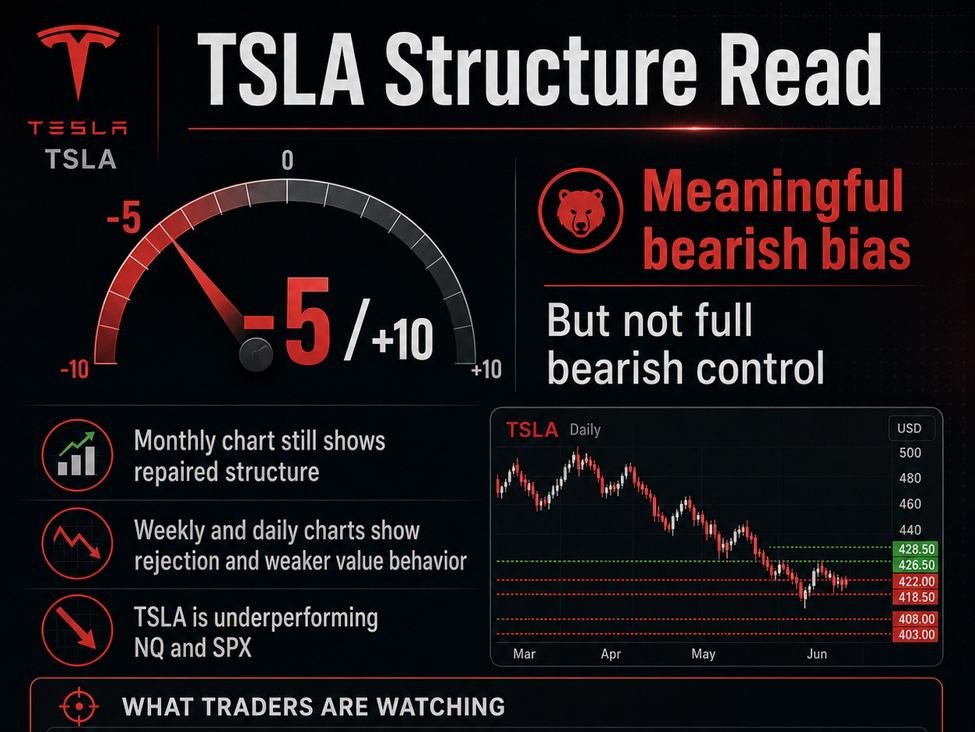
Tesla stock analysis today shows a final Structure Read score of -5 / +10, pointing to a meaningful bearish bias but not full bearish control. TSLA remains repaired on the monthly chart, but the weekly and daily structure now show upper-zone rejection, weaker value behavior, and relative underperformance versus NQ and SPX.
Key takeaways for Tesla stock investors and traders
- Final TSLA score: -5 / +10, meaning bearish pressure is active but not extreme.
- Primary bias: Tactical bearish while TSLA remains below $422-$418.50.
- First bullish repair zone: $426.50-$428.50.
- Main bullish repair zone: $439.50-$447.50.
- Stronger bearish confirmation: Sustained break below $408-$403.
- Main downside value target if support breaks: $392.50, followed by $389.50-$383.50.
Tesla is not in a clean higher-timeframe bearish breakdown, but the current setup is no longer attractive for fresh longs unless buyers repair the lost value zones. The stock rallied strongly after earnings, reached an upper post-earnings area, and then showed a clear seller response.
The main message is simple: TSLA’s monthly structure is still repaired, but the weekly and daily layers have turned meaningfully weaker.
What is the Tesla stock prediction score today?
Before we dive in, the market itself did not finish bullish, if I can say the least, as you probably know. U.S. equity markets triggered a sharp risk-off wave led by a 1.5% drop in the Nasdaq, fueled by escalating geopolitical tensions in Iran and unimpressive headlines out of China, forcing major U.S. indices to open sharply lower. This equity flush coincided with a massive bond market rout that pushed the 10-year Treasury yield to a near one-year high as Treasury yields jumped across the curve, a turbulent backdrop marking the moment Powell exits after one of the wildest Fed eras in history.
The current Tesla stock structure score is:
| Metric | Reading |
|---|---|
| Final Structure Read score | -5 / +10 |
| Bias | Meaningfully bearish |
| Confidence | Medium to Medium-High |
| State label | Late post-earnings repair into upper-zone rejection |
| Best stance | Avoid fresh longs unless repair is confirmed |
A score of -5 / +10 means TSLA has a bearish short-to-intermediate-term setup, but the signal is not bearish enough to call it a full breakdown. The monthly chart still prevents a deeper bearish score because price remains above important higher-timeframe value references.
What this means: On the investingLive -10 to +10 scale, a negative score shows bearish pressure. A score near -5 suggests the bearish case is actionable, but still needs confirmation from key support breaks.
Why did Tesla’s Structure Read turn bearish?
Tesla’s Structure Read turned bearish because the stock failed to hold higher value after a strong post-earnings repair. TSLA pushed into an upper resistance area, but buyers did not maintain control there. Instead, the latest structure shows signs of seller response, lower value acceptance, and weaker price behavior versus major benchmarks.
The important takeaway is not the individual order-flow details, but the higher-level shift:
| Structure element | Current read |
|---|---|
| Monthly chart | Still repaired, not aggressively bearish |
| Weekly chart | Upper-zone rejection risk |
| Daily chart | Seller response and weakening value behavior |
| Benchmark context | TSLA weaker than NQ and SPX |
| Tradeability | Fresh longs require repair confirmation |
This type of setup often appears when a stock has already recovered strongly after earnings, but then fails to sustain acceptance near the upper part of its post-event range. In that case, the market may rotate from “repair mode” into “distribution risk” or “profit-taking pressure.”
What this means: When a stock repairs after earnings but then rejects an upper value area, traders should watch whether buyers can quickly reclaim lost levels. If they cannot, the prior recovery may become vulnerable to a deeper pullback.
What are the key Tesla support and resistance levels today?
The most important TSLA levels are:
| Zone | Level | Why it matters |
|---|---|---|
| Immediate pressure zone | $422-$418.50 | Current bearish pressure area |
| First bullish repair zone | $426.50-$428.50 | First area buyers need to reclaim |
| Main upper-value repair zone | $439.50-$447.50 | Important resistance and prior higher-value area |
| Bearish rejection invalidation | $453.40 | Post-earnings high |
| Stronger bearish confirmation | $408-$403 | Broader support and confirmation zone |
| First downside value target | $392.50 | Important higher-timeframe value reference |
| Deeper downside cluster | $389.50-$383.50 | Prior value cluster |
| Post-earnings reference | $373.72 | Important event-related reference |
| Lower post-earnings range | $364.02 | Lower end of the post-earnings range |
The first area Tesla needs to reclaim is $426.50-$428.50. That would reduce immediate seller-control pressure. However, a stronger bullish repair would require acceptance above $439.50-$447.50.
Why is $426.50-$428.50 important for Tesla stock?
The $426.50-$428.50 zone is important because it represents Tesla’s first short-term repair area after the latest rejection.
If TSLA reclaims and holds above this zone, it may reduce immediate downside pressure. If price rallies into this area and fails, the zone may become resistance and a tactical short re-entry area.
Scenario: If buyers reclaim $428.50 and hold above it, TSLA could attempt a repair toward $439.50-$447.50. If the reclaim fails, the bearish structure remains active.
What this means: A repair zone is an area where buyers need to prove that recent selling pressure is being absorbed. A quick reclaim can signal stabilization, while repeated rejection can confirm that sellers still control the short-term structure.
Why is $439.50-$447.50 the main Tesla bullish repair zone?
The $439.50-$447.50 zone is the main bullish repair area because it represents the upper value region where TSLA recently failed to sustain acceptance.
This matters because the market already tested that higher area. The problem is that price could not hold it. For the bearish thesis to weaken materially, TSLA needs to reclaim this zone and hold above it.
| Bullish repair level | Interpretation |
|---|---|
| $439.50-$447.50 | Main area buyers need to reclaim |
| Above $447.50 | Stronger bullish repair signal |
| Above $453.40 | Likely invalidates the current rejection read |
A sustained move above $447.50 would be a stronger bullish signal. A sustained break above $453.40 would likely invalidate the current upper-zone rejection read.
What would confirm a deeper bearish move in Tesla stock?
A sustained break below $408-$403 would confirm a stronger bearish phase for TSLA.
This zone matters because it represents a broader daily and weekly support area. Losing it would suggest Tesla is no longer just rejecting the upper post-earnings zone. It would show that the stock is losing the broader repair structure.
If $408-$403 breaks and holds lower, the next downside value areas are:
- $392.50 – important higher-timeframe value reference
- $389.50-$383.50 – prior value cluster
- $373.72 – post-earnings reference
- $364.02 – lower end of the post-earnings range
Scenario: If TSLA remains below $422-$418.50 and then breaks below $408-$403, bearish continuation becomes more credible.
How does Tesla compare with NQ and SPX?
Tesla is underperforming both NQ and SPX in the latest daily and weekly context.
| Instrument | Latest behavior | Interpretation |
|---|---|---|
| TSLA | Sharper decline and weaker close | Stock-specific weakness |
| NQ | Pulled back, but less severely | Benchmark healthier than TSLA |
| SPX | Softer, but still stronger than TSLA | Broader market not as weak |
TSLA’s weakness is not only a broad market issue. The stock has been behaving worse than the technology benchmark and the broader equity benchmark, which strengthens the bearish interpretation.
What this means: Relative weakness occurs when a stock falls more than its benchmark. For Tesla, this suggests the latest pressure includes a stock-specific component, not only market beta.
TSLA Stock Technical Analysis on the Daily Chart: Rejects Historic Earnings Highs as Trapped Buyers Fuel Aggressive Value Area Flush
My simple and effective TSLA stock analysis on 1D chart
Based on my daily chart above, we are looking at a classic example of institutional distribution and aggressive seller control using Anchored Volume Profiles (AVPs).
When price moves quickly through these structural key levels without finding responsive buyers, it signals strong initiative selling and a heavy bearish bias. Here is a breakdown of exactly what is happening under the hood across those three marked zones.
1. The Failed Test & Rejection from the Old VAH (Point 1)
-
The Setup: The left-hand volume profile is anchored to an earnings period from late 2025. The orange line (labeled 1) represents the Value Area High (VAH) of that entire multi-month auction. This line marks the upper boundary of where 70% of the volume was traded during that period—essentially the limit of what the market accepted as “fair value.”
-
The Price Action: As TSLA rallied aggressively in May, it approached this orange line but reversed before even genuinely testing it.
-
The Market Mechanics: When price fails to reach a major historical level like an anchored VAH, it shows a severe lack of momentum or “buying exhaustion.” Insiders and large institutional sellers didn’t even wait for price to hit the exact level to supply the market; they started absorbing buy orders early, actively defending the old high-value structure.
2. Crossing Below the Historic POC (Point 2)
-
The Setup: The red line (labeled 2) marks the Point of Control (POC) of that same older anchored volume profile. The POC represents the absolute highest concentration of volume (the single heaviest price shelf) from that entire period.
-
The Price Action: Price cleanly sliced back down right through this level.
-
The Market Mechanics: In market microstructure, a historical POC acts as a massive magnet and a pivot of major support or resistance. Slicing back down through it means the market is actively rejecting that old, heavy acceptance zone. Instead of buyers stepping in to defend the historical “fair value” line, sellers pushed right through it, converting what should have been major structural support into overhead supply.
3. Acceptance Back into the Recent Value Area (Point 3)
-
The Setup: The second volume profile is anchored to the previous earnings period (late January 2026). The blue line (labeled 3) represents the Value Area High (VAH) of this more recent trading chunk.
-
The Price Action: The latest daily candle has crossed under this blue line and entered deep into the interior of this more recent value area.
-
The Market Mechanics: Entering a previous value area from above is a highly reliable bearish trigger often referred to as a Value Area Look-Above-and-Fail. Because price could not sustain itself above the blue line, it is now accepted back into the high-volume cluster below. The expectation here is that price will now seek liquidity inside this lower auction, with the recent profile’s interior red line (its own POC around $395) or the lower value boundaries becoming the logical targets.
The Velocity Factor: Why Speed Amplifies the Bearish Bias
The fact that this entire reversal from point 1 to point 3 happened “quite quickly”—spanning just a few daily candles—is structurally significant:
-
Initiative Selling vs. Responsive Selling: Slow, grinding pullbacks often indicate profit-taking or standard mean reversion. Fast, vertical drops through major volume shelves indicate Initiative Selling. This is where large funds are market-executing sell orders to get out or hedge positions rapidly.
-
Trapped Longs: Because the move down was swift, the traders who bought the aggressive May breakout above the blue line (Point 3) had no time to exit gracefully. They are now officially trapped buyers holding positions at a loss. As price moves deeper into the value area, their liquidations and stop-losses will act as automatic sell-side fuel, adding further downside pressure to the asset.
-
This is a unique and original investingLive.com stock idea of TSLA and readers are welcome to view other ideas at TradingView’s stock ideas for TSLA
How does the earnings context affect Tesla’s current setup?
Tesla last reported earnings on April 22, 2026 AMC. The stock initially reacted lower, then repaired strongly.
The key point is that TSLA already produced a meaningful post-earnings recovery before sellers appeared near the upper zone. That makes the long side less fresh and reduces the appeal of chasing new longs without confirmation.
| Earnings context | Current interpretation |
|---|---|
| Initial earnings reaction | Weak first response |
| Post-earnings behavior | Strong repair followed by upper-zone rejection |
| Current read | Repair is still visible, but momentum has deteriorated |
| Trading implication | Buyers need to reclaim lost value before the long side improves |
What this means: After earnings, a stock can repair from an initial negative reaction and still later become vulnerable if it fails near the upper part of its post-event range. Traders should distinguish between a real repair and a fresh bullish continuation signal.
What is the bullish scenario for TSLA?
The bullish scenario requires Tesla to repair lost value quickly.
A bullish repair would require:
- Reclaim $426.50-$428.50
- Hold above that zone without immediate rejection
- Push back toward $439.50-$447.50
- Show improving buying pressure
- Ideally outperform NQ during the repair attempt
| Bullish trigger | Level |
|---|---|
| First bullish repair | Sustained reclaim above $428.50 |
| Stronger bullish confirmation | Sustained reclaim above $447.50 |
| Bearish thesis invalidation | Sustained break above $453.40 |
Until those conditions appear, the bullish case remains only a repair attempt, not a fresh bullish continuation signal.
What is the bearish scenario for TSLA?
The bearish scenario is already active tactically, but it becomes stronger if Tesla fails to reclaim the latest repair zone.
Bearish continuation is favored if:
- TSLA remains below $422-$418.50
- Rallies toward $426.50-$428.50 fail
- TSLA continues to lag NQ and SPX
- Price breaks below $408-$403
- Value continues to migrate lower
| Bearish trigger | Level |
|---|---|
| Tactical bearish pressure | Below $422-$418.50 |
| Failed repair area | Rejection at $426.50-$428.50 |
| Stronger bearish confirmation | Sustained break below $408-$403 |
| Downside value target 1 | $392.50 |
| Downside value target 2 | $389.50-$383.50 |
The bearish case is not yet full bearish control because the monthly chart remains repaired. But the weekly and daily structures currently argue against chasing the long side.
Is Tesla stock a buy or sell today?
Tesla is not an attractive fresh long unless it reclaims and accepts above $426.50-$428.50, with stronger confirmation above $439.50-$447.50.
The tactical read favors caution or bearish positioning while TSLA remains below $422-$418.50, especially if rallies into $426.50-$428.50 fail. A stronger bearish setup would require a sustained break below $408-$403.
This is a scenario-based read, not a prediction guarantee. Traders should define their own risk, avoid overtrading, and wait for sustained acceptance rather than reacting to the first crossover of a level.
Today’s summary for Tesla stock investors and traders
Tesla’s latest Structure Read is bearish, with a final score of -5 / +10. The stock remains repaired on the monthly chart, but the weekly and daily layers now show upper-zone rejection, weaker value behavior, and relative weakness versus both NQ and SPX.
The first key test is $426.50-$428.50. A reclaim would reduce immediate bearish pressure, while a failed rally into that zone keeps sellers in control. The more important downside confirmation sits at $408-$403. If that zone breaks, TSLA could open a deeper path toward $392.50 and the prior value cluster near $389.50-$383.50.
For now, the cleanest read is that TSLA’s post-earnings repair was real, but it has become mature. The burden is now on buyers to reclaim lost value. Always do your own research and invest or trade TSLA stock at your own risk only. The above is for educational purposes only.
Why Tesla investors are watching Elon Musk’s China visit
How does the latest visit of Elon Musk affect TSLA investors
Investors may be wondering whether Elon Musk’s latest China visit, around the Trump-Xi meeting, can change the outlook for Tesla stock. The short answer: it may help sentiment, but investors still need to separate diplomatic headlines from confirmed business progress.
1. FSD approval in China remains the big potential catalyst
For Tesla investors, the main question is whether China will eventually allow a wider rollout of Tesla’s Full Self-Driving software.
Why it matters: Tesla already sells cars in China, but FSD could add a new software revenue stream on top of vehicle sales. That is important because software can carry higher margins than selling cars, and Tesla’s core EV business in China is under heavy pressure from local competitors such as BYD.
In simple terms: if Tesla can sell FSD subscriptions in China, it could help support profits and investor confidence. But until regulators give a clear green light, this remains a potential catalyst, not a confirmed win.
2. Musk’s presence may signal better political access
Musk’s appearance alongside President Donald Trump’s diplomatic and corporate delegation may also matter because Tesla is not just a car company. It depends on China for sales, manufacturing, suppliers, and regulatory approvals.
For younger or newer investors, the key idea is simple: when a CEO has strong access to major political leaders, markets often treat that as a possible advantage. It does not guarantee approvals or better terms, but it can reduce fears that the company is being locked out of an important market.
If the meetings with Chinese leadership are followed by a friendlier regulatory tone, investors may view that as positive for Tesla. If nothing concrete follows, the market may treat it more as headline excitement than a real business catalyst.
3. Tesla still needs a stable China supply chain
China is also critical to Tesla’s manufacturing and supply chain. Tesla depends on Chinese suppliers, factories, and cost advantages to keep production efficient.
This matters because even small disruptions in batteries, components, factory equipment, or export rules can affect margins. For Tesla, protecting the China supply chain is not only about growth – it is also about defending profitability.
In simple terms: Tesla needs China not just to sell more cars, but also to keep making cars efficiently and at competitive cost.
So, why do TSLA stock investors care?
Musk’s China visit may improve sentiment around Tesla, especially if investors believe it increases the chances of FSD approval, smoother regulation, and supply-chain stability. But for now, investors should treat it as a potential supportive factor rather than a confirmed bullish catalyst. The key will be whether the visit leads to real regulatory progress, especially around FSD in China.
Buy or sell TSLA stock? The quick FAQ!
- What is the Tesla stock prediction score at investingLive.com (17 May 2026)?
Tesla’s current Structure Read score is -5 / +10, signaling a meaningful bearish bias but not full bearish control. - What are the key Tesla support and resistance levels today?
Key TSLA levels are $422-$418.50 for immediate pressure, $426.50-$428.50 for first bullish repair, $439.50-$447.50 for stronger repair, and $408-$403 for deeper bearish confirmation. - Why is $426.50-$428.50 important for TSLA?
The $426.50-$428.50 zone is the first repair area buyers need to reclaim to reduce immediate seller-control pressure. - What would confirm a deeper bearish move in Tesla stock?
A sustained break below $408-$403 would confirm a stronger bearish phase and open the path toward lower value targets. - Is Tesla stock a buy or sell today?
TSLA is not an attractive fresh long unless it reclaims lost value, while the tactical read remains bearish below $422-$418.50.
You must always do your own research if you are considering to buy or sell Tesla stock as the above is for educational purposes only. Visit investingLive.com as well as other websites for additional perspectives.
