






- The Japanese Yen attracts fresh sellers amid BoJ uncertainty and positive risk tone.
- The divergent BoJ-Fed expectations should limit losses for the lower-yielding JPY.
- The technical setup backs the case for a further appreciating move for USD/JPY.
The Japanese Yen (JPY) struggles to capitalize on the previous day’s recovery move from over a one-week low touched against its American counterpart and drifts lower during the Asian session on Wednesday. The uncertainty over the likely timing of the next interest rate hike by the Bank of Japan (BoJ), along with the underlying bullish sentiment, acts as a headwind for the safe-haven JPY.
Investors, however, seem convinced that the BoJ will stick to the policy normalization path. In contrast, the Federal Reserve (Fed) is expected to cut interest rates in September, and the bets were reaffirmed by the broadly in-line July US consumer inflation figures on Tuesday. This keeps the US Dollar (USD) depressed near a two-week low and should offer some support to the lower-yielding JPY.
Japanese Yen bears regain control amid positive risk tone and BoJ uncertainty
- The Bank of Japan revised its inflation forecast at the end of the July meeting and reiterated that it will raise interest rates further if growth and inflation continue to advance in line with its estimates. However, domestic political uncertainty, concerns about the negative economic impact of higher US tariffs, and a continuous fall in Japan’s real wages suggest that the prospects for further BoJ policy normalization could be delayed.
- Meanwhile, data released this Wednesday showed that Japan’s Corporate Goods Price Index (CGPI) climbed 2.6% in July from a year earlier, down from a 2.9% increase in the previous month. However, a rise in the wholesale prices of food and agricultural goods points to signs of broadening inflationary pressure, which keeps alive market expectations for an imminent interest rate hike by the BoJ by the end of this year.
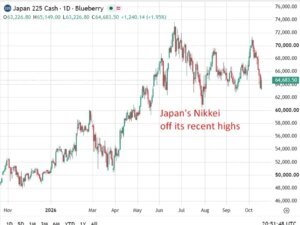
- The S&P 500 and the Nasdaq posted record closing highs on Tuesday. The spillover effect remains supportive of the upbeat market mood and pushes Japan’s Nikkei225 to the 43,000 mark for the first time ever on Wednesday. This, along with the BoJ rate-hike uncertainty, prompts fresh selling around the safe-haven Japanese Yen following the overnight bounce from a one-week low touched against the US Dollar.
- The USD Index (DXY), which tracks the Greenback against a basket of currencies, consolidates Tuesday’s downfall amid the growing acceptance that the Federal Reserve will resume its rate-cutting cycle next month. The bets were reaffirmed by mostly in line US consumer inflation figures released on Tuesday. This, in turn, might hold back traders from placing aggressive bullish bets around the USD/JPY pair.
- The US Bureau of Labor Statistics reported that the headline Consumer Price Index (CPI) remained unchanged at 2.7% on a yearly basis in July. On a monthly basis, the CPI and the core CPI rose by 0.2% and 0.3%, respectively, to match analysts’ estimates. However, the core gauge, which excludes food and energy prices, came in above market estimates and increased to the 3.1% YoY rate from the 2.9% in June.
- The data support the view that recent tariff-related price pressures will be largely transitory. This, along with signs of deteriorating US labor market conditions and that the economy could be weakening, reinforces the narrative for a September interest rate cut by the Fed. Moreover, traders are currently pricing in a higher probability that the Fed will lower borrowing costs at least twice by the year-end.
- There isn’t any relevant market-moving economic data due for release from the US on Wednesday, leaving the USD at the mercy of speeches from a slew of influential FOMC members. The market focus will then shift to the US Producer Price Index, due on Thursday, which will be followed by the Preliminary Q2 GDP print from Japan on Friday and could infuse some volatility around the USD/JPY pair.
USD/JPY technical setup backs the case for further gains towards reclaiming the 149.00 mark
From a technical perspective, spot prices showed some resilience below the 147.75 resistance-turned-support for the second straight day. Moreover, the emergence of some dip-buying suggests that the path of least resistance for the USD/JPY pair is to the upside. Hence, a subsequent move towards the overnight swing high around the 148.50-148.55 area, en route to the 149.00 round figure, looks like a distinct possibility.
On the flip side, weakness below the Asian session low, around the 147.70 region, might still be seen as a buying opportunity near the 147.00 mark and remain limited near the 146.80 support. The latter represents the 200-period Simple Moving Average (SMA) on the 4-hour, which, if broken, could make the USD/JPY pair vulnerable to test sub-146.00 levels and slide further to the 145.00 psychological mark.
Bank of Japan FAQs
The Bank of Japan (BoJ) is the Japanese central bank, which sets monetary policy in the country. Its mandate is to issue banknotes and carry out currency and monetary control to ensure price stability, which means an inflation target of around 2%.
The Bank of Japan embarked in an ultra-loose monetary policy in 2013 in order to stimulate the economy and fuel inflation amid a low-inflationary environment. The bank’s policy is based on Quantitative and Qualitative Easing (QQE), or printing notes to buy assets such as government or corporate bonds to provide liquidity. In 2016, the bank doubled down on its strategy and further loosened policy by first introducing negative interest rates and then directly controlling the yield of its 10-year government bonds. In March 2024, the BoJ lifted interest rates, effectively retreating from the ultra-loose monetary policy stance.
The Bank’s massive stimulus caused the Yen to depreciate against its main currency peers. This process exacerbated in 2022 and 2023 due to an increasing policy divergence between the Bank of Japan and other main central banks, which opted to increase interest rates sharply to fight decades-high levels of inflation. The BoJ’s policy led to a widening differential with other currencies, dragging down the value of the Yen. This trend partly reversed in 2024, when the BoJ decided to abandon its ultra-loose policy stance.
A weaker Yen and the spike in global energy prices led to an increase in Japanese inflation, which exceeded the BoJ’s 2% target. The prospect of rising salaries in the country – a key element fuelling inflation – also contributed to the move.


