Canada‘s April inflation report showed headline CPI accelerating to 2.8% (y/y) — its fastest pace since May 2024 — as the U.S.-Iran war continued to drive gasoline prices sharply higher and last year’s carbon levy removal dropped out of the annual comparison.
Statistics Canada reported that the consumer price index rose 0.4% (m/m) in April, lifting the annual rate from 2.4% in March to 2.8%, with a 28.6% (y/y) surge in gasoline prices accounting for the bulk of the acceleration. The monthly print also missed the 0.7% forecast, and on a seasonally adjusted basis, the CPI gained a more modest 0.3%.
Critically for the Bank of Canada (BOC), the energy shock showed limited pass-through into underlying prices. CPI-trim eased to 2.0% (y/y) from 2.2%, reaching its 2% target for the first time in more than five years, while CPI-median slipped to 2.1% from 2.3%, and CPI excluding food, energy and indirect taxes fell to just 1.5% (y/y), a five-year low.
Key Takeaways
- Headline CPI rose to 2.8% (y/y) in April, up from 2.4% in March, but came in well below the 3.1% consensus forecast
- CPI excluding food, energy and indirect taxes fell to 1.5% (y/y), its lowest since March 2021
- Monthly CPI gained 0.4% (m/m), below the 0.7% forecast; on a seasonally adjusted basis, the monthly increase was 0.3%
- The BOC’s preferred core measures eased: CPI-trim fell to 2.0% (y/y), on target for the first time in more than five years
- CPI-median slipped to 2.1% (y/y); the average of the two hit 2.05%, its lowest since January 2021
- Gasoline prices surged 28.6% (y/y) after a 5.9% gain in March, driven by war-related supply disruptions, the seasonal shift to summer blends and a base-year effect from last year’s carbon levy removal; energy prices rose 19.2% (y/y) overall, with fuel oil and other fuels up 41.3%
- Natural gas fell just 2.4% (y/y), a far smaller decline than the 18.1% drop in March as the carbon levy base effect faded; transportation costs rose 7.6% (y/y), their highest since November 2022
- Food prices eased to 3.5% (y/y) from 4.0%, with food purchased from stores up 3.8%, down from 4.4%
- Rent rose 3.6% (y/y), slowing from 4.2% in March, its slowest pace since January 2022; mortgage interest costs fell 0.1% (y/y), the first annual decline since mid-2022
Link to official Statistics Canada Consumer Price Index (April 2026)
Analysts widely characterized the report as a supply shock with only minor spillovers to core inflation, supporting the case for the BOC to remain on hold at its current 2.25% rate.
The broader view was that without the conflict, the conversation would be about cuts rather than hikes. Markets were pricing roughly 50 basis points of tightening for all of 2026 after the release, down from 54 basis points before the data.
Market Reactions
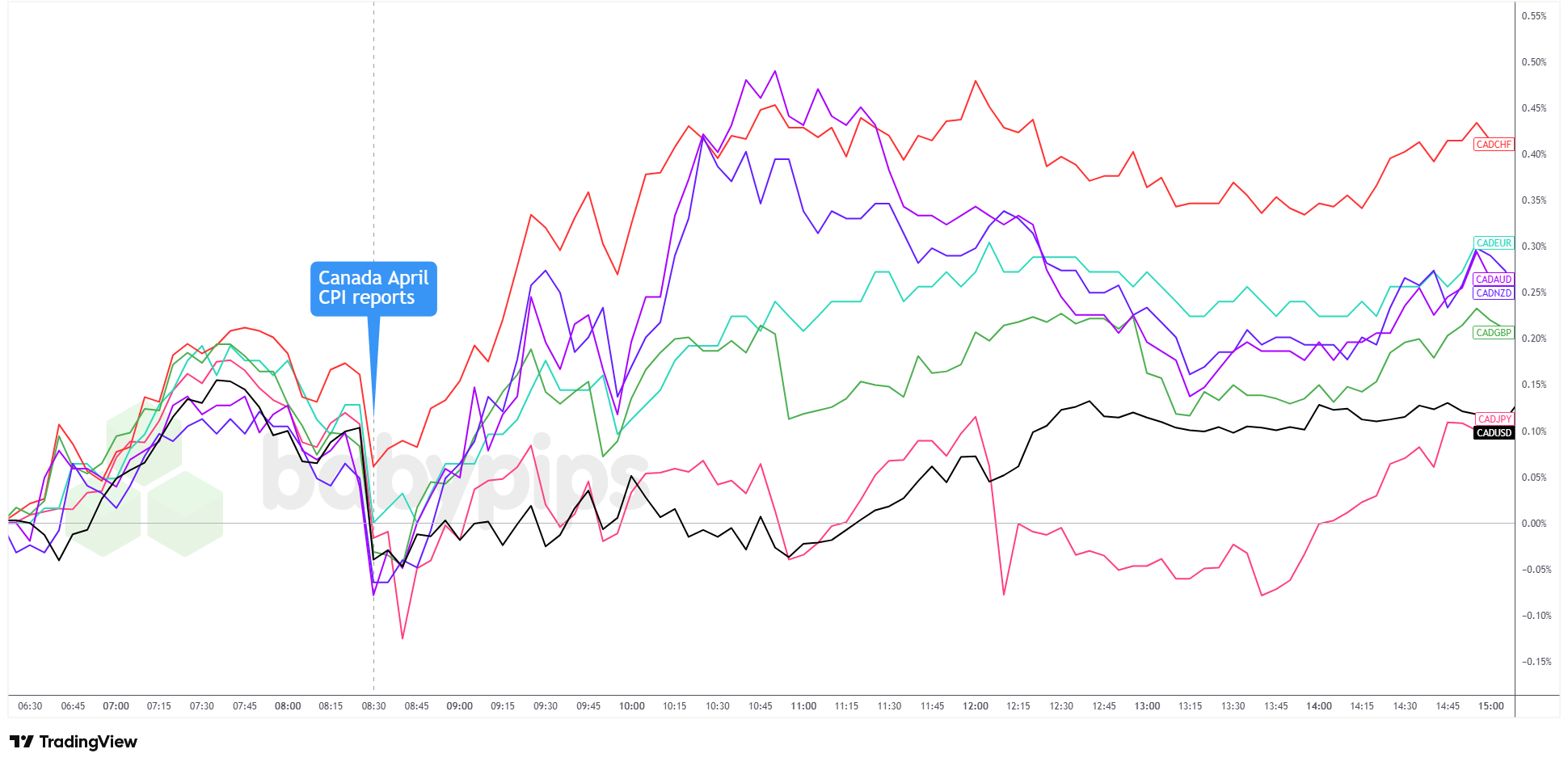
Canadian Dollar vs. Major Currencies: 5-min
Overlay of CAD vs. Major Currencies – Chart Faster with Tradingview
The Canadian dollar picked up a slightly bullish tone ahead of the U.S. session, then moved sideways before the 8:30 a.m. release. It initially sold off hard after the headline missed expectations, briefly hitting a nearly five-week low against the U.S. dollar.
However, as traders worked through the details and the soft core readings registered, demand for the Loonie rebuilt steadily through the mid-morning. CAD extended gains across most major crosses, with CAD/CHF leading while CAD/EUR, CAD/AUD, CAD/NZD, and CAD/JPY tracking closely behind.
By the London close, traders seemed relieved that the energy shock was not spreading into broader inflation. That helped CAD hold its gains across the board by day’s end, though broad U.S. dollar strength tied to hawkish Fed expectations kept CAD/USD close to flat on the session.
Canada’s April CPI report showed headline inflation rising to 2.8% while core measures eased, and if the distinction between headline and core inflation isn’t immediately clear, it’s worth understanding how each one shapes central bank thinking. Premium members can read our lesson:
📖 Inflation: The Force That Moves Central Banks
Reading this helps you understand how CPI measures are calculated and interpreted, why core inflation matters more to the BOC than headline figures, and how inflation regimes shape rate decisions and currency values.
And if you’re not a Premium subscriber yet, now’s a good time to sign up.
With Babypips Premium, you get full access to School of Pipsology lessons that help you understand not just what the inflation numbers say, but how the BOC reads them and what that means for CAD.