







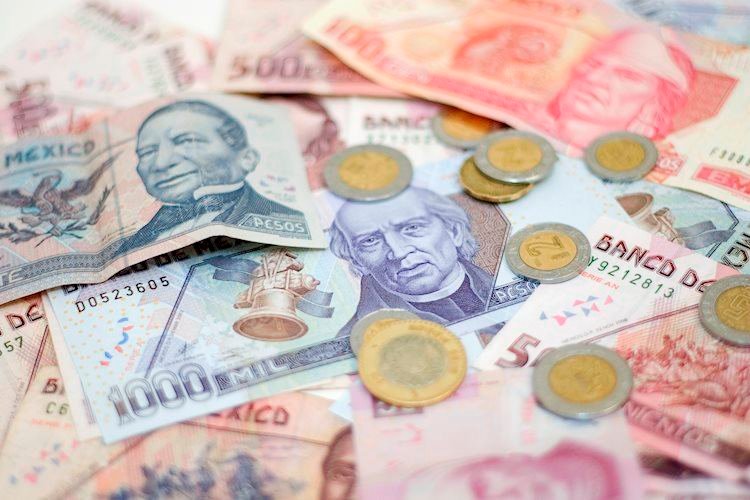
- Mexican Peso trims some of its weekly losses but remains ready to print over 4% weekly losses.
- Mexico’s government’s lack of transparency weighed on the Mexican Stock Exchange and caps Peso’s recovery.
- A subtle pullback in US bond yields weighed on the US Dollar and provided breathing space for the Peso.
Mexican Peso (MXN) stages a comeback versus the US Dollar (USD) late during the New York session, as the USD/MXN drops from around seven-month highs at around 18.48 and falls below Thursday’s daily close of 18.25, which could open the door for a deeper correction in the exotic pair. The USD/MXN posts solid weekly gains of more than 4%.
US economic data revealed before the Wall Street open lifted the USD/MXN exchange rate towards its highs after the US Department of Labor revealed an outstanding labor market report. The docket featured automobile figures in Mexico, which crushed estimates but failed to boost the Peso. That is a consequence of the latest decisions by the Mexican government, which is set to shift airport tariffs, spooking investors and weighing on the Mexican Stock Exchange.
Nevertheless, a slight retracement in US yields undermined the Greenback and opened the door for the latest USD/MXN pullback.
Daily Digest Market Movers: Mexican Peso recovers some territory, eyes 18.10
- The US 10-year Treasury bond yield drops from a daily high of 4.88% to 4.78%, a headwind for the USD/MXN pair.
- US Nonfarm Payrolls for September came at 336K, exceeding forecasts of 170K, and crushed last month’s 227K (upwardly revised from 187K).
- The Unemployment Rate in the US stood at 3.8% above estimates but flat compared with August, while the Participation Rate stood at 62.8%.
- Average Hourly Earnings eased from 4.3% to 4.2% YoY.
- Auto Exports in Mexico rose 16% YoY in September, above the prior month’s 15.7%.
- Mexico’s September auto Production soared 24%, smashing August’s minuscule 2.8% growth.
- According to Reuters, “Rohan Patel, Tesla’s senior public policy and business development executive, in a post on the platform X, formerly Twitter, rejected a Mexican media report saying Tesla had canceled its plans and thanked local, state and federal officials.”
- The Mexican Stock Exchange continues to feel the effects of the government’s decision to change airport tariffs, while rumors of Tesla’s canceling its Giga factory plant spooked investors.
- A Citi Banamex poll showed economists estimate headline inflation at 4.70% and core at 5.09% for the year’s end.
- Analysts polled by Citi Banamex foresee the USD/MXN to end 2023 at 17.80, up from 17.60, and for 2024 at 18.86, up from 18.70 two weeks ago.
- On Wednesday, the IMF raised Mexico’s growth projection in 2023 from 2.6% to 3.2% and from 1.5% foreseen in July to 2.1% for 2024.
- Banxico’s September poll amongst economists reported that interest rates are expected to remain at 11.25% while inflation would dip to 4.66%.
- The same poll shows the exchange rate is set to finish at around 17.64, down from 17.75.
- Mexico’s S&P Global Manufacturing PMI for September came at 49.8, sliding to contractionary territory and below August’s 51.2, as the economy loses steam.
- The Bank of Mexico (Banxico) held rates at 11.25% in September and revised its inflation projections from 3.5% to 3.87% for 2024, above the central bank’s 3% target (plus or minus 1%).
- Banxico’s Government Board highlighted Mexico’s economic resilience and the strong labor market as the main drivers to keep inflation at the current interest rate level.
Technical Analysis: Mexican peso retreats below 18.20
The daily chart shows that the Mexican Peso is set to extend its losses. The USD/MXN pair has hit a new cycle high at 18.48, putting into play a challenge of the psychological 18.50 figure, which could extend towards the April 2018 yearly low of 18.60. With those levels cleared, the next stop would be the March 24 high at 18.79, followed by the psychological 19.00 figure. Conversely, if USD/MXN drops below 18.25, that would exacerbate a drop toward the 18.10s area, followed by the 18.00 figure.
US Dollar FAQs
The US Dollar (USD) is the official currency of the United States of America, and the ‘de facto’ currency of a significant number of other countries where it is found in circulation alongside local notes. It is the most heavily traded currency in the world, accounting for over 88% of all global foreign exchange turnover, or an average of $6.6 trillion in transactions per day, according to data from 2022.
Following the second world war, the USD took over from the British Pound as the world’s reserve currency. For most of its history, the US Dollar was backed by Gold, until the Bretton Woods Agreement in 1971 when the Gold Standard went away.
The most important single factor impacting on the value of the US Dollar is monetary policy, which is shaped by the Federal Reserve (Fed). The Fed has two mandates: to achieve price stability (control inflation) and foster full employment. Its primary tool to achieve these two goals is by adjusting interest rates.
When prices are rising too quickly and inflation is above the Fed’s 2% target, the Fed will raise rates, which helps the USD value. When inflation falls below 2% or the Unemployment Rate is too high, the Fed may lower interest rates, which weighs on the Greenback.
In extreme situations, the Federal Reserve can also print more Dollars and enact quantitative easing (QE). QE is the process by which the Fed substantially increases the flow of credit in a stuck financial system.
It is a non-standard policy measure used when credit has dried up because banks will not lend to each other (out of the fear of counterparty default). It is a last resort when simply lowering interest rates is unlikely to achieve the necessary result. It was the Fed’s weapon of choice to combat the credit crunch that occurred during the Great Financial Crisis in 2008. It involves the Fed printing more Dollars and using them to buy US government bonds predominantly from financial institutions. QE usually leads to a weaker US Dollar.
Quantitative tightening (QT) is the reverse process whereby the Federal Reserve stops buying bonds from financial institutions and does not reinvest the principal from the bonds it holds maturing in new purchases. It is usually positive for the US Dollar.


