


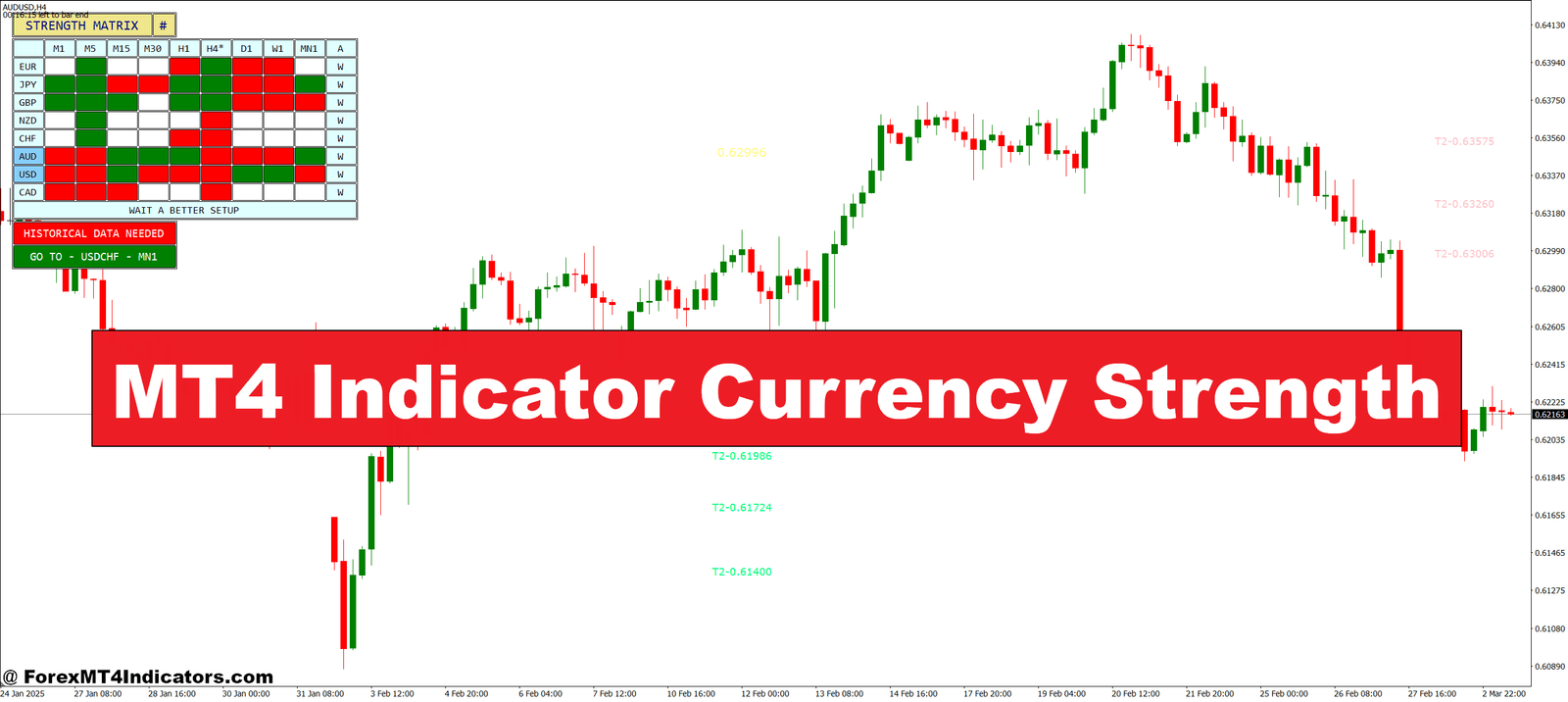
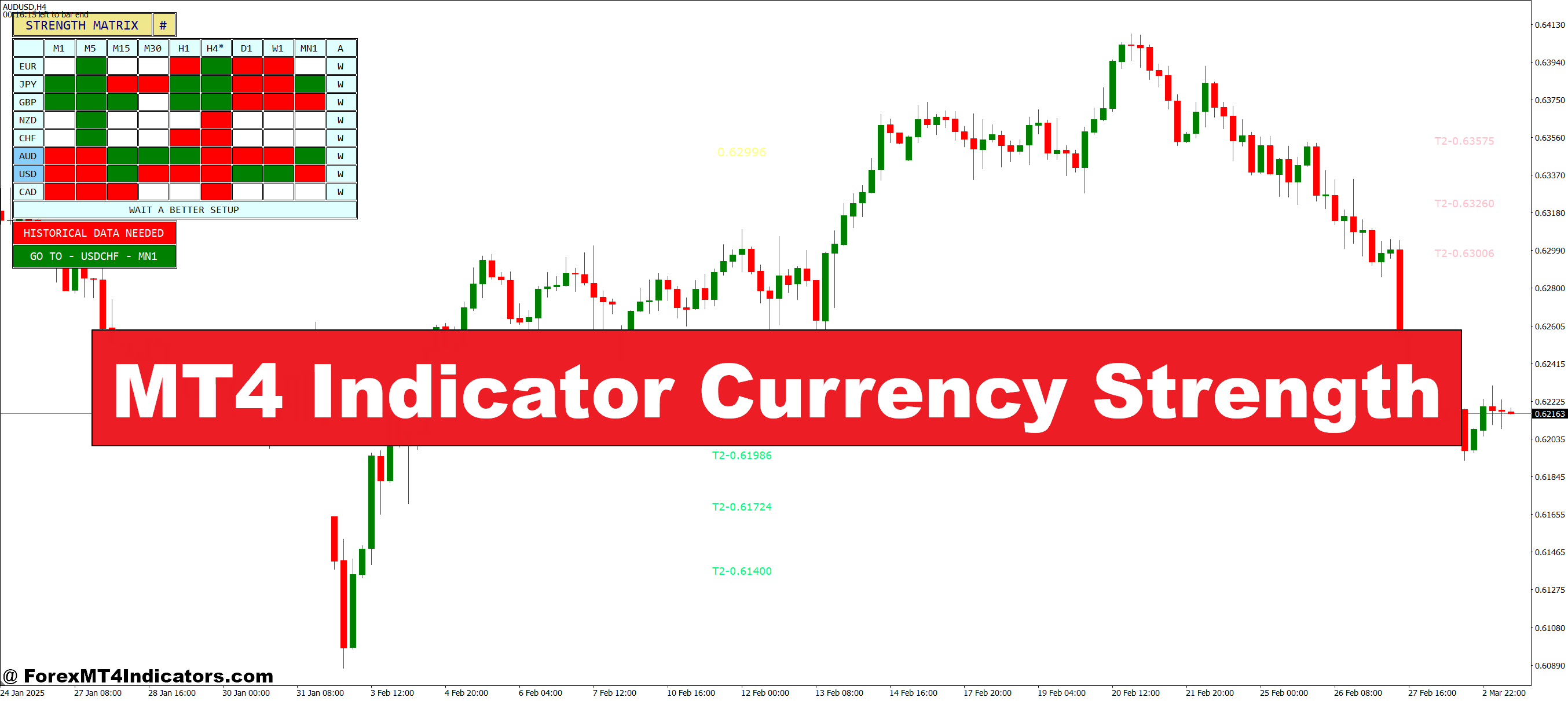
The MT4 indicator currency strength tool solves this by measuring the relative performance of each major currency in real-time. Instead of guessing which pair has momentum, traders can identify the strongest and weakest currencies, then trade the pair that combines them. This approach transforms forex from a guessing game into a data-driven hunt for the path of least resistance.
What Is the Currency Strength Indicator?
A currency strength indicator measures how each currency is performing against all others over a specific period. Unlike traditional indicators that analyze a single pair, this tool calculates the composite strength of eight major currencies: USD, EUR, GBP, JPY, CHF, CAD, AUD, and NZD.
The indicator displays these currencies as separate lines on a chart, each showing relative strength on a scale, typically ranging from 0 to 10 or displayed as percentage values. When the EUR line is at the top, and the JPY line is at the bottom, the biggest opportunities exist in pairs combining those two currencies.
Here’s what makes it different: Standard oscillators like RSI or MACD tell you if a pair is overbought. Currency strength tells you why. If EUR/USD is falling, you’ll know immediately whether to short it (if EUR is weak) or look for long opportunities in other dollar pairs (if USD is strong).
How the Currency Strength Calculation Works
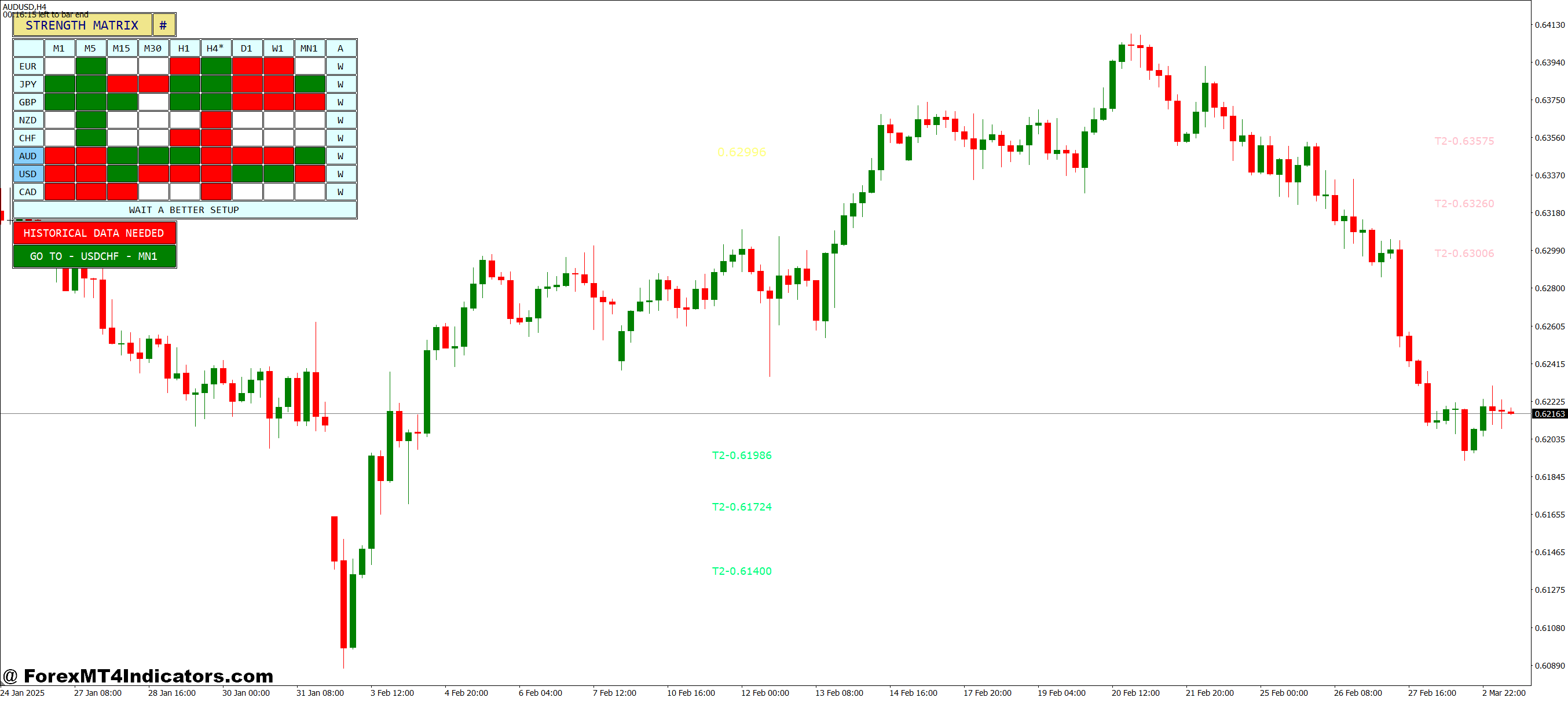
Most MT4 currency strength indicators use one of two calculation methods. The simpler approach measures each currency’s price movement against all other majors over a set period—usually the last 24 hours or a specific number of candles. If the euro gained against six currencies and lost against one, it registers as strong.
The more sophisticated versions incorporate smoothing algorithms similar to moving averages. Some developers use relative strength calculations comparing each currency’s performance to its average, while others track the cumulative pip movement across all pairs. For instance, if USD/JPY moves up 50 pips and EUR/USD moves down 30 pips in the same timeframe, the indicator attributes strength to the dollar.
The exact formula varies by developer, but the principle stays consistent: aggregate performance across multiple pairs reveals true currency strength. Think of it like tracking a basketball player’s contribution to their team—points alone don’t tell the story, but assists, rebounds, and defensive stops create a complete picture.
Practical Trading Applications
The basic strategy is straightforward: trade pairs combining the strongest and weakest currencies. When GBP shows maximum strength, and JPY shows maximum weakness, GBP/JPY becomes the primary target.
But experienced traders use currency strength more strategically. Last month, during the Federal Reserve’s hawkish pivot, USD strength spiked while EUR, GBP, and AUD all weakened simultaneously. Instead of spreading capital across EUR/USD, GBP/USD, and AUD/USD shorts, focusing on the single strongest setup—AUD/USD in this case, since the Australian dollar was weakest—produced the cleanest move with the least whipsaw.
The indicator also prevents rookie mistakes. Say EUR/USD breaks resistance and looks bullish. Before entering, check the currency strength. If both EUR and USD are strengthening together, that breakout is driven by broader dollar weakness affecting all pairs. The move lacks conviction. But if the EUR is genuinely strong while the USD is weak, the breakout has fuel.
Divergence between pairs reveals hidden opportunities, too. When EUR/USD trades flat but the currency strength indicator shows EUR climbing and USD falling, something’s about to give. That compression often precedes explosive moves as the pair catches up to the underlying currency dynamics.
One trader I know uses it exclusively on the 4-hour chart during the London open. He waits until two currencies show clear separation—one at the top, one at the bottom, both trending in the same direction for at least three candles. Then he enters that pair with tight stops. His win rate jumped from 52% to 67% after implementing this filter.
Settings and Customization Options
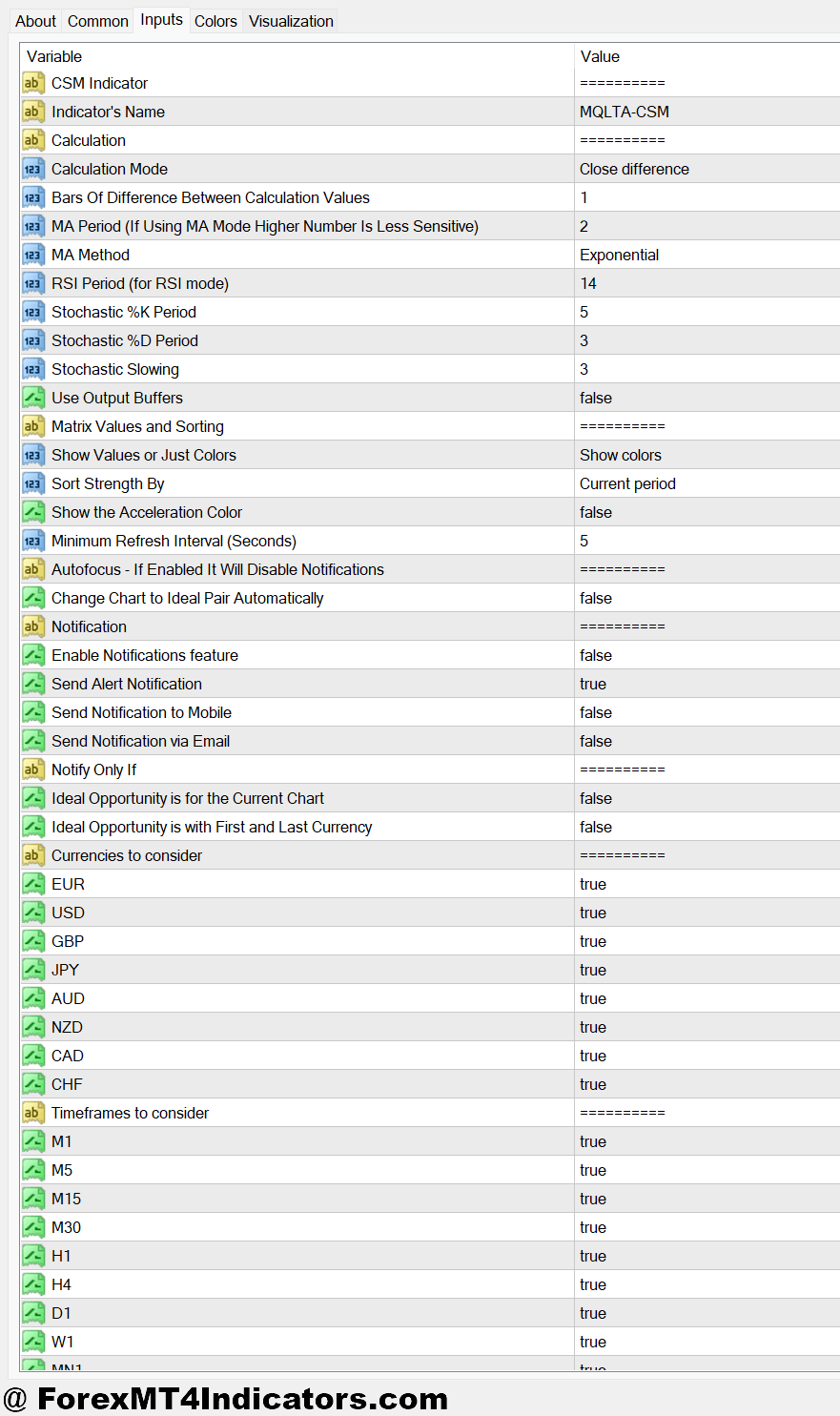
The default period setting on most currency strength indicators is 24 (24 periods, typically 24 hours on the H1 chart). Day traders often reduce this to 12 or even 6 periods to capture intraday momentum shifts. Swing traders extend it to 48 or 96 periods for a broader view.
Smoothing parameters matter too. Higher smoothing values (like 5 or 10) reduce noise but create lag. Lower values (1 or 2) respond faster but generate false signals during choppy sessions. For scalping during the New York open, minimal smoothing works. For position trading, heavy smoothing filters out daily noise.
Some versions allow you to exclude certain currencies. If you never trade the Swiss franc, removing CHF declutters the display. Others include exotic currencies, though liquidity concerns make these less practical.
Color schemes affect usability more than traders realize. The default rainbow of colors gets confusing when eight lines overlap. Set your primary currencies (USD, EUR, JPY) to bold, contrasting colors—red, blue, green—and make the rest muted grays. Your eyes will track the important moves faster.
Advantages and Honest Limitations
The main advantage is clarity. When five indicators on EUR/USD give mixed signals, currency strength cuts through the noise. It’s either strong or it’s not. This tool also reveals correlations instantly—when all dollar pairs move together, you know it’s about the dollar, not individual pair dynamics.
Currency strength excels at confirming trade ideas. Got a setup on GBP/USD? Check if the pound strength and dollar weakness align. If they do, confidence increases. If they don’t, reconsider.
That said, currency strength isn’t a standalone strategy. It won’t tell you where to enter or when to exit. It identifies which pairs to focus on—you still need price action, support and resistance, or other indicators to time entries. Some traders make the mistake of buying every pair with a strong currency, ignoring that they’re already overextended.
The indicator also lags during sudden news events. A surprise rate decision sends currencies spiking before the indicator registers the move. By the time the signal appears, the easy money is gone.
False signals emerge during range-bound markets, too. When no currency shows clear strength or weakness, all the lines bunch together in the middle. Trading these conditions leads to chop and fake-outs. The indicator works best when currencies are actually trending—which, let’s be honest, is maybe 30% of the time.
Compared to correlation matrices, currency strength is more intuitive but less precise. Correlation coefficients give you exact readings; strength indicators give you approximate rankings. For quick decision-making, that’s usually enough. For institutional-level analysis, raw correlation data might be better.
How to Trade with MT4 Indicator Currency Strength
Buy Entry
- Strong currency at top, weak at bottom – Wait for at least a 2-point separation on a 0-10 scale between your two currencies before entering; if EUR is at 8.5 and USD is at 3.0 on the 4-hour chart, buy EUR/USD.
- Three consecutive candles of strength – Enter only after the strong currency holds the top position for three complete H1 candles (3 hours minimum) to avoid false spikes during low-volume Asian sessions.
- Rising strength line with 45-degree angle – Look for the currency line climbing steadily upward at roughly 45 degrees over 6-12 candles; vertical spikes often reverse quickly, while gradual climbs sustain longer moves.
- Confirmation at major support level – Combine currency strength with price action by buying when EUR/USD tests 1.0850 support AND the euro line crosses above 6.0 while the dollar drops below 4.0.
- Risk 1% with 20-pip stop – On GBP/USD, place your stop 20 pips below the recent swing low when pound strength exceeds 7.5; never trade if the strength gap is less than 1.5 points—that’s choppy territory.
- Avoid during currency line convergence – Don’t buy if four or more currencies cluster between 4.0-6.0 on the indicator; wait for clear separation, or you’ll get whipsawed in ranging markets.
- Target the weakest pair combination – If GBP reads 8.2 (strongest) and JPY reads 2.1 (weakest), skip GBP/USD at 7.5 strength and trade GBP/JPY instead for maximum momentum on the daily chart.
- Exit when lines cross – Close 50% of your EUR/USD long when the euro strength line crosses below 6.5, or the dollar line crosses above 5.0, even if the price hasn’t hit your target.
Sell Entry
- Weak currency at bottom, strong at top – Sell when your base currency drops below 3.0 while the quote currency rises above 7.0; for example, short AUD/USD when Aussie hits 2.5 and dollar hits 8.0 on H4.
- Downward strength angle for 4+ hours – Wait for the currency line to decline steadily for at least four 1-hour candles before shorting; sudden drops often bounce as fast as they fell.
- Weakness confirmed at resistance rejection – Short GBP/USD at 1.2950 resistance only if the pound line falls below 4.0 while dollar strength exceeds 6.5; price rejection alone isn’t enough confirmation.
- Maximum 2% risk with 30-pip stop – On EUR/JPY shorts, place stops 30 pips above recent swing high when yen strength climbs past 7.0; if separation is less than 2 points, skip the trade entirely.
- Don’t short during news spikes – Avoid selling when currency strength lines move vertically within 1-2 candles (usually NFP or rate decisions); wait 2-3 hours for lines to stabilize before entering.
- Divergence between strength and price – Short when USD/JPY makes higher highs but dollar strength makes lower highs over 8-12 H1 candles; this divergence signals exhaustion and impending reversal.
- Trade the extreme pair only – If USD is strongest at 8.7 and JPY is weakest at 1.9, short USD/JPY rather than USD/CAD; always match the two extreme currencies for cleanest directional moves.
- Exit at strength line compression – Close your EUR/USD short when the gap between euro and dollar narrows to less than 2 points or when three other currencies enter the same range on the 4-hour chart.
Making Currency Strength Work for You
The MT4 indicator currency strength works best as a filter, not a signal generator. Use it to narrow down the universe of 28 major pairs to the two or three worth watching. Then apply your actual strategy, whether that’s breakouts, reversals, or trend following, to those specific pairs.
Start by observing how the currencies behave during different market sessions. The Japanese yen often strengthens during Tokyo hours. The pound moves duringthe London open. These patterns become obvious when you’re tracking individual currencies rather than pairs.
But here’s the thing: no indicator eliminates risk. Trading forex carries substantial risk, and currency strength tools don’t guarantee profits. They help you make informed decisions, but losses are still part of the game. Position sizing and risk management matter more than any indicator—currency strength included.
The real value comes from understanding why pairs move, not just that they’re moving. Once you start thinking in terms of individual currencies rather than pairs, market structure becomes clearer. You’ll stop chasing random setups and start hunting genuine imbalances between strong and weak currencies. That shift in perspective? That’s where consistent profitability lives.
Recommended MT4/MT5 Broker
XM Broker
- Free $50 To Start Trading Instantly! (Withdraw-able Profit)
- Deposit Bonus up to $5,000
- Unlimited Loyalty Program
- Award Winning Forex Broker
- Additional Exclusive Bonuses Throughout The Year
- Exclusive 90% VIP Cash Rebates for all Trades!


Already an XM client but missing out on cashback? Open New Real Account and Enter this Partner Code: VIP90
(Free MT4 Indicators Download)