



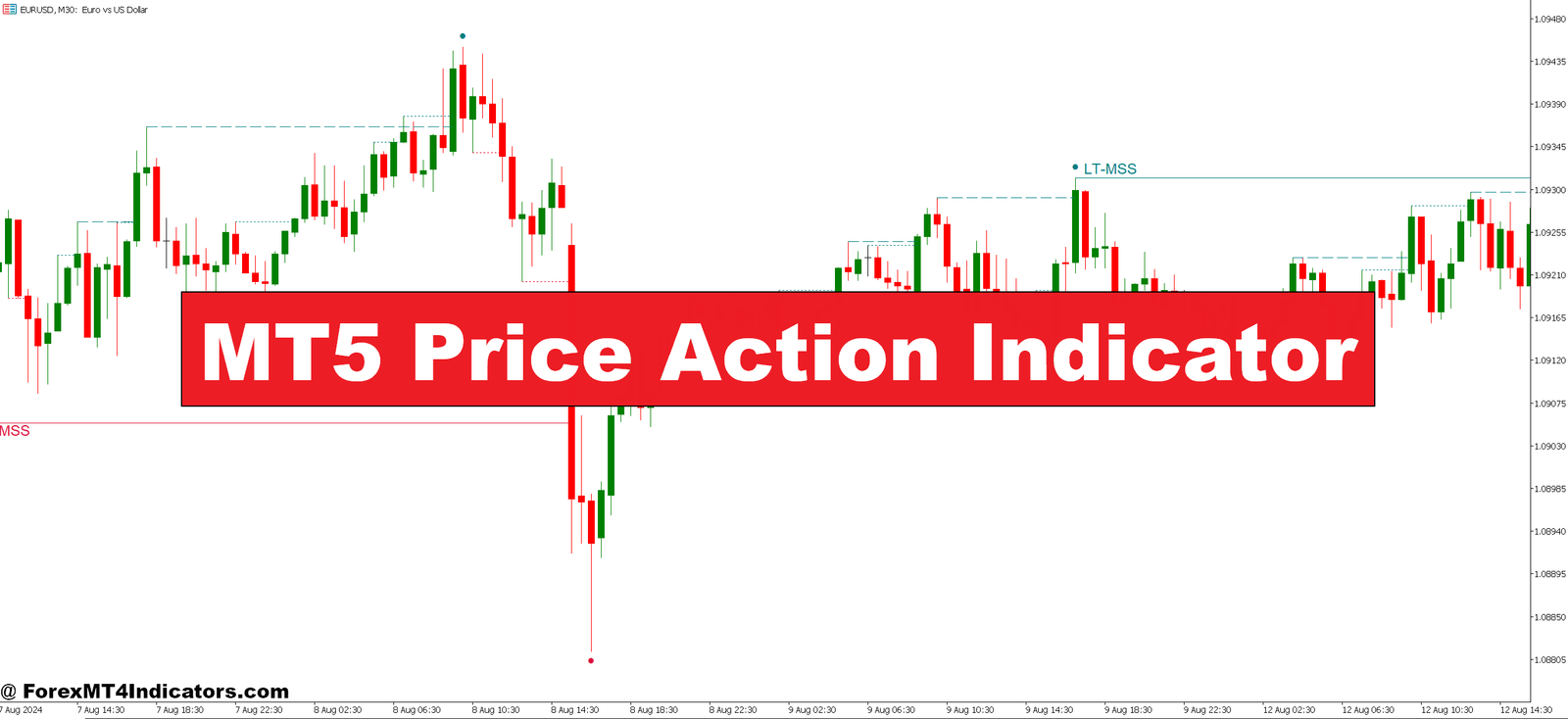
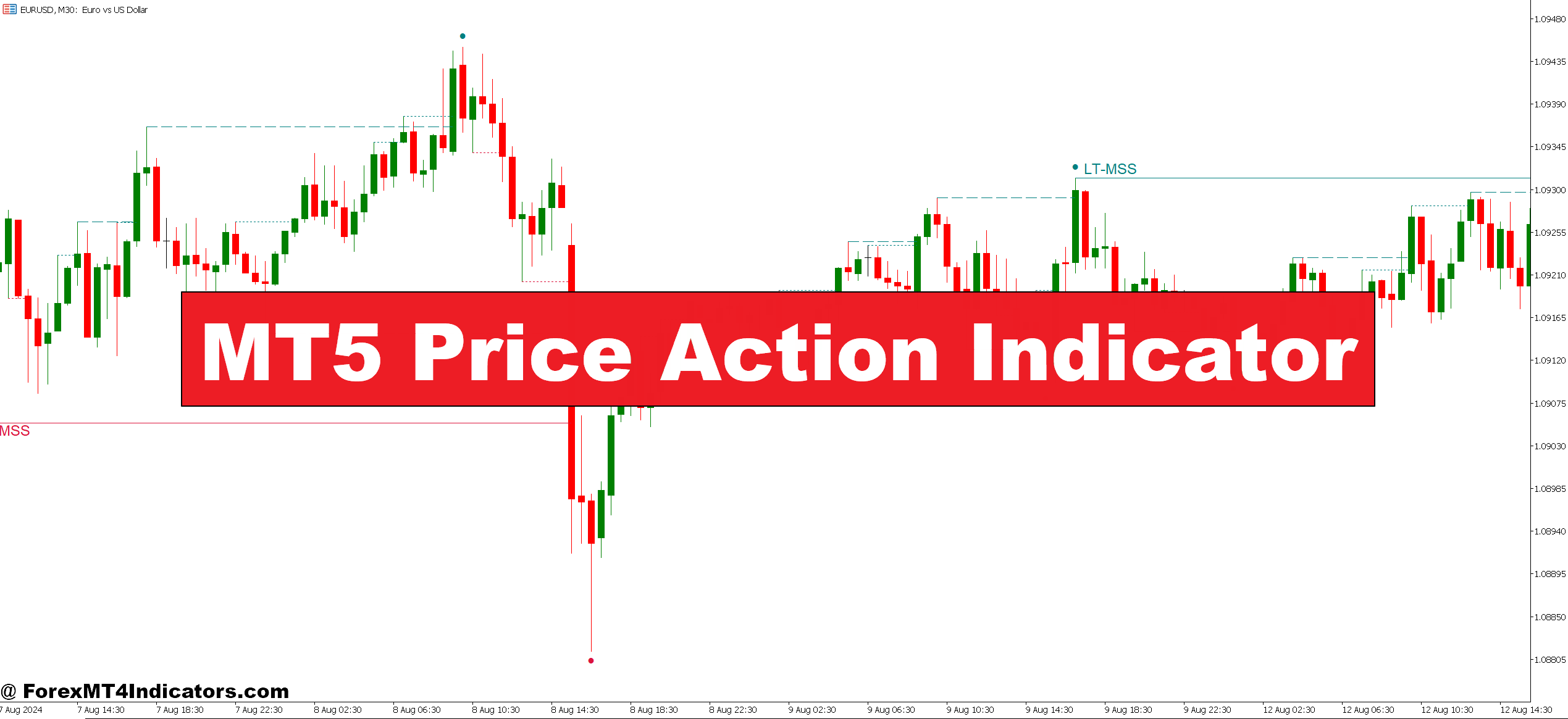
An MT5 price action indicator is a technical tool designed specifically for the MetaTrader 5 platform that identifies and visualizes price movement patterns without heavy mathematical transformations. Unlike lagging indicators that smooth or average past data, these tools mark key price structures in real-time: swing highs and lows, support and resistance zones, candlestick patterns, or momentum shifts based on actual candle behavior.
The term covers various tools, but they share one philosophy: price tells the story if you know how to read it. Some indicators automatically detect patterns like pin bars or engulfing candles. Others mark fractal points or identify trend structure breaks. The best ones don’t predict they simply organize what price is already showing.
What makes these indicators valuable for MT5 users? They integrate seamlessly with the platform’s superior backtesting capabilities and multi-timeframe analysis tools, letting traders validate price action concepts with hard data rather than gut feelings.
How Price Action Indicators Actually Work
Here’s where it gets practical. Most MT5 price action indicators use one of three core approaches.
- Pattern Recognition Models scan each completed candle against predefined criteria. A pin bar indicator, for instance, checks whether the candle’s wick exceeds the body by a certain ratio (typically 2:1 or 3:1) and whether it appears near key levels. When conditions match, it fires an alert or plots a marker.
- Structure-Based Tools identify swing points using lookback periods. They might mark a swing high when price makes a peak that’s higher than the previous X candles and the following Y candles. This creates visual anchor points showing where price momentum shifted. Some traders use a 5-3-3 structure (5 candles left, peak, 3 candles right) on higher timeframes for significant reversals.
- Momentum Shift Indicators measure the character of price movement rather than direction. They might calculate the ratio of candle bodies to total ranges across a rolling window, flagging when the market transitions from choppy sideways action to trending momentum. When you see tight-bodied candles suddenly give way to large-bodied bars, that shift often precedes sustained moves.
The math isn’t rocket science that’s the point. A resistance zone indicator might simply track where price rejected twice within 20 pips over the last 100 bars. It’s marking obvious levels, but doing it systematically so you don’t miss them while managing three currency pairs simultaneously.
Real-World Application: Trading the Pattern

Let’s talk specifics. On GBP/JPY’s 1-hour chart during the November 2024 volatility, a swing point indicator marked a lower high at 191.85 after price failed to break 192.20. Three candles later, price knifed through the previous swing low at 190.40. That structure break clearly marked by the indicator signaled the shift from ranging to bearish trending.
A trader watching this could’ve entered short at 190.35 with a stop above 191.90 (just above the lower high), targeting the next support zone at 188.80. Risk-to-reward: roughly 1:2.5. The indicator didn’t predict anything it just organized the information so the setup was obvious.
But here’s the thing: you still need context. That same indicator will mark swing breaks in choppy conditions too, and those often lead nowhere. During Asian session ranges, price action indicators fire signals that get you chopped up. The tool shows you price structure; you provide the market context about whether that structure matters.
One practical tip: combine timeframes. If your primary timeframe is the 15-minute chart, check what the price action indicator shows on the 1-hour or 4-hour. When swing breaks align across timeframes say, a 15-minute structure break happening as price approaches a 4-hour resistance zone that’s where edge lives.
Customization: Making It Work for Your Style
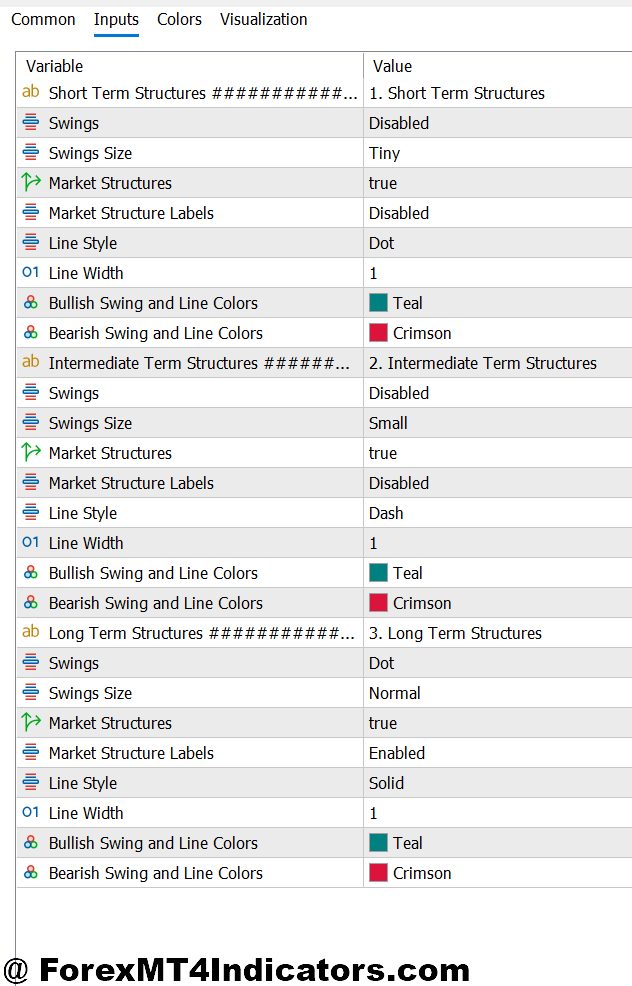
Most MT5 price action indicators come with adjustable parameters that significantly affect their behavior. Understanding these settings separates traders who use tools effectively from those who complain that “nothing works.”
- Sensitivity Settings control how many patterns or swing points get marked. A pin bar indicator might have a wick-to-body ratio parameter. Set it to 2:1, and you’ll catch more patterns (including weaker ones). Crank it to 4:1, and you’ll only see the most dramatic rejections. Scalpers might want more signals; swing traders want fewer, higher-quality setups.
- Lookback Periods determine how many candles the indicator considers. A swing high indicator with a 5-bar lookback reacts quickly but marks more minor swings. A 20-bar lookback is slower but identifies more significant pivots. For day trading, shorter lookbacks (5-10 bars) make sense. For position trading, you’d extend it to 15-25 bars or more.
- Zone Thickness matters for support/resistance indicators. Some traders prefer exact lines; others want 10-pip zones acknowledging that levels aren’t precise. GBP pairs with their wider spreads need thicker zones than EUR/USD’s tight spreads.
One often-overlooked setting: alert customization. Set alerts for pattern formation rather than watching charts constantly. When a pin bar forms at a key zone on AUD/USD’s 4-hour chart, you want to know even if you’re away from your desk.
Advantages and Real Limitations
The advantages are straightforward. Price action indicators reduce decision paralysis by highlighting what matters. They’re not repainting the past (at least, the properly coded ones aren’t). They work across all timeframes and currency pairs because price behavior is universal. And they encourage traders to think about market structure rather than chasing magic settings on lagging oscillators.
There’s also the simplicity factor. A clean chart with swing points marked beats a rainbow of EMAs and stochastic oscillators every time. Less distraction means clearer thinking, especially during volatile sessions when you need to act fast.
But let’s be honest about limitations. Trading forex carries substantial risk, and no indicator guarantees profits including these. Price action indicators mark patterns, but patterns fail. A perfect pin bar at support can get steamrolled if fundamental news hits. During major economic releases like NFP or central bank decisions, technical patterns take a backseat to raw order flow.
These indicators also require interpretation. They’re not mechanical systems spitting out “buy here” signals. A swing break might be the start of a trend or just a stop hunt before price reverses. You need to filter signals through additional analysis: Is there clear directional momentum? What’s the broader market context? Where are the major levels?
And here’s something traders don’t discuss enough: even good indicators can become crutches. Relying on automated pattern detection can prevent you from developing the skill to read raw price action yourself. Use these tools as training wheels, not permanent solutions.
How They Compare to Traditional Technical Indicators
Stack an MT5 price action indicator against something like MACD or RSI, and the differences become clear. Traditional oscillators derive from price but operate steps removed from actual market behavior. MACD measures the relationship between two moving averages useful, but you’re analyzing an analysis of an analysis.
Price action tools stay closer to the source. When a swing low indicator marks a level, it’s pointing to where buyers actually stepped in with enough force to reverse downward momentum. That’s tangible market behavior, not a mathematical abstraction.
That said, they’re not mutually exclusive. Some traders use price action indicators for entries and structure, while using RSI or MACD for confluence. If price breaks a swing low and RSI drops below 30 into oversold territory, that’s two different analytical methods agreeing which adds confidence.
The edge price action indicators hold over indicator soup? They age better. A support zone that mattered in 2020 might still matter now. But that perfect MACD crossover setting someone found? Market conditions shift, and those parameters stop working. Price action concepts support, resistance, momentum shifts remain constant because they reflect human behavior, which doesn’t fundamentally change.
How to Trade with MT5 Price Action Indicator
Buy Entry

- Bullish swing low break rejection – When price breaks below a marked swing low by 5-10 pips on EUR/USD 1-hour chart then immediately reverses with a strong bullish candle, enter long with stop 15 pips below the swing low.
- Pin bar at support zone – Look for pin bars with 3:1 wick-to-body ratio forming at identified support on GBP/USD 4-hour chart; enter on next candle open with stop below pin bar low, targeting 2:1 reward-to-risk.
- Higher high confirmation – After indicator marks a higher high above previous swing peak, enter long on pullback to 50% retracement level; works best on daily charts during clear uptrends with 40-50 pip stops.
- Failed breakdown pattern – When price breaks support by 15-20 pips but closes back above within 2-3 candles, enter long as bulls defend the level; avoid during major news events when breakouts tend to follow through.
- Multiple timeframe alignment – Only take buy signals when 15-minute swing break coincides with 1-hour bullish structure and 4-hour uptrend; single timeframe signals in ranging markets produce 60%+ false entries.
- Momentum candle after consolidation – When price coils in 20-30 pip range for 8+ candles then breaks higher with body 2x average size, enter on retest of breakout level with 25-pip stop.
- Don’t buy at resistance – Ignore bullish patterns forming within 10 pips of marked resistance zones on any timeframe; wait for break and retest confirmation or risk getting trapped in rejection zones.
- Volume surge confirmation – Enter long only when bullish swing breaks occur with 150%+ average volume; low-volume breakouts on Asian session EUR/USD frequently reverse within 5-10 candles.
Sell Entry

- Bearish swing high break – When price breaks above marked swing high then fails with rejection candle, enter short on break below that candle’s low; use 20-pip stop above swing high on GBP/USD pairs.
- Shooting star at resistance – Identify shooting stars with upper wick 3x body size at resistance zones on 4-hour charts; enter short next candle with stop 10 pips above high, minimum 1.5:1 risk-reward ratio.
- Lower low confirmation – After indicator marks new lower low, enter short on rally to 38.2% Fibonacci retracement of the down-leg; works best on daily timeframe with 60-80 pip stops for swing trades.
- Failed breakout above resistance – When price spikes 15-25 pips above resistance but closes back below within 1-2 candles, enter short immediately; this “bull trap” pattern works exceptionally well on EUR/USD London open.
- Triple timeframe bearish structure – Only sell when 15-minute shows swing break, 1-hour confirms lower high, and 4-hour displays downtrend; single timeframe signals during choppy conditions lose 70% of the time.
- Distribution pattern completion – When price makes 3+ similar highs within 30-pip range then breaks lower with momentum candle, enter short on retest with stop above range high plus 15 pips.
- Avoid selling at major support – Never take short signals within 15 pips of daily/weekly support zones even if pattern looks perfect; these levels attract massive buying interest that invalidates technical setups.
- News event filter – Skip all sell signals 30 minutes before and 2 hours after high-impact news (NFP, rate decisions, GDP); price action patterns fail when fundamental order flow dominates the market structure.
Making It Work for You
The MT5 price action indicator isn’t a holy grail those don’t exist in trading. What it offers is structure and clarity in reading market movements that are already happening. It marks swing points you might miss during fast markets, highlights patterns forming across multiple pairs, and keeps your analysis grounded in actual price behavior rather than derivative mathematics.
Start simple. Pick one type of price action indicator swing points, pattern recognition, or structure breaks and learn it thoroughly on a demo account. Test it across different pairs and timeframes. Notice when signals work and when they fail. Build that pattern recognition before adding complexity.
And remember: the indicator shows you price structure, but you bring the context. Market conditions, timeframe alignment, risk management those elements determine whether a marked pattern becomes a profitable trade or a lesson in what not to do. Use these tools to organize information, not as a substitute for trading skill.
The question isn’t whether price action indicators work. It’s whether you’ll put in the screen time to understand what price is telling you.
Recommended MT4/MT5 Broker
XM Broker
- Free $50 To Start Trading Instantly! (Withdraw-able Profit)
- Deposit Bonus up to $5,000
- Unlimited Loyalty Program
- Award Winning Forex Broker
- Additional Exclusive Bonuses Throughout The Year
- Exclusive 90% VIP Cash Rebates for all Trades!


Already an XM client but missing out on cashback? Open New Real Account and Enter this Partner Code: VIP90
(Free MT4 Indicators Download)