



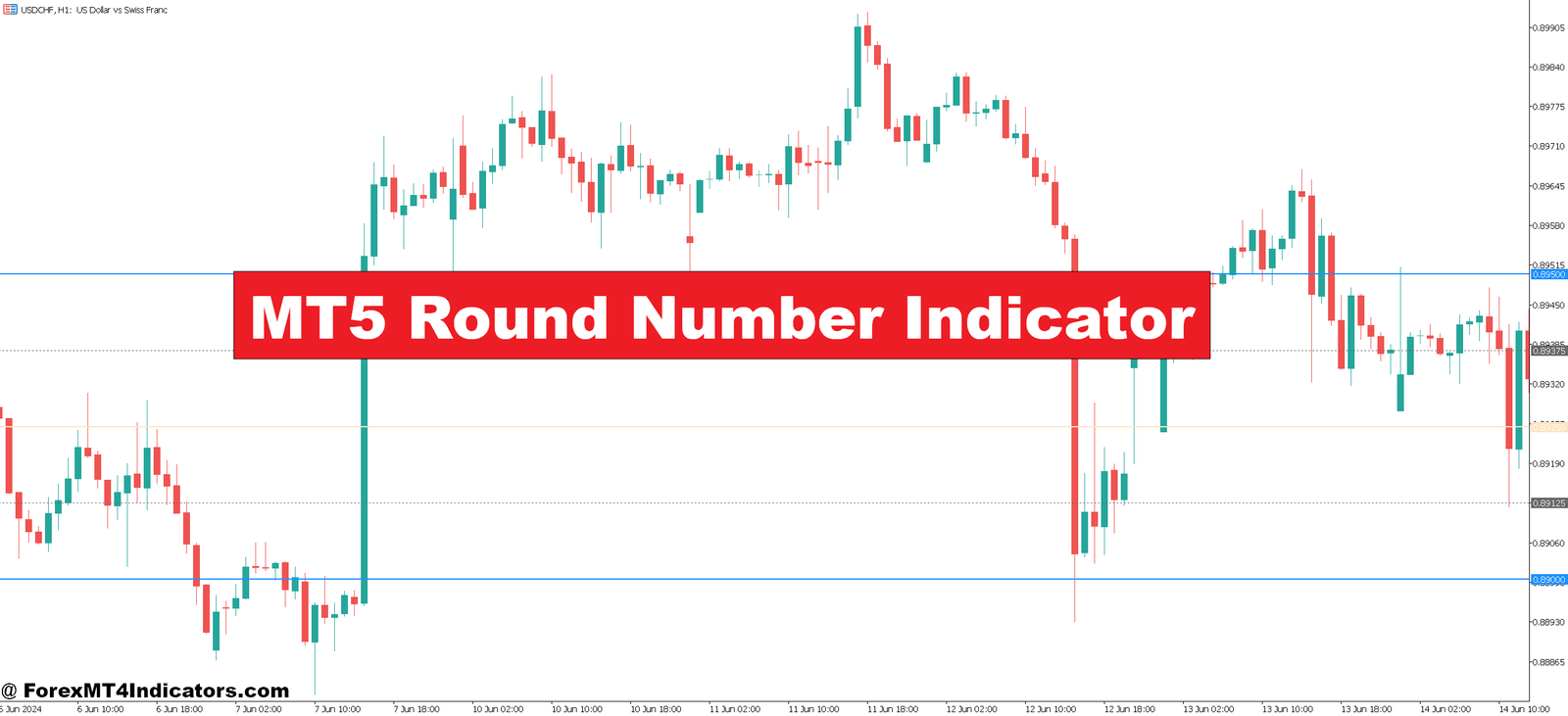
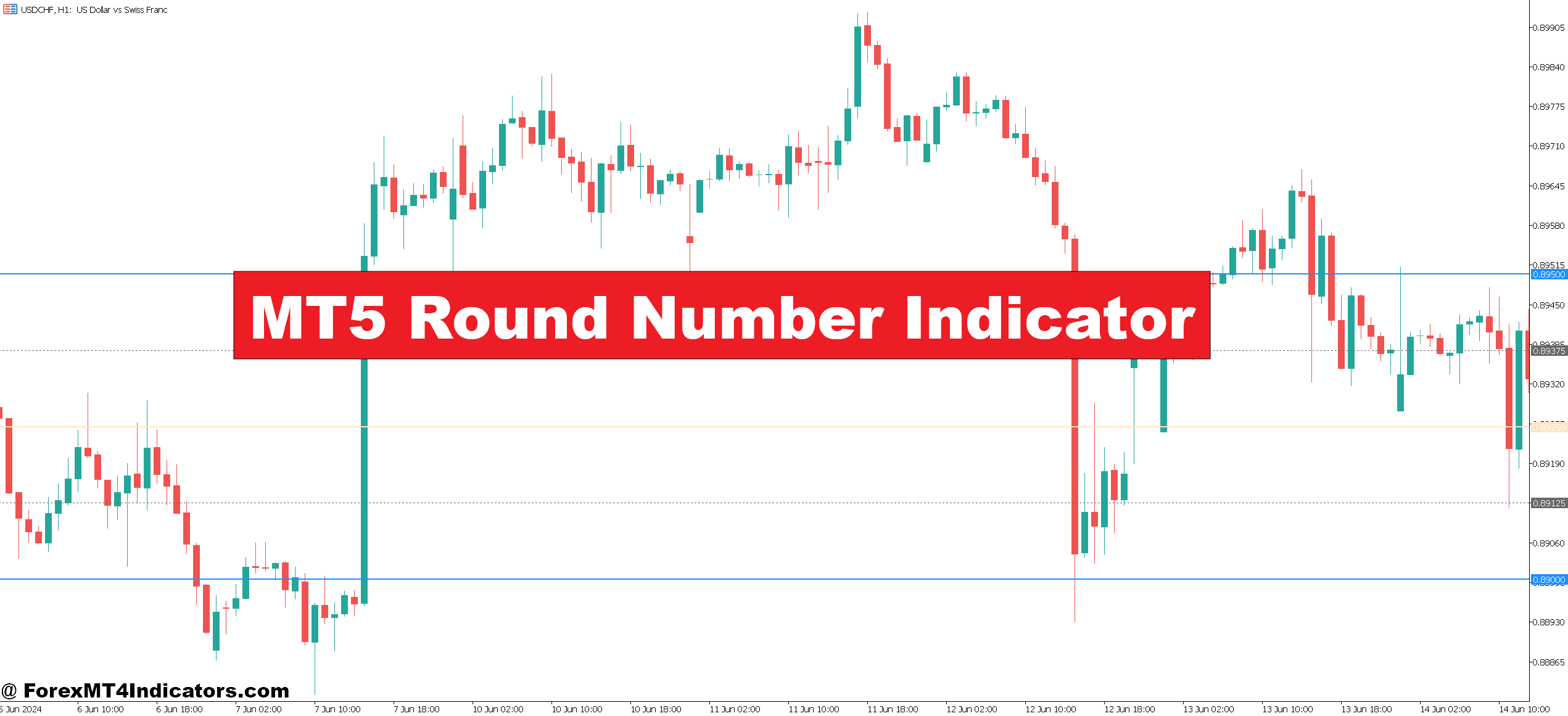
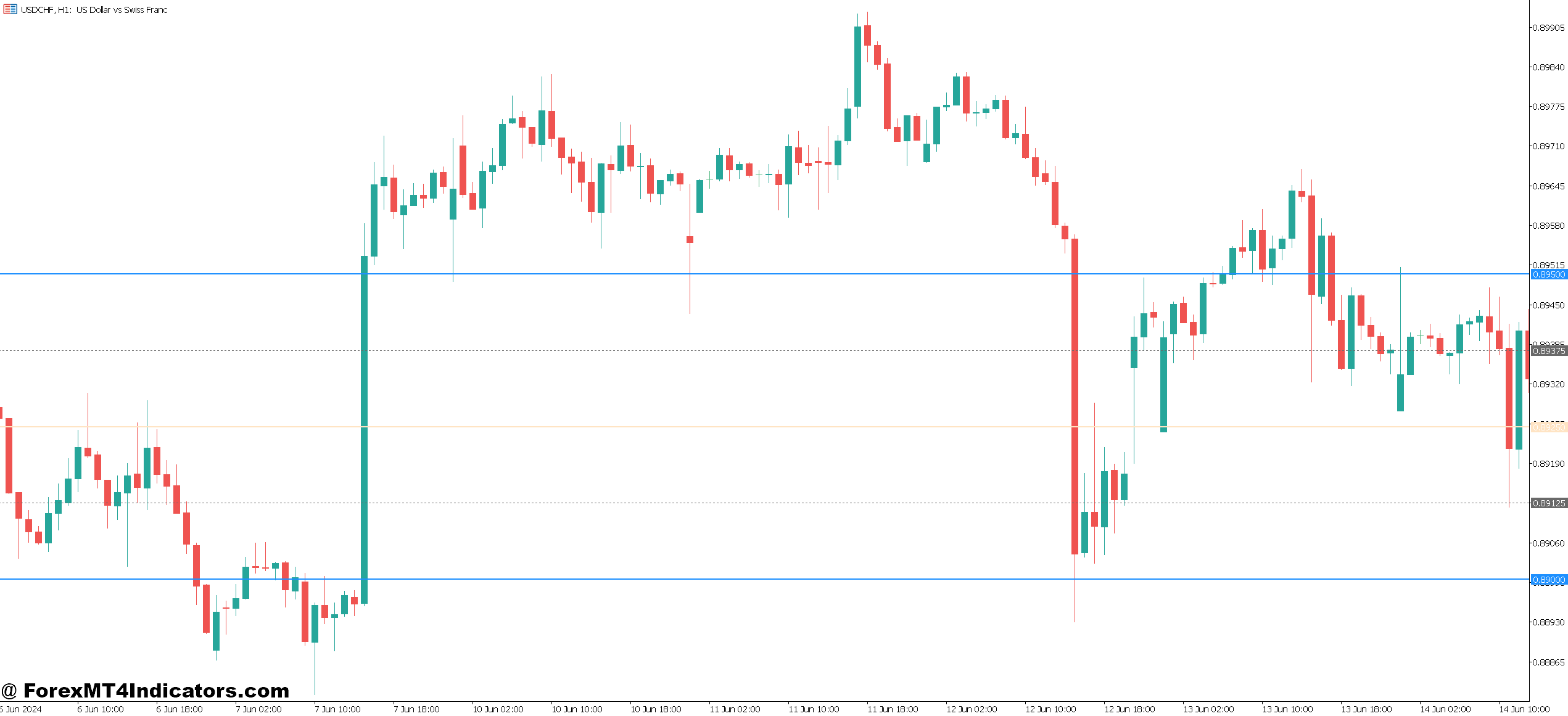
The MT5 Round Number Indicator is a technical tool that marks whole numbers and half numbers on price charts. Think 1.1000, 1.1050, 1.1100 for EUR/USD, or 150.00, 151.00, 152.00 for USD/JPY. These aren’t random lines—they’re price levels where human psychology and algorithmic trading collide.
Here’s why these levels matter: Traders naturally gravitate toward round numbers when placing orders. Institutional desks set stop losses at these levels. Banks park limit orders there. Retail traders place take-profits at nice, clean numbers because our brains prefer them. The result? Liquidity clusters at these points, creating support and resistance zones that actually influence price movement.
The indicator doesn’t calculate complex formulas or use historical price data. It simply reads the current price scale and draws horizontal lines at predetermined intervals. Most versions let you set the increment—every 10 pips, 20 pips, 50 pips, or 100 pips depending on what you’re trading and your timeframe.
How Price Reacts at Round Numbers
Price action around round numbers follows predictable patterns, though “predictable” doesn’t mean “guaranteed.” On a 4-hour EUR/USD chart, watch what happens as price approaches 1.0900 from below. You’ll often see momentum slow down. Buyers become cautious. Sellers see an opportunity.
The 1.1000 level on EUR/USD is a perfect example. During the 2024 summer rally, price tested this level multiple times. Each approach brought increased volatility. Candlestick wicks extended into the zone, only to snap back. When price finally broke through, it didn’t look back for weeks.
But round numbers don’t just act as resistance. They flip to support after a break. That same 1.1000 level, once broken, became a floor where dip-buyers consistently stepped in. This flip behavior happens because traders remember these levels. They’re embedded in our collective trading memory.
Smaller pairs show this effect too. USD/CAD at 1.3500, AUD/USD at 0.6500—same pattern. The cleaner the number, the stronger the reaction tends to be. Quarter levels (like 1.0750) show some effect, but not as pronounced as the big round figures.
Setting Up and Customizing the Indicator
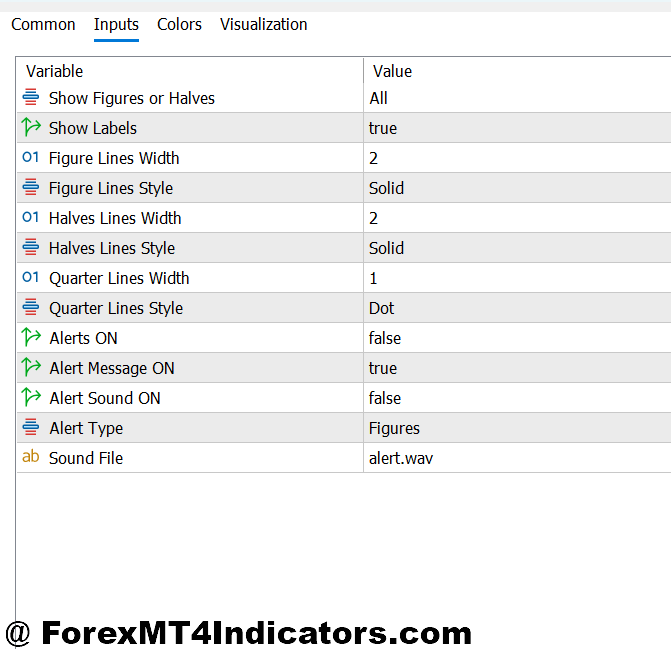
Most MT5 round number indicators offer straightforward customization. The key parameter is the increment setting. For scalping on 5-minute or 15-minute charts, a 20-pip or 25-pip increment works well. You don’t want your chart cluttered with too many lines, but you need enough reference points to catch the action.
Day traders on 1-hour charts typically use 50-pip increments. This gives clean spacing and highlights the major psychological levels without visual noise. Swing traders looking at daily charts? Go with 100-pip increments. The focus shifts to major round numbers like 1.2000, 1.3000, not the smaller divisions.
Color coding helps. Set your round hundreds (like 1.1000) in a bold color—red or blue. Make your fifty levels (1.1050) a lighter shade. Some traders add dotted lines for quarter levels, though that’s optional. The goal is visual clarity at a glance.
Here’s a practical tip: Combine the indicator with price alerts. Set notifications 10-15 pips before major round numbers. This gives you time to analyze whether price might reverse or break through. During the London open, when GBP/USD approaches 1.2500, that alert gets you focused on the level before the fireworks start.
Real Trading Scenarios and Applications
Testing this indicator on USD/JPY during volatile NFP days reveals its real value. When the jobs report hit in December 2024, USD/JPY was sitting at 148.50. The 149.00 level was in sight. Traders who marked this level in advance saw the initial spike to 148.95, then the aggressive rejection back to 148.20. That’s a 75-pip move in minutes—and it hinged on that round number rejection.
The indicator shines during range-bound conditions. EUR/USD spent weeks bouncing between 1.0800 and 1.0900 in late 2024. Traders using these round number levels as buy and sell zones captured consistent 80-100 pip swings. The strategy was simple: buy near 1.0800, sell near 1.0900, rinse and repeat.
Breakout traders use it differently. They wait for price to close above a major round number with conviction—a 4-hour or daily candle close works best. GBP/USD breaking above 1.3000 after weeks of consolidation typically signals a new leg up. But here’s the catch: false breakouts happen. Price might spike through 1.3000, grab stops, then reverse. That’s why confirmation matters.
Combine the indicator with moving averages or RSI for better entries. When EUR/USD approaches 1.1000 and the 50-period MA converges at the same level, that’s confluence. Add oversold RSI to the mix, and you’ve got a high-probability long setup. The round number alone isn’t enough—it’s one piece of the puzzle.
Advantages and Real Limitations

The biggest advantage is simplicity. You don’t need to understand Fibonacci sequences or master complex indicators. Round numbers are intuitive. They work because everyone sees them, creating a self-fulfilling dynamic.
The indicator also provides universal reference points. Whether you’re trading EUR/USD or exotic pairs, round numbers matter. They transcend currency pairs, timeframes, and trading styles. A scalper and a swing trader can both use 1.0900 as a decision point, just with different tactics.
That said, round numbers aren’t magic. During strong trends, price blows right through them. The March 2024 dollar rally saw USD/JPY slice through 145.00, 146.00, 147.00 like butter. Traders waiting for reversals got run over. Trends trump psychology sometimes.
Choppy markets create another problem—whipsaws. Price might touch 1.1000 five times in a session, each time triggering reactions, none leading anywhere. These fake-outs frustrate traders and eat into accounts through repeated small losses and spread costs.
The indicator also doesn’t tell you direction. It marks levels, but you still need to read market structure, understand momentum, and manage risk. It’s a roadmap, not a GPS with turn-by-turn directions.
How It Compares to Other Level Indicators
Fibonacci retracement tools plot levels based on recent swing highs and lows. They’re dynamic and change with price action. Round numbers are static—1.1000 is always 1.1000. That permanence is both a strength and limitation. Fibs might catch hidden support zones that round numbers miss, but they also require more interpretation.
Pivot points calculate daily, weekly, or monthly levels using open, high, low, close data. They’re more complex but potentially more precise for intraday trading. The downside? They change every period, requiring constant recalculation. Round numbers sit there, waiting.
Support and resistance indicators try to identify levels based on historical price reactions. They’re backward-looking, which can be powerful but also lag. Round numbers are forward-looking in a sense—they’re always relevant because traders always care about them.
Many professionals use round numbers alongside Fibs and pivots. The confluence of a Fibonacci 61.8% level at 1.0950 near the round number 1.1000 creates a zone rather than a line. That’s how institutional traders think—in zones where probability clusters.
How to Trade with MT5 Round Number Indicator
Buy Entry

- Price bounce off major round number – Enter long when EUR/USD rejects 1.1000 with a bullish engulfing candle on the 1-hour chart, placing your stop 20-30 pips below the level.
- False breakdown and reclaim – Buy when price spikes below 1.0900, then closes back above it within 15-30 minutes, indicating trapped sellers and potential reversal momentum.
- Support flip after breakout – Wait for GBP/USD to break above 1.3000, pull back to retest it, then enter long when price holds with confirmation from a higher low.
- Confluence with moving average – Take the buy when price approaches 1.0800 and the 50-period MA sits at the same level on the 4-hour chart, doubling your support.
- Reduced position into resistance – If buying mid-range, cut your position size by 50% when approaching the next round number (like 1.0950), protecting profits before potential rejection.
- Skip the chop – Don’t enter if price has tested the same round number 3+ times in one session without breaking—this signals indecision and likely whipsaw conditions.
- Volume confirmation required – Only take the signal if buying volume increases at the round number support, visible through tick volume or CVD indicators showing accumulation.
- Risk no more than 1.5% – Set your stop loss 15-25 pips below the round number and calculate position size so a full stop equals 1-1.5% of your account maximum.
Sell Entry

- Rejection at major resistance – Short when USD/JPY hits 150.00 and forms a bearish pin bar or shooting star on the 4-hour chart, with stop 25-35 pips above the high.
- Failed breakout above round number – Enter short when GBP/USD spikes to 1.2515, can’t sustain above 1.2500, then closes below it—bulls failed and sellers take control.
- Resistance holds on retest – Sell when EUR/USD breaks below 1.1000, rallies back to test it from underneath, then rejects with a lower high forming.
- Double top at psychological level – Short when price makes two attempts at 1.3000 within 8-12 hours but can’t break through, showing clear seller dominance at that round number.
- Overbought into round number – Take the sell when RSI reads 70+ as price reaches 1.0900, combining technical overbought conditions with psychological resistance.
- Avoid shorting strong trends – Don’t sell at round numbers if the daily chart shows a clear uptrend with price above the 200-period MA—you’re fighting momentum and likely to get stopped out.
- Profit target at next round number – Set your take-profit 10 pips before the next major round number below (if shorting from 1.1000, target 1.0910 instead of 1.0900 to avoid the crowd).
- Tighten stops after 50-pip move – Once your short moves 50 pips in profit, trail your stop to breakeven or 20 pips profit to protect gains if price reverses at the next support level.
Final Thoughts on Using Round Number Levels
The MT5 Round Number Indicator works because it reflects how humans and algorithms interact with price. Those clean, even numbers attract orders, create liquidity, and influence decision-making across all trading timeframes. Used correctly, it gives traders reference points for entries, exits, and risk management. The indicator won’t tell you when to buy or sell, but it highlights where price might pause, reverse, or accelerate—and that information has real value.
Don’t expect round numbers to work in isolation. They’re most effective when combined with trend analysis, momentum indicators, and solid risk management. Watch how price behaves as it approaches these levels. Does it slow down? Does volume spike? These context clues matter more than the line itself.
Trading forex carries substantial risk. No indicator guarantees profits, and round numbers fail during powerful trends or in erratic market conditions. Test the indicator on demo accounts first. See how these levels align with your trading strategy and timeframe before risking real capital. The best tool is the one that fits your style and helps you make better decisions—not the one that promises easy money.
Recommended MT4/MT5 Broker
XM Broker
- Free $50 To Start Trading Instantly! (Withdraw-able Profit)
- Deposit Bonus up to $5,000
- Unlimited Loyalty Program
- Award Winning Forex Broker
- Additional Exclusive Bonuses Throughout The Year
- Exclusive 90% VIP Cash Rebates for all Trades!


Already an XM client but missing out on cashback? Open New Real Account and Enter this Partner Code: VIP90
(Free MT4 Indicators Download)