


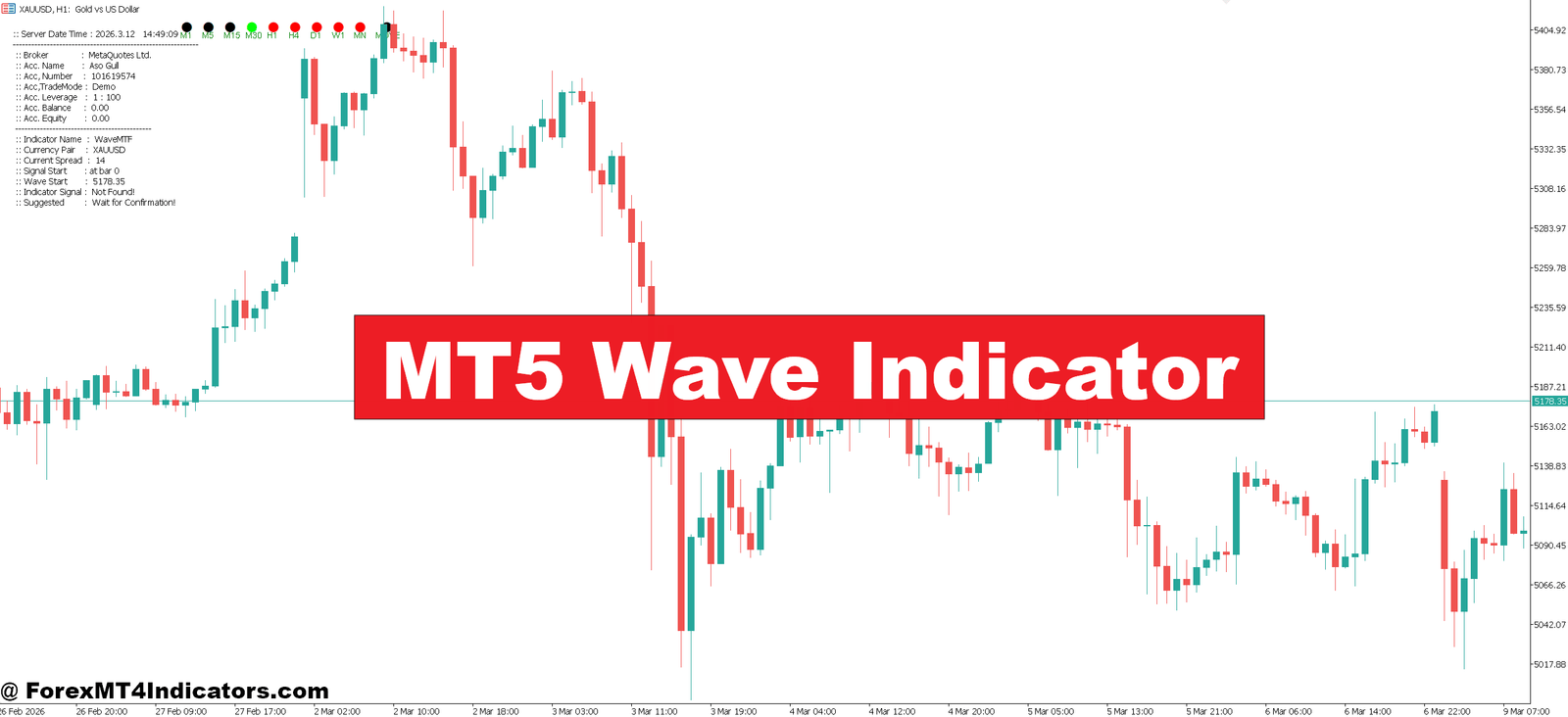

The MT5 Wave Indicator is a technical tool that visualizes market momentum through oscillating wave patterns. Unlike simple moving averages, it measures the rhythm of price swings to identify potential trend continuations or reversals. Traders often use it alongside traditional support and resistance levels to confirm signals. For example, on GBP/USD 1-hour charts during the London session, wave peaks can highlight when bullish momentum is peaking, while troughs suggest short-term exhaustion.
The indicator works by converting price movements into a smoothed wave line. This allows traders to see underlying momentum shifts that aren’t immediately obvious on candlestick charts. While it doesn’t predict the market with certainty, it acts as a guide for spotting areas where price is likely to react.
MT5 Wave Indicator How It Works

At its core, the MT5 Wave Indicator calculates momentum by comparing current price levels against a smoothed average over a defined period. Typically, traders set a period of 14 or 21 bars to balance responsiveness with noise reduction. The calculation involves:
- Measuring price changes between bars.
- Applying a smoothing function to filter out small, inconsequential fluctuations.
- Generating wave peaks and troughs that reflect overbought or oversold conditions in the short-term trend.
For instance, on EUR/JPY 4-hour charts, a wave peak aligning with resistance might indicate that the upward trend is losing steam. Conversely, when a trough coincides with support levels, it could signal a rebound. Experienced traders watch for wave crossovers and the slope direction to time entries more precisely, reducing the likelihood of chasing false breakouts.
Practical Application in Trading
Using the MT5 Wave Indicator requires pairing it with market context. Here’s a practical scenario: during an NFP release, USD/CAD 1-hour charts may show erratic price swings. The wave indicator can help distinguish between temporary spikes and genuine trend changes. Traders notice that when the wave line starts forming consistent higher lows during an uptrend, it signals sustained bullish pressure.
Another example: on AUD/USD 30-minute charts, a trader observes that the wave indicator forms a lower peak just below resistance. This suggests weakening bullish momentum, and they may tighten stops or prepare for a short position. By combining wave signals with price action, traders can enter trades closer to optimal points and avoid whipsaws.
MT5 Wave Indicator Settings and Customization

The MT5 Wave Indicator is flexible and can be tailored to different trading styles:
- Period Adjustment – Short periods (7–10 bars) react faster but generate more noise, suitable for scalping. Longer periods (21–50 bars) smooth swings for swing trading.
- Signal Sensitivity – Traders can modify smoothing parameters to make wave peaks and troughs more distinct.
- Chart Timeframes – On higher timeframes like daily charts, it filters minor fluctuations and highlights significant trend changes. On intraday charts, it can catch quick momentum shifts.
For example, setting a 14-bar period on EUR/USD 1-hour charts often balances signal accuracy with noise reduction, giving clear entry cues without too many false alarms.
Advantages and Limitations
Advantages:
- Visualizes momentum in a simple line, helping traders spot potential reversals.
- Effective on multiple timeframes, from 15-minute to daily charts.
- Enhances trade timing when combined with support/resistance and trendlines.
Limitations:
- Like any indicator, it can generate false signals during choppy markets.
- Doesn’t account for fundamental events like economic releases; traders must remain aware.
- Not a standalone system—best used in combination with other confirmation tools.
A balanced approach prevents overreliance and encourages disciplined risk management.
Comparison With Similar Indicators
Compared to traditional moving averages or RSI:
- Moving Averages – Lag behind price; MT5 Wave captures momentum shifts more visually.
- RSI – Highlights overbought/oversold conditions but lacks directional wave shape clarity.
- MACD – Shows trend and momentum but can be slower on short-term charts; MT5 Wave is more responsive for scalpers.
This differentiation helps traders choose the best tool depending on their strategy and timeframe.
How to Trade with MT5 Wave Indicator
Buy Entry
- Wave line forms higher low – Enter when the wave line on EUR/USD 1-hour chart shows a higher low, signaling bullish momentum; set stop loss 15–20 pips below recent swing low.
- Wave crosses above midpoint – When GBP/USD 4-hour chart wave crosses above its midpoint, it indicates upward pressure; confirm with bullish candlestick close.
- Price bounces from support – On AUD/USD daily chart, if price touches support and wave line rises, consider long; avoid if overall trend is strong down.
- Wave slope turns positive – Enter when the wave line slope rises sharply on USD/JPY 1-hour, suggesting trend acceleration; watch for news spikes.
- Alignment with trendline – When wave peaks align with an upward trendline on EUR/USD 4-hour, enter buy; skip if price is choppy or whipsawing.
- Wave retracement near 38–50% Fibonacci – On GBP/USD daily, buy if wave rebounds near key Fibonacci levels; risk small position if volatility is high.
- Breakout confirmation – Enter after wave confirms breakout above recent consolidation on USD/CHF 1-hour; set 20–25 pip stop below breakout.
- Momentum divergence – On EUR/JPY 1-hour, if price makes lower low but wave makes higher low, enter buy cautiously; use tight stop.
Sell Entry
- Wave line forms lower high – Enter when wave line on EUR/USD 1-hour shows a lower high, indicating weakening bullish momentum; set stop 15–20 pips above recent swing high.
- Wave crosses below midpoint – On GBP/USD 4-hour, a cross below midpoint signals bearish pressure; confirm with a bearish candlestick close.
- Price rejects resistance – On AUD/USD daily chart, sell when price hits resistance and wave line drops; avoid if trend is strong up.
- Wave slope turns negative – Enter when wave slope drops sharply on USD/JPY 1-hour, signaling trend weakening; avoid during news spikes.
- Trendline alignment – When wave troughs align with a downward trendline on EUR/USD 4-hour, enter sell; skip in sideways chop.
- Wave retracement near 50–61.8% Fibonacci – On GBP/USD daily, sell if wave retraces down near key Fibonacci resistance; use tight risk management.
- Breakdown confirmation – Enter after wave confirms breakdown below consolidation on USD/CHF 1-hour; stop 20–25 pips above breakdown point.
- Momentum divergence – On EUR/JPY 1-hour, if price makes higher high but wave makes lower high, consider short; always use proper stop loss.
Conclusion
The MT5 Wave Indicator offers traders a practical way to visualize momentum and timing. Key takeaways include:
- It highlights trend strength and potential reversals through wave patterns.
- Works across multiple timeframes and pairs, offering flexibility for different strategies.
- Best used alongside price action, support/resistance, and other confirmation methods.
- Traders should manage expectations—no tool guarantees profits.
By integrating this indicator thoughtfully, traders can reduce missed opportunities and improve decision-making, especially during trending conditions. Trading forex carries substantial risk. No indicator guarantees profits, so disciplined entry, exit, and risk management remain essential. Observing wave patterns with real market context helps sharpen intuition and timing for more consistent results.
Recommended MT4/MT5 Broker
XM Broker
- Free $50 To Start Trading Instantly! (Withdraw-able Profit)
- Deposit Bonus up to $5,000
- Unlimited Loyalty Program
- Award Winning Forex Broker
- Additional Exclusive Bonuses Throughout The Year
- Exclusive 90% VIP Cash Rebates for all Trades!


Already an XM client but missing out on cashback? Open New Real Account and Enter this Partner Code: VIP90
(Free MT4 Indicators Download)