




The NZDUSD
NZD/USD
Understanding NZD/USD: A Comprehensive GuideThe NZD/USD is a commonly offered currency pair representing the New Zealand dollar or Kiwi and US dollar. The pair is popular for exposure into a commodity currency, i.e. the NZD, which helps capture risk appetite for forex traders. Like its Antipodean counterpart, the Australian Dollar, the NZD/USD is seen as a carry trade, due in part to interest rate differentials which favor the NZD. The NZD is the world’s seventh most liquid pair at the time of
Understanding NZD/USD: A Comprehensive GuideThe NZD/USD is a commonly offered currency pair representing the New Zealand dollar or Kiwi and US dollar. The pair is popular for exposure into a commodity currency, i.e. the NZD, which helps capture risk appetite for forex traders. Like its Antipodean counterpart, the Australian Dollar, the NZD/USD is seen as a carry trade, due in part to interest rate differentials which favor the NZD. The NZD is the world’s seventh most liquid pair at the time of
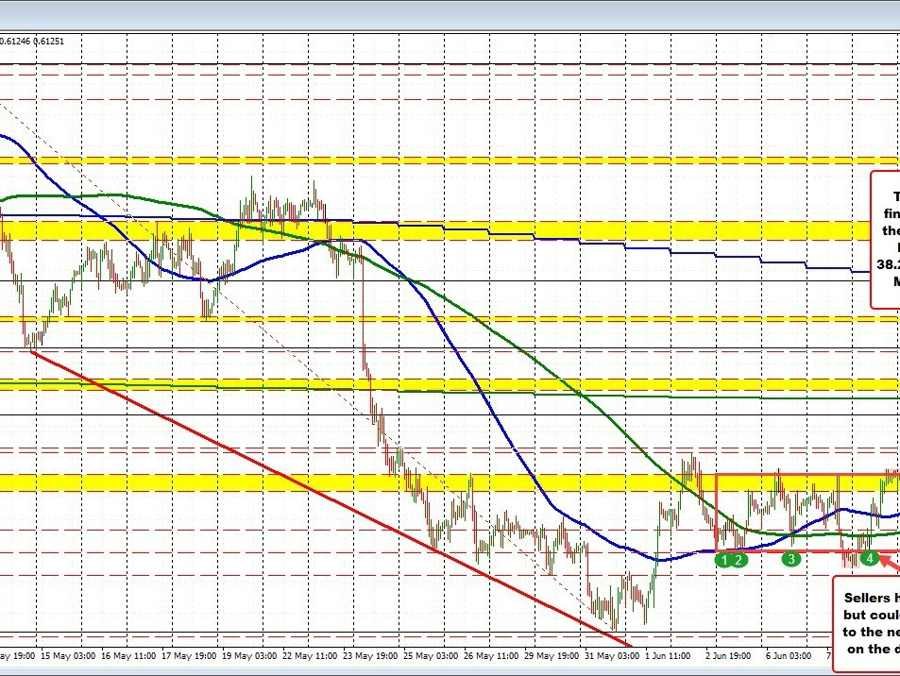
Read this Term moved higher today based on the lows against a swing area near the 0.60829 level before moving to the upside and breaking outside of what has been an up-and-down trading range until today (largely under the 0.6100 level).
The move to the upside today did extend the range for the week and moved up to test the 38.2% retracement of the May trading range. The retracement level came in at 0.61367 and that’s where the price stalled.
If the buyers are to take more control, getting above the 38.2% retracement is a minimum retracement level needed to show that they are serious about moving against the current trend. Absent that, the move to the upside is just a “plain vanilla” correction.
So as we head into the new trading week, getting about 38.2% retracement will be needed going forward. If the price can move above that level the 200-day moving average
Moving average
A moving average is a statistical tool that is used to smooth out short-term fluctuations in data and reveal longer-term trends. It is calculated by taking the average of a certain number of data points over a specific period of time, and then plotting that average as a line on a chart. The most common types of moving averages are simple moving averages (SMA) and exponential moving averages (EMA).In financial markets, moving averages are often used to analyze stock prices, exchange rates, and ot
A moving average is a statistical tool that is used to smooth out short-term fluctuations in data and reveal longer-term trends. It is calculated by taking the average of a certain number of data points over a specific period of time, and then plotting that average as a line on a chart. The most common types of moving averages are simple moving averages (SMA) and exponential moving averages (EMA).In financial markets, moving averages are often used to analyze stock prices, exchange rates, and ot
Read this Term at 0.6148 level would be the next close hurdle. The price in the NZDUSD has not been above the 200-day moving average since breaking below it on May 24. Move above that level and 50% of the same move down would be targeted at 0.61838
On the downside, failure to get above the 38.2% retracement would have traders thinking toward a retest of the 0.6100 level. Move below that level and the 100 and 200-hour moving averages will be in play (blue and green lines on the chart below).
So although the price is solidly higher in trading today, the buyers could not really break to the upside and give the buyers more confidence. As a result, traders will go into the new week with the continued battle between buyers and sellers in the NZDUSD pair.
NZDUSD


