







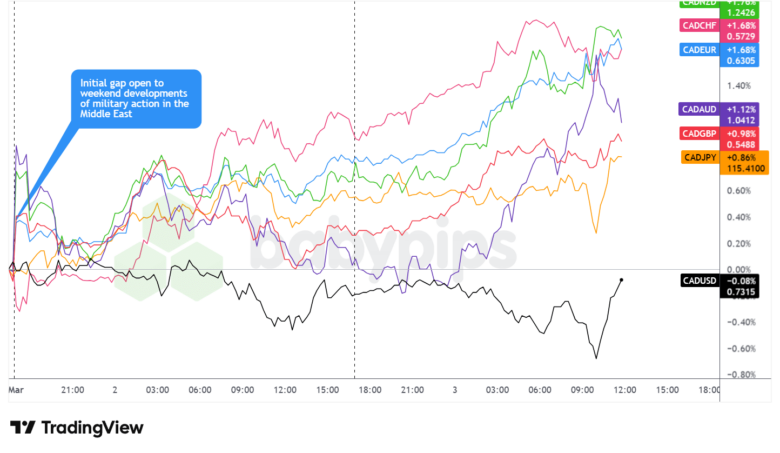
When crude oil prices spiked past $83 a barrel this week due to supply threats in the Strait of Hormuz, the Canadian dollar (CAD) began outperforming most major currencies. This occurred because Canada’s status as a top global oil exporter means its currency naturally tends to strengthen when energy prices rise.
If you are wondering why the CAD is suddenly leaving the euro (EUR) and Japanese yen (JPY) in the dust—while still fighting to keep pace with the U.S. dollar (USD)—let’s break down the mechanics.
Conflict in the Middle East
Over the past few days, escalating geopolitical conflict in the Middle East has brought commercial shipping through the Strait of Hormuz to a near standstill. Because roughly 20% of the world’s global oil consumption passes through this narrow waterway, the threat of a supply bottleneck sent a shockwave through energy markets.
Brent crude (the global benchmark for oil) jumped sharply, reaching highs not seen since 2024. But in the forex market, a spike in oil is never just a spike in oil. It represents a massive wealth transfer from countries that buy oil to countries that sell it.
This brings us to Canada. Canada is one of the world’s largest producers and exporters of crude oil. Because of this heavy reliance on energy exports, the Canadian dollar is widely considered a “commodity currency” or a “petrocurrency.” When the price of oil goes up, the value of the Loonie typically follows suit.
Why is the Canadian Dollar Outperforming Its Peers?
Overlay of CAD vs. Major Currencies – Chart Faster With TradingView
To understand the Canadian dollar’s outperformance, we have to look at a concept called “terms of trade.” This is a fancy economic term that simply measures the ratio of a country’s export prices to its import prices.
When oil prices skyrocket, Canada’s terms of trade improve dramatically. Here is how that mechanism generally plays out:
- Canada sells its oil to the global market at much higher prices.
- This influx of revenue increases the flow of foreign capital into the Canadian economy.
- Buyers need Canadian dollars to purchase Canadian goods, which likely drives up demand for the CAD.
As a result, the CAD has been outperforming currencies of nations that are heavy net-importers of energy. For example, the Eurozone and Japan rely heavily on imported oil. For them, $83+ crude acts like a massive, unexpected tax on their economies, leading traders to favor pairs like EUR/CAD (which moves lower) and CAD/JPY (which moves higher).
However, you might notice the CAD isn’t dominating the U.S. dollar. The USD is holding its ground because it acts as the market’s ultimate “safe haven” during geopolitical panic, and the U.S. is also a massive energy producer itself.
Promoted: Stop Risking Your Own Capital on Unpredictable Geopolitics.
You’ve read the fundamental breakdown and spotted the CAD’s momentum—but playing big macro shifts requires serious capital. With FundingPips, you trade a simulated account and can earn up to 100% of your rewards. Whether you’re looking for a 2 Step PRO evaluation starting at just $29 or seeking funding options up to $300K, you have the flexibility to trade your way.
Learn more about FundingPips and use code HELLO to get 20% OFF your first purchase!
Disclosure: We may earn a commission from our partners if you sign up through our links, at no extra cost to you.
What Does This Mean for Traders?
If the conflict in the Strait of Hormuz persists and oil remains elevated, historical patterns suggest the Canadian dollar may continue to find support, especially against the currencies of energy-starved economies. Traders may want to watch cross pairs like CAD/CHF or EUR/CAD for potential setups driven by this divergence.
But markets are complex, and the CAD isn’t invincible. There are a few counterarguments to Canadian dollar bullishness that traders must keep on their radar:
- Global Demand Destruction: If oil shoots up to $100 or $120 a barrel, it could trigger a global recession. A shrinking global economy means people buy fewer goods, travel less, and ultimately need less oil. If global demand collapses, commodity currencies like the CAD are historically the first to suffer.
- Domestic Economic Headwinds: The Bank of Canada (BoC) has to balance the boost from oil with the reality of Canada’s domestic economy. Canadian consumers are carrying record levels of household debt, largely tied to a fragile housing market. If the BoC is forced to cut interest rates to save the domestic consumer, a widening interest rate gap with the U.S. could weigh heavily on the CAD.
- The “Risk-Off” Environment: If the geopolitical conflict expands significantly, panic tends to drive investors straight into cash—specifically the U.S. dollar and the Swiss franc (CHF). In a true panic scenario, the CAD’s oil advantage might be entirely eclipsed by the broader rush to safety.
The Bottom Line
- The Catalyst: Disruptions in the Strait of Hormuz have pushed oil prices significantly higher, injecting a geopolitical risk premium into the energy market.
- The Reaction: The Canadian dollar is outperforming oil-importing currencies (like the EUR and JPY) because Canada’s economy benefits from higher crude export revenues.
- The Nuance: The CAD is still struggling to beat the USD, as the greenback benefits from both safe-haven flows and domestic U.S. energy independence.
- The Risk: Persistently high oil prices could eventually cause global “demand destruction,” which historically hurts all commodity-linked assets.
What to Watch Next
Traders should keep a close eye on official headlines regarding the Strait of Hormuz—any sign of de-escalation could cause oil prices (and the CAD) to retrace quickly. Additionally, watch the upcoming U.S. Energy Information Administration (EIA) crude inventory reports, and any forward guidance from the Bank of Canada (BoC) regarding how they plan to navigate this sudden inflationary shock.
This article is for educational purposes only. It does not constitute financial advice. Trading involves substantial risk, and past performance is not indicative of future results. Always do your own research and consider consulting with a qualified financial advisor.
Promoted: Master Your Execution During Macro Shocks
When sudden geopolitical headlines send oil and the CAD spiking, does your execution stay clinical or get emotional? TradeZella’s trade replay tool lets you revisit your past trades tick-by-tick. See exactly where your entry slipped or why you hesitated, so you can dominate the next volatility spike with a data-driven playbook.
Start Your Journal with Tradezella and use code “PIPS20” to save 20%!
Disclosure: To help support our free daily content, we may earn a commission from our partners if you sign up through our links, at no extra cost to you.


