







New Zealand’s Q1 2026 employment report delivered a modest but meaningful beat against expectations, as the jobless rate ticked lower while wage growth accelerated.
Combined with a generally risk-on lean from cautious optimism for a US-Iran peace deal, the results kept the Kiwi supported while RBNZ expectations remained well-anchored.
Watchlists are price outlook & strategy discussions supported by both fundamental & technical analysis, a crucial step towards creating a high-quality discretionary trade idea before working on a risk & trade management plan.
If you’d like to follow our “Watchlist” picks right when they are published throughout the week, check out our BabyPips Premium subscribe page to learn more!
The Setup
What We Were Watching: New Zealand Labor Market Report (Q1 2026)
- Expectation: Unemployment rate to tick down to 5.3% from 5.4% prior; employment change to rise 0.3% q/q from 0.5% prior
- Data outcome: Unemployment rate fell to 5.3%; employment change came in at 0.2% q/q; LCI held at 0.4% q/q
- Market environment surrounding the event: Broad risk sentiment was cautiously constructive heading into the release, with Tuesday’s Pentagon ceasefire reassurances having unwound much of Monday’s Hormuz-driven fear. Equities at fresh all-time highs, and the RBA’s third consecutive rate hike to 4.35% kept commodity currency appetite supported.
Event Outcome
New Zealand’s Q1 2026 labor market report delivered a headline beat, but the details were more mixed. The unemployment rate slipped to 5.3%, matching both market expectations and the RBNZ’s forecast, though the drop was partly helped by a lower participation rate of 70.4%. Employment grew just 0.2% q/q, missing the 0.3% forecast and slowing from Q4’s 0.5% gain.
Wage growth also stayed soft, with the Labour Cost Index holding at 2.0% y/y, underutilization steady at 12.9%, and little sign that labor costs are adding fresh inflation pressure.
Key Takeaways:
- Unemployment rate fell to 5.3% in Q1 2026, matching both the 5.3% consensus and the RBNZ’s forecast and improving from 5.4% in Q4 2025; the decline was partly attributable to a dip in the participation rate to 70.4% from 70.5%, rather than a broad acceleration in hiring
- Employment change came in at +0.2% q/q, missing the 0.3% forecast and slowing from +0.5% prior; underutilization held at 12.9%, with approximately 406,000 people underutilised across unemployment, underemployment, and available-but-not-counted categories
- Private sector labour cost index rose 0.4% q/q and 2.0% y/y; all-sector wage growth running at 2.0% annually remains well below the 3.1% CPI reading, indicating labor costs are not yet contributing materially to inflation
- The headline beat was sufficient to keep RBNZ tightening expectations intact, with markets pricing a 35% chance of a May hike and a July move fully priced in following the release
- Economists flagged that Q1 data may not yet capture the full labor market impact of the U.S.-Iran conflict, with the employment hit from that shock potentially taking another six to twelve months to fully materialize
The New Zealand dollar strengthened broadly after the release, as traders focused on the unemployment rate beating the 5.4% forecast and kept bidding NZD through the rest of the session. The main exception was AUD/NZD, which traded mostly flat as both commodity currencies moved in sync, limiting any real divergence on the cross.
Fundamental Bias Triggered: Despite softer employment growth and wage data, the headline unemployment rate still beat consensus. Combined with sustained RBNZ tightening expectations, that was enough to trigger a net bullish NZD reaction and keep the hawkish repricing narrative intact.
Promotion: Top-tier catalysts like the New Zealand’s quarterly jobs report can trigger emotional execution. TradeZella AI powered journal turns your raw data into a high-performance playbook. Sync your broker, replay your trades bar-by-bar, and use the Playbook Designer to ensure that next time an economic data point surprises the market, you’re executing with clinical precision.
Click on the link to learn more and use code “PIPS20” to save 20% off first purchase!
Disclosure: We may earn a commission from our partners if you sign up through our links, at no extra cost to you.
Broad Market and Exogenous Drivers:
Geopolitical Escalation and Reassurance (Monday-Tuesday)
The week opened sharply risk averse as confirmed U.S. Iran exchanges of fire in the Strait of Hormuz drove safe haven flows into the dollar and yen. Japanese and Chinese markets were closed for an extended holiday, thinning liquidity and amplifying the moves. NZD sold off with other high beta currencies, pressured further by Trump’s Project Freedom announcement, which Iran called a ceasefire violation.
Tuesday brought relief after Pentagon officials said the ceasefire technically remained in place. The RBA delivered its third hike of the year, but Governor Bullock’s neutral tone pushed the next expected move to September. Risk appetite then recovered through London and the U.S. session, erasing most of Monday’s losses.
Peace Deal Optimism and NZD Jobs Catalyst (Wednesday)
Wednesday was driven by geopolitical relief after Axios reported, and a Pakistani diplomatic source confirmed via Reuters, that the U.S. and Iran were nearing a framework deal to gradually reopen the Strait of Hormuz.
Trump also said Project Freedom had been paused as a confidence-building step. WTI crude plunged more than 7% to around $92.50, the S&P 500 hit fresh records, and DXY fell from about 98.30 to 97.89 during Asia. That was the backdrop for New Zealand’s Q1 jobs report. China’s RatingDog Services PMI beat at 52.6, and ADP employment topped forecasts at 109K, while weak eurozone Services PMIs, Germany at 46.9 and the broader region at 47.6, weighed on the euro.
Deal Skepticism and Late Week Reversal (Thursday-Friday)
Thursday cooled the rally after Iran attacked three U.S. warships and doubts resurfaced over whether a deal was close. Kashkari warned that a prolonged Hormuz closure could force Fed rate hikes, lifting Treasury yields and making the dollar the top major. NZD pulled back with risk sentiment.
Friday’s mood improved after the U.S. April NFP beat at 115K, though record low UMich sentiment at 48.2 kept stagflation worries alive. A late Russia-Ukraine ceasefire announcement gave risk one final lift, leaving NZD as the week’s top major currency.
NZD/USD: Bullish NZD Event Outcome + Risk-On Scenario = Arguably good odds of a net positive outcome
NZD/USD 1-hour Forex Chart Faster with TradingView
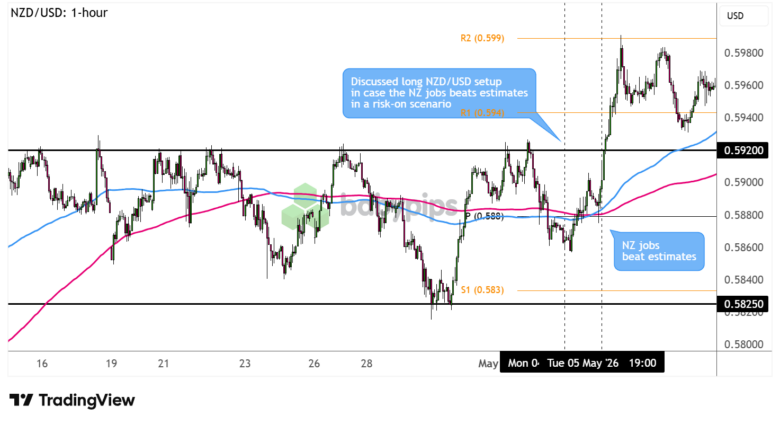
Last week, our analysts identified NZD/USD as the setup to watch if New Zealand’s labor market beat estimates within a supportive risk environment. Both conditions were nominally met: the unemployment rate printed at 5.3%, edging out the 5.4% consensus.
In addition, Wednesday’s session was defined by one of the week’s strongest risk-on moves as reports of a U.S.-Iran framework agreement broke during the Asian hours. On that basis, this watchlist discussion on NZD/USD was arguably the setup best positioned to move beyond the watchlist stage.
By the time the jobs data was printed, NZD/USD had already climbed to its strongest level in two months. The pair was being driven by the broad dollar selloff and high-beta currency bid that preceded the release, not by any anticipation of the domestic outcome.
The original technical entry levels discussed in the watchlist were no longer valid, so traders would have needed to adapt to the new price picture entirely. The data itself offered limited independent fuel: employment change missed at 0.2% against a 0.3% forecast, the participation rate dipped, and wages held at 2.0% annually against a 3.1% CPI reading. The unemployment beat confirmed the RBNZ’s own projection, keeping existing rate hike pricing intact, but it did not shift the policy outlook.
Put plainly, NZD’s move hinged on “a lot of borrowed risk sentiment.” Thursday’s session underlined this point. As Iran deal skepticism resurfaced, NZD/USD gave back a meaningful portion of its gains with little domestic support to fall back on.
Those already positioned ahead of the data by riding the geopolitical risk trade rather than waiting for the jobs print were best placed to see a positive outcome. Those entering at or above post-event levels were relying on further sentiment follow-through that Thursday’s reversal quickly tested.
Promoted: Capitalize on the News Events Without Risking Your Own Funds.
In an economic data surprise, the corresponding currency can swing wildly intraday. Why risk your personal capital during extreme volatility?
Most proprietary firms terminate your evaluation account if you execute a trade during a major macroeconomic release, but FundedNext permits news trading across all models. Test 020your thesis with up to $300,000 in simulated capital, or take advantage of their Free Trial to experience the platform risk-free.
Explore FundedNext and Start Your Free Trial!
Disclosure: We may earn a commission from our partners if you sign up through our links.
Not Eligible to Move Beyond Watchlist – EUR/NZD & Bearish NZD Setups
EUR/NZD: Bullish NZD Event Outcome + Risk-Off Scenario

EUR/NZD 1-hour Forex Chart Faster with TradingView
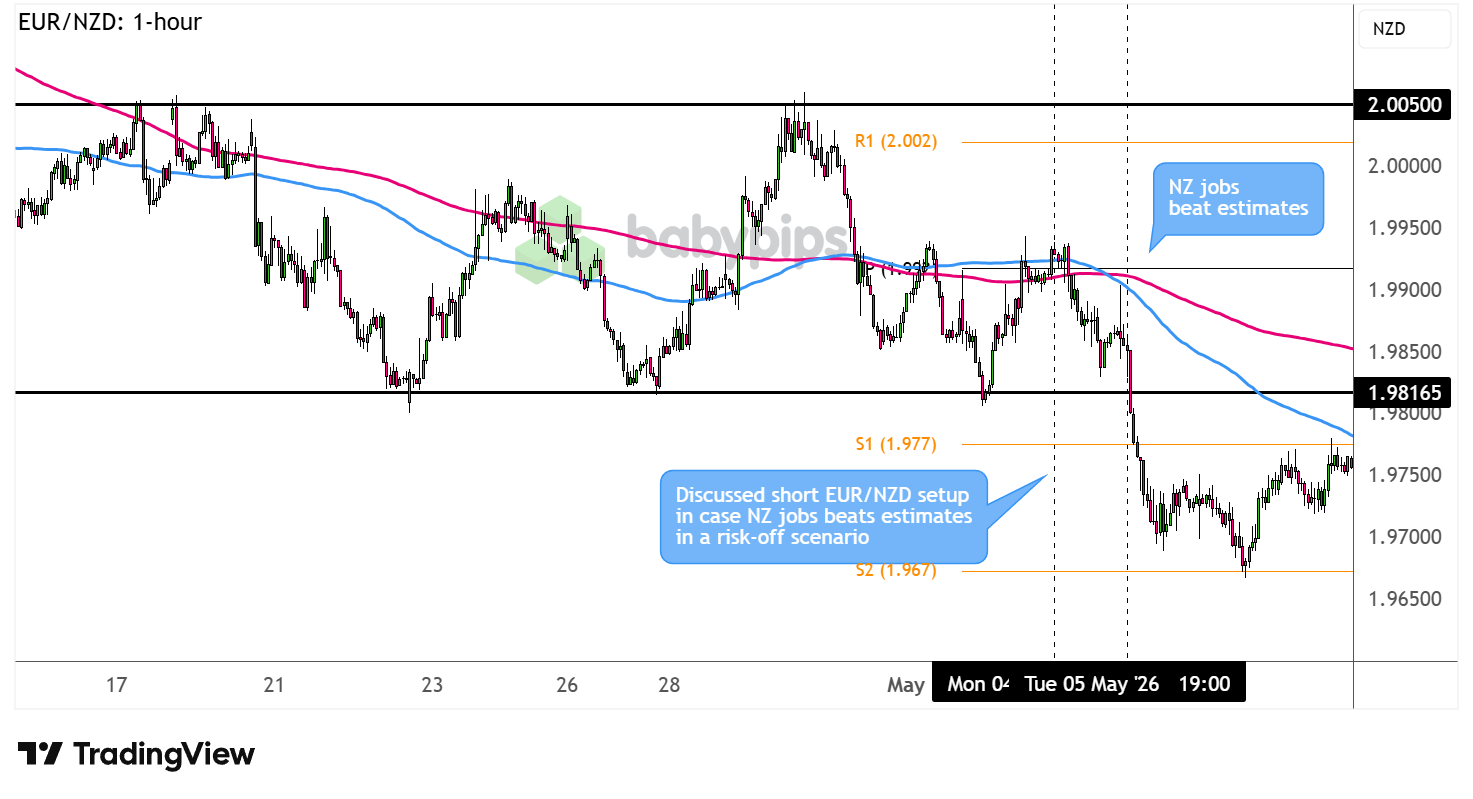
The EUR/NZD watchlist setup needed the NZD jobs beat to land in a risk-off environment. The idea was that renewed Middle East uncertainty would pressure the euro, while a resilient Kiwi gave the pair enough downside momentum. New Zealand’s unemployment rate did beat at 5.3%, so the data condition was met.
The market backdrop, however, was the week’s strongest risk-on session, fueled by coordinated U.S. de-escalation signals and optimism around a possible Iran deal. That means the required setup was not fully triggered, so EUR/NZD didn’t qualify for a move beyond the watchlist stage on the original terms.
That said, the pair still fell sharply. EUR/NZD broke below the 1.9816 area, extended toward S1 at 1.977, and kept sliding from there. The move likely reflected two cross-specific domestic drivers: NZD strength after the jobs data and euro weakness after deeply contractionary Euro Area services PMIs, with Germany at 46.9 and the broader region at 47.6. In other words, the euro could not catch a bid even while global risk appetite improved.
The trade probably would have worked, but not for the reason the original scenario laid out. The key drivers were still there: NZD had support from the labor market headline, while the euro was hit by weak PMI data.
But risk-off flows were not the engine. Cross-specific fundamentals were. Traders who spotted that shift and built the short case around EUR/NZD’s own dynamics had a legitimate adapted argument. The original setup did not match the market backdrop, but the directional thesis still held up.
AUD/NZD: Bearish NZD Event Outcome + Risk-On Scenario

AUD/NZD 1-hour Forex Chart Faster with TradingView
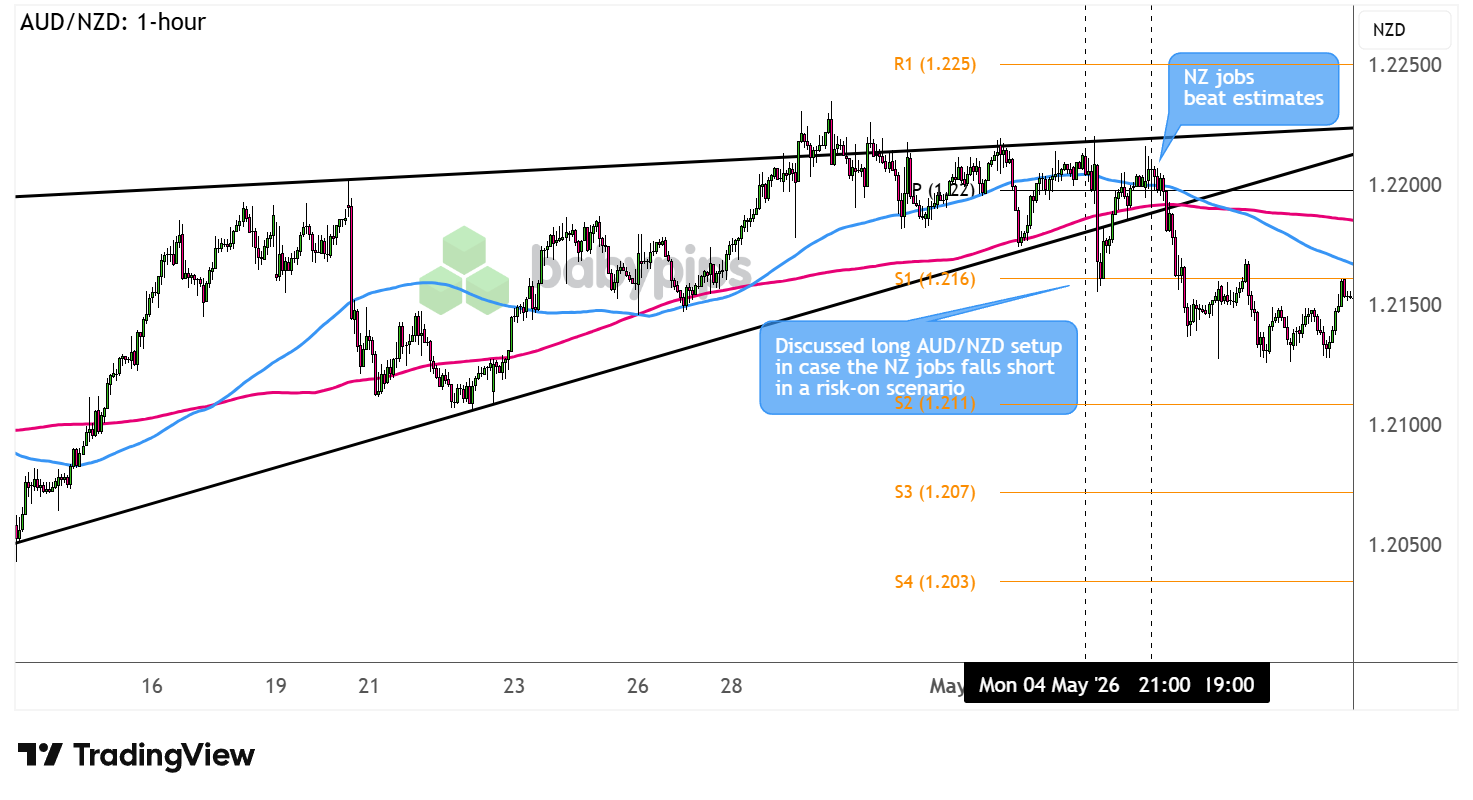
This watchlist idea flagged a rising wedge pattern, with AUD/NZD gearing up for a potential test of resistance ahead of the target event and possibly gearing up for a bullish breakout in case the New Zealand jobs numbers fall short of estimates in a risk-on setting.
Although risk sentiment was supportive of higher-yielding currencies during the release, the jobs numbers turned out to be net positive for the Kiwi since the unemployment rate ticked lower while wage growth accelerated, rendering this setup not eligible to move beyond the watchlist stage.
In addition, the RBA decision prior to the jobs release wound up overall bearish for the Aussie when policymakers did not sound as hawkish as expected, allowing the wedge resistance to hold and even pushing AUD/NZD below the support after the central bank announcement. This slight shift in tone also kept the Aussie on the back foot versus the Kiwi for the remainder of the week.
With that, the pivot point near the 1.2200 major psychological mark and 100 SMA dynamic inflection point held as a solid ceiling during the target event, forcing AUD/NZD to slump back to S1 (1.2160) a few hours after the numbers were printed.
Further downside was seen in the next trading sessions while markets repriced RBNZ tightening expectations and risk-taking favored the Kiwi, given the shift in RBA policy dynamics. AUD/NZD consolidated below S1 and around the 1.2150 minor psychological mark towards Friday’s close on US-Iran diplomatic uncertainty.
NZD/JPY: Bearish NZD Event Outcome + Risk-Off Scenario
NZD/JPY 1-hour Forex Chart Faster with TradingView
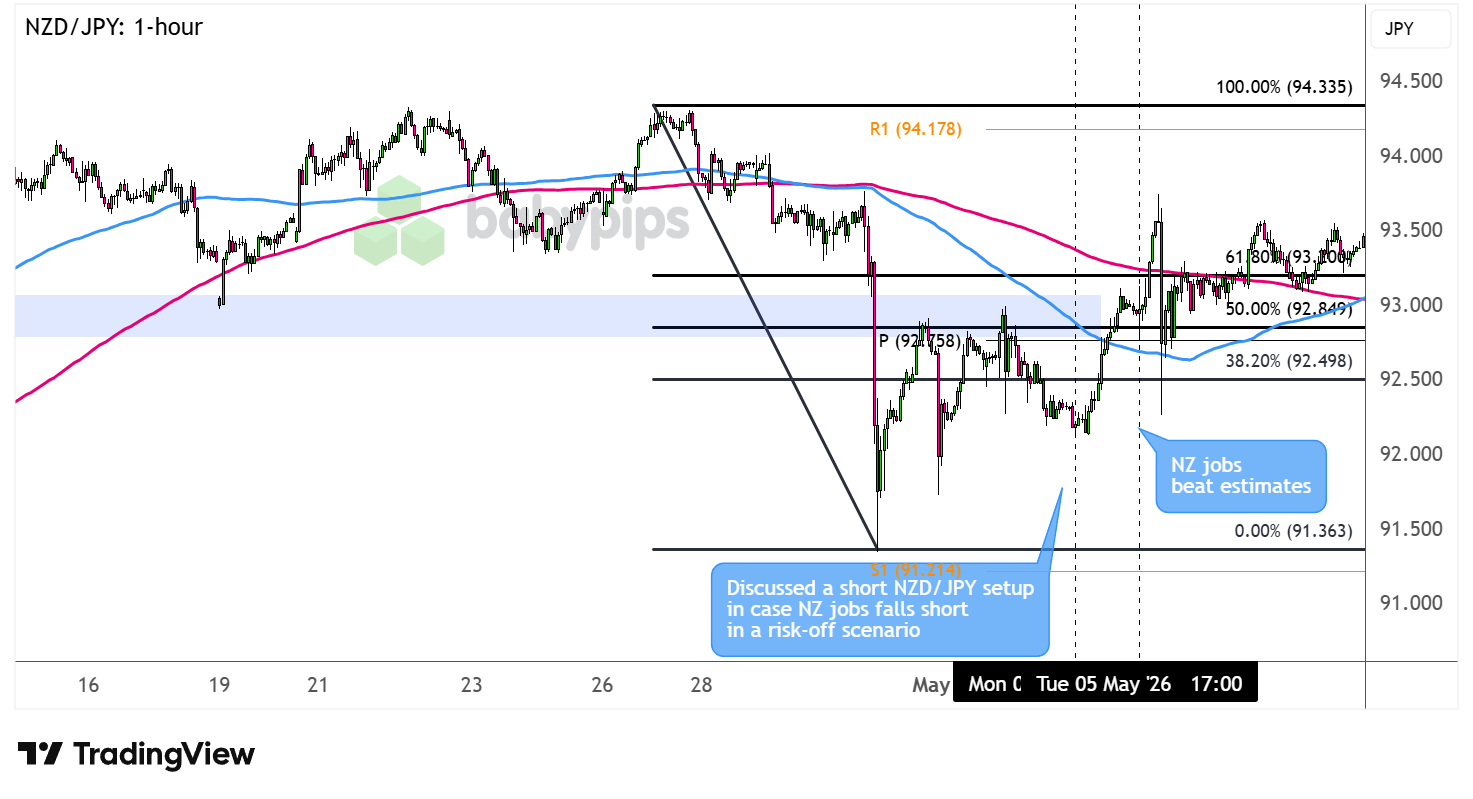
This NZD/JPY watchlist idea looked into an ongoing correction to the 50% Fib and pivot point (92.75) ahead of the target event, projecting that the area of interest could hold or that bearish pressure could pick up enough for a dip to the previous lows should the jobs numbers disappoint.
The actual report turned out net positive for the Kiwi, with markets focusing on the dip in unemployment and pickup in wage growth, while risk sentiment leaned towards cautious optimism for diplomacy between the US and Iran. Our original setup discussion was invalidated from moving beyond the watchlist stage.
NZD/JPY busted through the ceiling close to the 93.00 handle and even zoomed to highs around the 93.50 minor psychological mark as risk-taking on de-escalation kicked in strongly midweek.
Though unconfirmed Japanese government intervention on Wednesday still kept the yen’s losses in check and triggered additional volatility afterwards, the pair maintained its bullish lean and slowly trudged higher for the remainder of the week while markets priced in stronger odds of a neutral-to-hawkish RBNZ.
NZD/JPY cruised back to test its intraweek highs close to the 93.50 mark and held on to this resistance towards Friday’s close while markets digested persistent uncertainty surrounding US-Iran negotiations.
The Verdict
NZD/USD moved higher around New Zealand’s Q1 2026 labor market release, but the weekly recap had the right read: Kiwi’s gains depended on one domestic print and a lot of “borrowed risk appetite.”
The unemployment rate slipped to 5.3%, matching the RBNZ’s own forecast rather than delivering a clear hawkish surprise. That was enough to support the existing Kiwi bid and keep RBNZ hike pricing alive, but it was not a strong catalyst by itself.
The bigger push came from the geopolitical backdrop. Iran deal optimism had already dragged the dollar to weekly lows and lifted NZD/USD to two-month highs before the jobs data printed. In other words, the report landed after the move was already well underway.
The technical setup was also no longer clean by the time of the release since NZD/USD had already broken above the key watchlist levels. That made the original entry structure outdated. Thursday’s reversal, as Iran deal doubts returned and the dollar bounced sharply, showed the risk of a move built mostly on sentiment.
Overall, we’d rate this NZD/USD discussion as neutral for a net positive outcome. The direction was right, but the main driver sat outside the labor market setup, the data was mixed under the hood, and the outcome depended heavily on timing. Traders who caught the risk rally early likely did well, while those waiting for the jobs print were probably chasing a move that had already priced in much of the thesis.
Key Takeaways:
Sometimes, positioning matters more than the data print
When a major data release lands in the middle of a strong geopolitical risk move, the event itself can become secondary. NZD/USD gained more from Iran deal optimism and a weaker dollar than from New Zealand’s jobs data. Traders who treated the move as sentiment-driven likely had a cleaner read than those waiting for a textbook data trade.
A headline beat that matches the central bank’s forecast is not automatically hawkish
New Zealand’s unemployment rate fell to 5.3%, beating the 5.4% market forecast but matching the RBNZ’s own projection. That confirmed the existing policy outlook rather than strengthening the case for faster tightening. With employment growth missing and wages still running below CPI, the data kept the RBNZ path intact but did not meaningfully upgrade it.
As we saw with New Zealand’s Q1 2026 labor market release, major currency pairs move quickly in the absence of a broader catalyst. Choppy price action, shifting geopolitical headlines, and mixed underlying data can quickly invalidate a technical setup before you even have a chance to enter. If you were just blindly chasing signals, a week like this might leave you frustrated or second-guessing your edge.
But trading isn’t about perfectly predicting the future; it’s about being prepared for any scenario.
That is exactly what BabyPips Premium is designed to do. We don’t just hand you a directional bias and wish you luck. We provide the comprehensive fundamental context, the technical zones of interest, the “what-if” alternate scenarios, and the weekly recaps so you understand exactly why the market is moving the way it is.
Even when a Watchlist setup doesn’t trigger, gets invalidated by sudden risk-on flows, or ends in a choppy breakeven, the deep-dive analysis provided in our Premium content gives you a crucial advantage. It equips you with the situational awareness to adapt your strategy on the fly, manage your risk like a pro, and execute your chosen trades with absolute confidence.
Stop guessing at the headlines and start trading with conviction. Unlock BabyPips Premium today and get the daily insights you need to navigate whatever the market throws your way.


