






The Reserve Bank of New Zealand (RBNZ) lowered interest rates from 3.25% to 3.00% in August, marking its seventh interest rate cut since starting its rate cut cycle in August 2024.
The Monetary Policy Committee reached a split 4-2 decision in favor of the 25bp cut, with two members preferring a larger 50bp reduction, reflecting the central bank’s concern about the stalled economic recovery and significant spare capacity.
Key Takeaways:
- RBNZ reduced OCR by 25bp to 3.00% in a 4-2 split vote, with minority favoring 50bp cut
- Annual CPI at 2.7%, expected to briefly peak at 3.0% in Q3 2025 before returning to 2% target by mid-2026
- New Zealand’s economic recovery stalled in Q2 2025, with high-frequency data suggesting contraction
- Central bank projects OCR falling to 2.71% by year-end 2025 and 2.55% in early 2026
- Door left open for further easing if medium-term inflation pressures continue to moderate
Link to official RBNZ Monetary Policy Statement for August 2025
The RBNZ highlighted that New Zealand’s economy has stalled, with household and business spending constrained by global economic policy uncertainty, falling employment, higher prices for essentials, and declining house prices. The central bank emphasized the presence of significant spare capacity in the economy and declining domestic inflation pressure as justification for continued monetary easing.
In his presser, RBNZ Governor Christian Hawkesby struck a dovish tone that reinforced expectations for more aggressive easing ahead. He stressed that the “next two meetings are live” with “no decisions made,” while confirming the OCR projection bottoms out around 2.5%, consistent with further cuts.
Hawkesby also pointed out that the RBNZ had “never had a 4 to 2 vote before,” underlining the unusual split within the committee. He added that Q2 economic activity was “considerably weaker than expected” and that house prices were “not rising as we had expected,” warning that if businesses and consumers remain cautious, it could call for more policy action. Importantly, he said the OCR is “not restrictive anymore” and welcomed the weaker New Zealand dollar, a clear signal the RBNZ is comfortable letting the currency slide to support the economy.
Market Reaction:
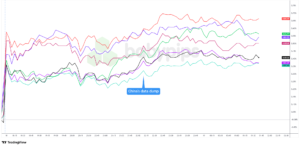
New Zealand Dollar vs. Major Currencies: 5-min
Overlay of NZD vs. Major Currencies Chart by TradingView
The New Zealand dollar, which had been ranging with a bearish lean ahead of the release, dropped sharply at the RBNZ’s “dovish cut” event.
NZD fell the most against safe-haven currencies, with NZD/JPY down 0.85% and NZDC/HF dropping 0.70%, while NZD/USD declined 1.10%, NZD/EUR and NZD/CAD both fell 0.90%, and NZD/GBP showed relative resilience with only a 0.30% decline.
The sharp selloff may have been fueled by several factors: the surprising 4 to 2 split vote that showed serious debate over a larger 50bp cut, dovish guidance projecting rates dropping to 2.55% by early 2026 from 2.85% before, the admission that New Zealand’s recovery has “stalled” after weaker than expected Q2 data, and growing worries about global trade tensions feeding risk-off sentiment.
Even though the 25bp cut matched consensus, markets took the overall tone as more dovish than expected, pricing in a more aggressive easing path and keeping steady selling pressure on Kiwi.


