

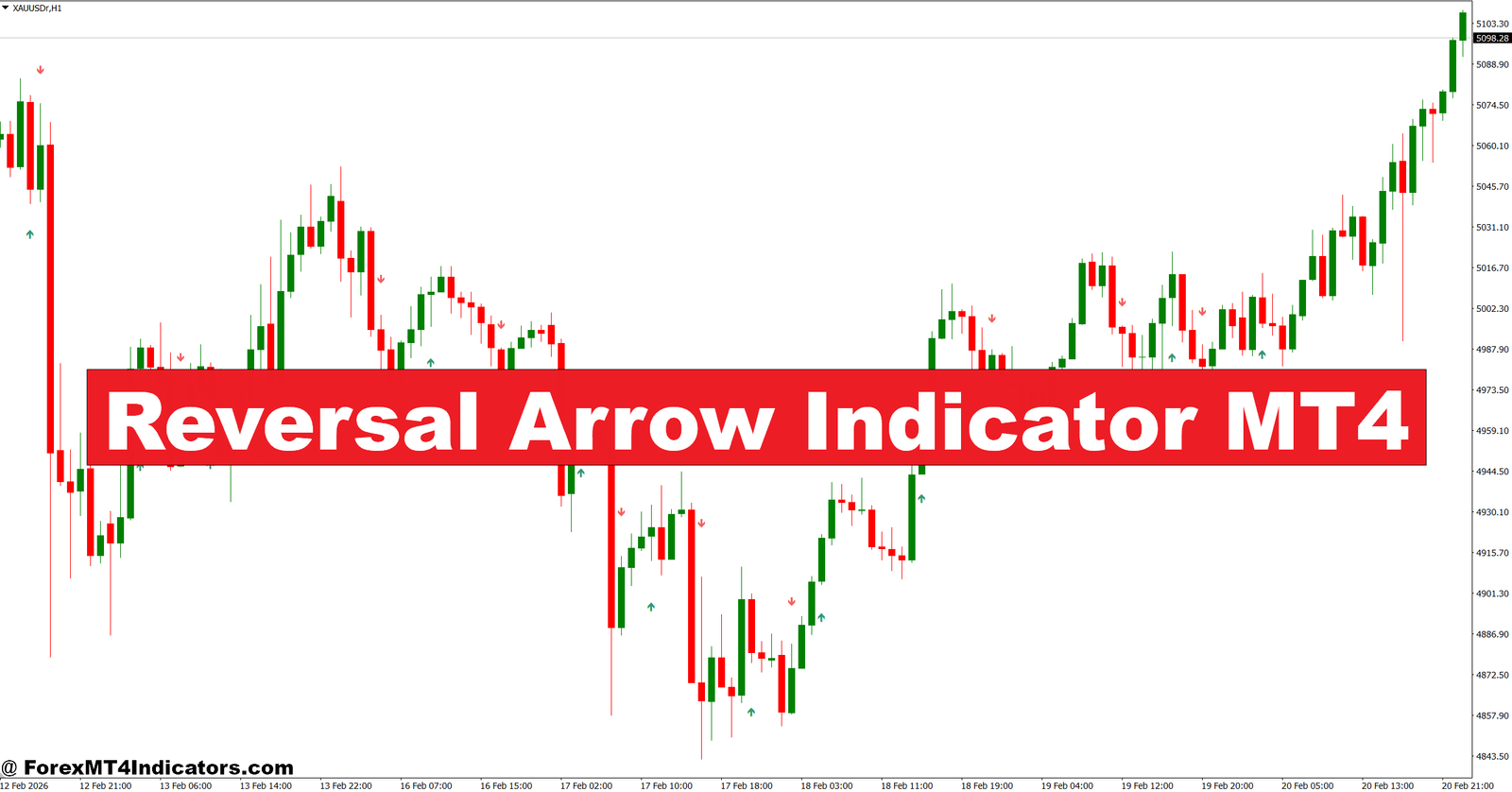

The Reversal Arrow Indicator MT4 is designed to mark possible market reversals directly on the chart using visual arrows. Instead of guessing where the trend might change, traders receive a clear signal that price momentum may be shifting.
The following sections explain how this indicator works, how traders apply it in real trading conditions, and where it fits within a broader technical analysis strategy.
Understanding the Reversal Arrow Indicator MT4
The Reversal Arrow Indicator MT4 is a technical analysis tool that identifies possible trend reversals and displays them as arrows above or below price candles. A downward arrow normally suggests potential selling pressure, while an upward arrow indicates a possible bullish reversal.
Most versions of this indicator combine several technical signals. These may include moving average crossovers, price momentum filters, and volatility calculations. When multiple conditions align, the indicator prints an arrow on the chart to alert traders.
For example, a trader analyzing GBP/USD on the 30-minute timeframe might notice a series of bearish candles. Suddenly an upward arrow appears below a candle near a support zone. That signal suggests the selling momentum may be slowing and buyers could be entering the market.
The visual nature of arrow indicators makes them especially helpful for traders who prefer simple chart signals instead of complex indicator panels. They are often used by scalpers and intraday traders who need quick decision support.
Still, arrows should not be treated as automatic trade commands. Experienced traders combine them with price action, support and resistance levels, and trend analysis before opening a position.
How the Indicator Identifies Market Reversals

Behind the simple arrow signal, the Reversal Arrow Indicator MT4 usually follows a structured calculation process. While the exact formula varies depending on the version, the core idea is momentum exhaustion.
The indicator monitors several conditions:
- Price deviation from short-term moving averages
- Momentum slowing after strong directional movement
- Overbought or oversold market conditions
- Candle structure that signals rejection of a price level
When these factors appear together, the indicator interprets the situation as a possible reversal.
Consider a real trading example. EUR/USD on a 1-hour chart climbs steadily for several hours and moves about 60 pips above its 20-period moving average. During the next candle, price forms a long upper wick near resistance. If momentum indicators also show weakening strength, the indicator may print a downward arrow above the candle.
This signal suggests buyers are losing control and sellers might push price lower.
However, market structure matters. During strong trends arrows may appear several times before an actual reversal happens. Traders often wait for confirmation, such as a bearish candle close or a break of a short-term support level.
Testing the indicator during high-impact events can also reveal its behavior. When testing this on volatile Non-Farm Payroll release days, arrows appeared more frequently due to sharp price swings. That observation shows why traders must consider market conditions before relying on signals.
Practical Trading Applications
In real trading environments, the Reversal Arrow Indicator MT4 is often used as a timing tool rather than a complete trading strategy.
A common method involves combining the indicator with support and resistance zones.
Example scenario:
USD/JPY on the 1-hour timeframe approaches a strong resistance level around 150.80. The pair has already gained nearly 90 pips during the London session. As price tests the resistance area, a downward arrow appears above the candle.
A trader might interpret this as a potential short opportunity.
Entry could occur after the next bearish candle closes. Stop-loss might be placed 15–20 pips above the resistance zone, while the first profit target could sit near the previous intraday support level.
Another approach works in trending markets.
Suppose AUD/USD trends upward on the 4-hour chart. Price pulls back temporarily, and an upward arrow appears near a rising support line. Instead of chasing price at the top, the indicator helps the trader enter during the pullback.
That type of setup often produces better risk-to-reward ratios.
Still, arrows inside sideways markets require caution. During range conditions, signals may appear frequently and create what traders call “whipsaw” trades.
Reversal Arrow Indicator MT4 Settings and Customization Options

Most versions of the Reversal Arrow Indicator MT4 allow traders to adjust several parameters. These settings help adapt the tool to different timeframes and trading styles.
Common adjustable inputs include:
- Signal sensitivity
- Moving average periods used in calculations
- Arrow display settings
- Alert notifications
Short-term traders often increase signal sensitivity to detect faster reversals. For example, a scalper trading EUR/USD on a 5-minute chart may prefer faster signals even if some are less accurate.
Swing traders usually do the opposite. They reduce sensitivity so arrows appear only when stronger reversal conditions occur. This approach works well on 4-hour or daily charts.
Currency pair behavior also matters. GBP/JPY, known for strong volatility, might require wider filtering settings to reduce false alerts.
Many traders also enable sound or push alerts so they don’t need to watch the chart constantly. When the arrow appears, the platform sends a notification.
Even with customization, backtesting remains important. Testing the indicator on several currency pairs and timeframes helps determine which settings produce the most consistent signals.
Advantages and Limitations
Arrow indicators are popular mainly because they simplify trading decisions. Instead of analyzing several indicators at once, traders receive a clear visual signal.
Some advantages include:
Easy interpretation for both new and experienced traders
Quick identification of potential turning points
Compatibility with multiple trading strategies
Works on various timeframes from M5 to daily charts
That said, no indicator works perfectly in all market environments.
The biggest limitation appears during strong trending markets. Price may continue moving in one direction even after a reversal arrow appears. Traders who enter too early can experience unnecessary drawdown.
Another issue occurs in ranging markets where price moves back and forth rapidly. In those conditions arrows may appear frequently without producing meaningful trends.
Compared with indicators such as RSI or MACD, the Reversal Arrow Indicator MT4 focuses more on timing than momentum measurement. RSI shows overbought or oversold levels numerically, while arrow indicators convert multiple signals into a visual trigger.
Because of this difference, many traders combine the two tools. An upward arrow supported by an RSI reading below 30 tends to produce stronger setups.
How to Trade with Reversal Arrow Indicator MT4
Buy Entry

- Wait for an Up Arrow Signal – Enter a buy trade when the indicator prints an upward arrow below a candle on the 1-hour or 4-hour chart, especially on pairs like EUR/USD. This usually suggests bullish momentum may start after a short pullback.
- Confirm Near Support Zone – If the up arrow appears near a clear support level or previous swing low, consider buying. For example, EUR/USD bouncing from support with a 20–30 pip stop loss can provide a safer entry.
- Check Bullish Candle Close – Open a buy position only after the arrow candle closes bullish. This helps avoid fake signals that often happen during sideways movement on the 1-hour timeframe.
- Combine with Oversold Conditions – If the arrow appears while RSI is below 30 on GBP/USD, it often signals exhaustion in selling pressure. Many traders target 40–60 pips on intraday setups.
- Use Pullback Entries in Uptrend – During a strong trend on the 4-hour chart, wait for a temporary pullback and then a new upward arrow. This strategy works well on trending pairs like GBP/USD.
- Set Proper Stop Loss – Place the stop loss about 15–25 pips below the signal candle on EUR/USD or slightly below the nearest support level to control risk.
- Trade During Active Sessions – Buy signals tend to perform better during the London or New York session when volatility increases. Signals during low-volume Asian sessions may produce weak moves.
- Avoid Range Markets – Skip buy signals when the market is moving sideways within a 20–30 pip range. Arrow indicators can produce frequent false signals in choppy conditions.
Sell Entry

- Wait for a Down Arrow Signal – Enter a sell trade when the indicator prints a downward arrow above a candle on pairs like GBP/USD or EUR/USD, especially on the 1-hour or 4-hour timeframe.
- Look for Resistance Rejection – If the arrow appears near a strong resistance level, it often indicates a potential reversal. Traders commonly aim for a 40–70 pip target on swing setups.
- Confirm Bearish Candle Close – Do not sell immediately when the arrow appears. Wait for the candle to close bearish to confirm selling pressure.
- Use Overbought Confirmation – A downward arrow combined with RSI above 70 can signal that buyers are losing strength. This setup often appears before short-term reversals.
- Follow the Higher Timeframe Trend – Selling signals are stronger when the daily or 4-hour chart already shows a downtrend. This increases the probability of continuation.
- Place Controlled Stop Loss – Set a stop loss 20–30 pips above the arrow candle high on EUR/USD to protect the trade if the reversal fails.
- Trade After Break of Minor Support – A safer approach is to wait for price to break a small support level after the arrow appears. This confirms that sellers are taking control.
- Avoid News Volatility – Skip sell signals during major news events like Non-Farm Payroll or interest rate decisions. Sudden 80–100 pip spikes can invalidate technical signals quickly.
Conclusion
The Reversal Arrow Indicator MT4 offers a straightforward way to spot possible turning points in the forex market. It highlights moments when momentum may shift, giving traders an early signal to examine potential trades.
In practical use, several key ideas stand out. The indicator works best when traders combine it with support and resistance zones, confirmation candles, and broader trend analysis. Adjusting sensitivity settings can help match the tool to different timeframes. And testing signals on specific pairs such as EUR/USD or GBP/JPY helps reveal how it behaves under varying volatility conditions.
Still, balance is important. No technical tool guarantees accurate signals every time. Trading forex carries substantial risk. No indicator guarantees profits.
Used carefully, the Reversal Arrow Indicator MT4 can become a helpful part of a trader’s decision process. The real advantage comes when signals are treated as alerts rather than automatic trade commands. Traders who combine indicator signals with disciplined risk management often get the most value from tools like this.
Recommended MT4/MT5 Broker
XM Broker
- Free $50 To Start Trading Instantly! (Withdraw-able Profit)
- Deposit Bonus up to $5,000
- Unlimited Loyalty Program
- Award Winning Forex Broker
- Additional Exclusive Bonuses Throughout The Year
- Exclusive 90% VIP Cash Rebates for all Trades!


Already an XM client but missing out on cashback? Open New Real Account and Enter this Partner Code: VIP90
(Free MT4 Indicators Download)