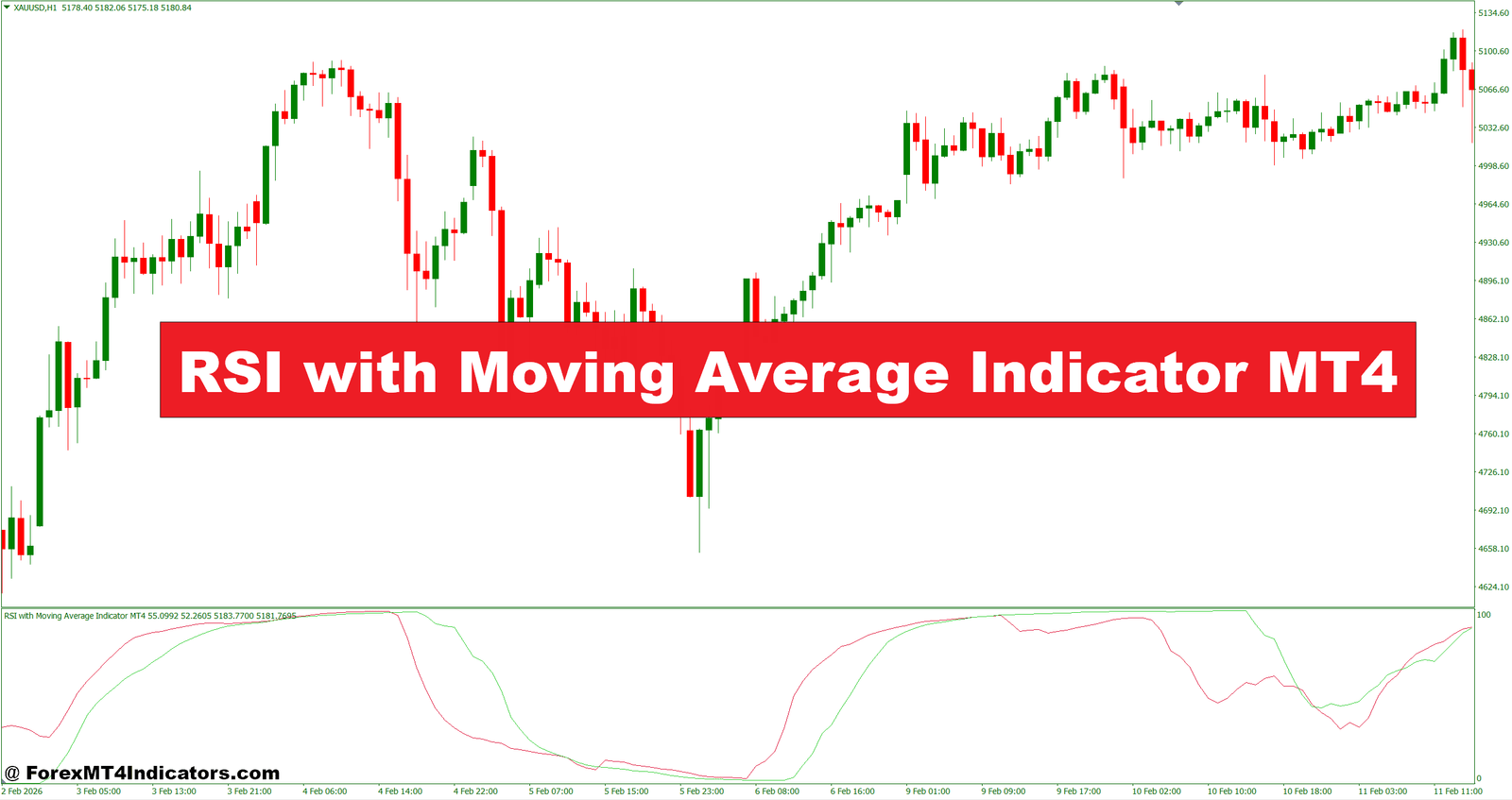
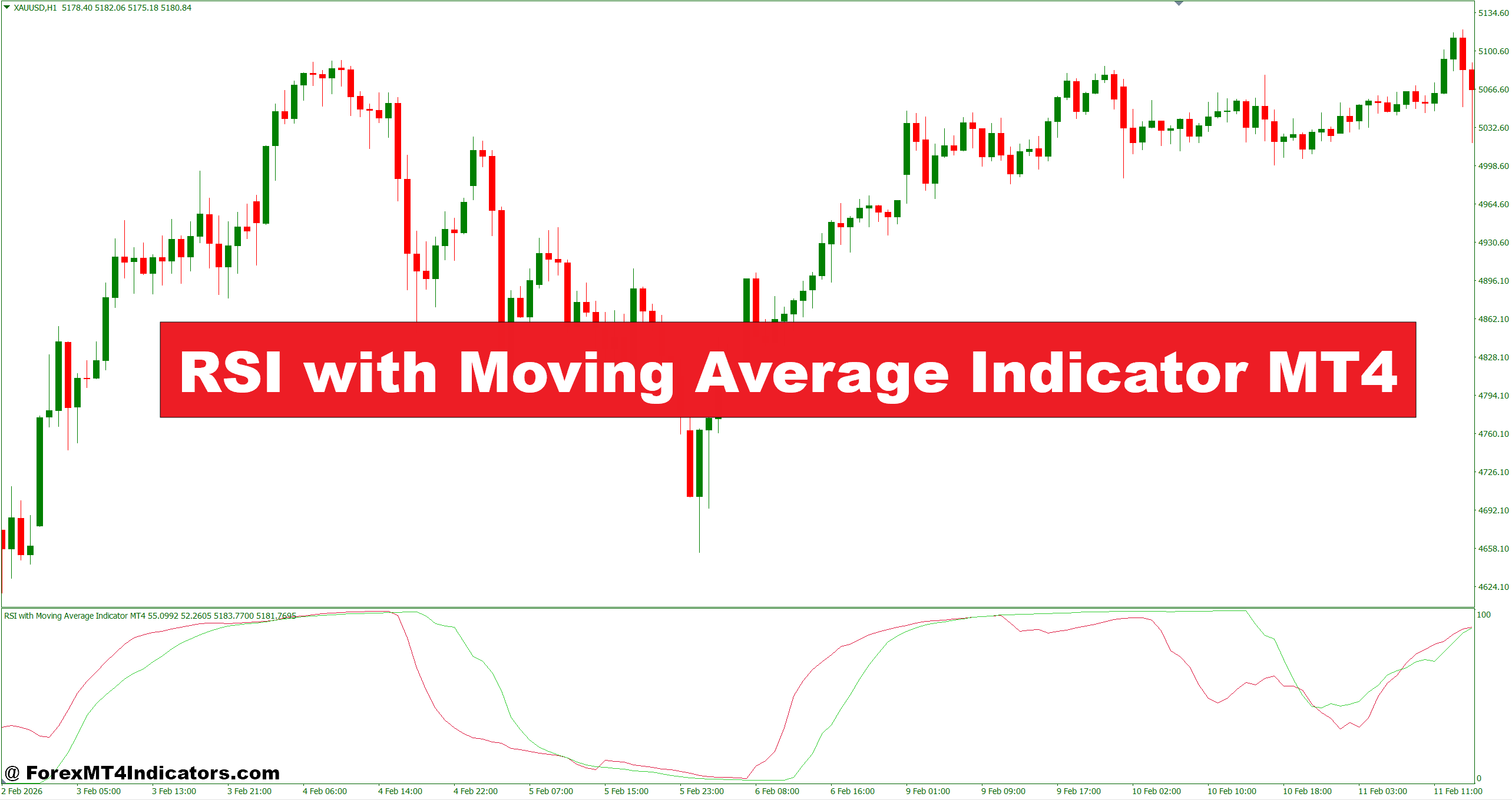
The standard Relative Strength Index measures momentum on a 0–100 scale, flagging overbought conditions above 70 and oversold below 30. It works. But it also generates a lot of chop — situations where price keeps grinding in one direction while RSI whipsaws around the midline.
The RSI with Moving Average MT4 indicator solves this by plotting a smoothed moving average line directly on the RSI panel. Traders watch for crossovers between the RSI line and its MA, rather than just watching RSI levels. This shift from static thresholds to dynamic crossovers changes how signals are interpreted entirely.
Most versions use a 14-period RSI paired with a 9-period exponential moving average applied to the RSI values. Some builds also color-code the RSI histogram based on whether it sits above or below the MA — a small feature that makes reading the chart significantly faster under live conditions.
How the Signal Logic Works in Practice
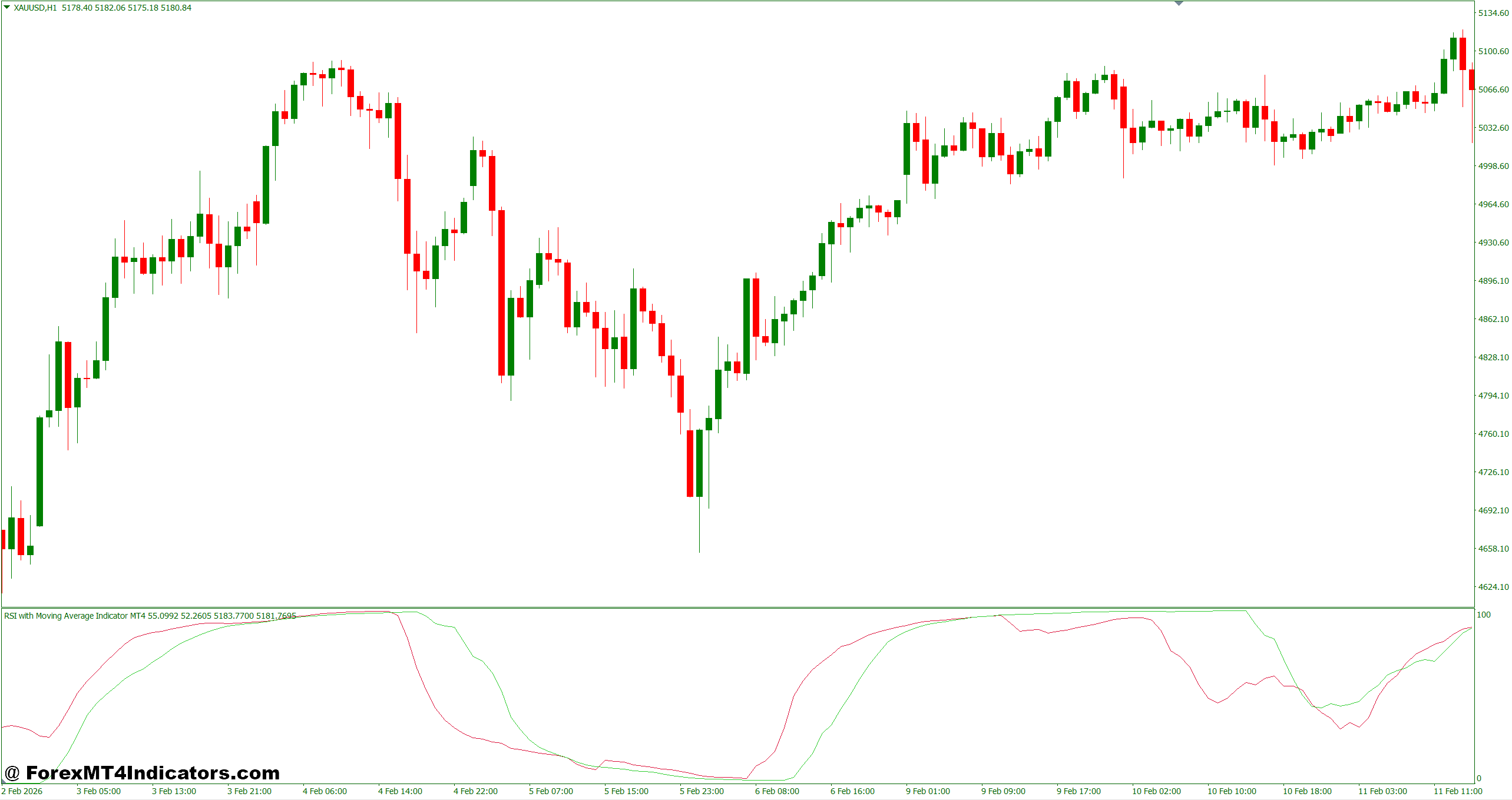
Here’s the thing — crossover-based signals only matter if a trader understands what they’re confirming. The RSI crossing above its moving average suggests momentum is shifting bullish. The RSI crossing below signals bearish momentum building. Neither is a standalone entry trigger.
When testing this on volatile NFP days, for instance, the RSI MA crossovers fire rapidly and produce fake-outs. That’s expected — the indicator wasn’t designed for news-driven spikes. But on a Tuesday morning EUR/USD 1-hour chart with steady directional flow, the RSI crossing its 9-period EMA while price holds above a key support level produces reliable confluence.
A practical example: EUR/USD at 1.0850 support in a clear uptrend. RSI had pulled back to 45, then crossed back above its MA around the 50 level. Price simultaneously bounced from support. That combination — structure plus momentum confirmation — is where this indicator earns its keep.
RSI with Moving Average Indicator MT4 Settings and Customization

Default settings (RSI 14, MA 9) work well on the 1-hour and 4-hour charts for major pairs like EUR/USD, GBP/USD, and USD/JPY. For scalpers on the 5-minute chart, tightening the MA to 5 or 6 periods makes the signal more responsive — though it also increases noise considerably.
Swing traders working the daily chart often extend the MA period to 14 or 21. This slows the crossovers down and reduces the signal count, but the signals that do appear tend to align better with meaningful trend shifts. On commodity currencies like AUD/USD or NZD/USD, which trend strongly during Asian and London sessions, this slower setting filters out a lot of mid-session chop.
One setting worth adjusting is the RSI overbought/oversold levels. In strong trends, the classic 70/30 thresholds get hit early and stay there — which creates confusion. Adjusting to 60/40 during ranging markets and 80/20 during strong trending conditions is a practical tweak experienced traders make without much fanfare.
Honest Advantages and Real Limitations

The RSI with Moving Average indicator’s biggest strength is reducing premature signals. Waiting for the RSI to cross its MA — rather than just touch 30 or 70 — adds a timing layer that standard RSI can’t provide. Traders who constantly got stopped out entering on RSI reversals alone often find this approach improves their entry timing noticeably.
That said, it lags. Any moving average introduces lag, and applying one to RSI compounds the delay. In fast-moving markets — think post-FOMC announcements or major breakouts — the crossover arrives well after the best entry has passed. This isn’t a flaw unique to this tool; it’s the nature of smoothed indicators.
Compared to MACD, which many traders use for similar momentum crossover signals, the RSI MA approach keeps the 0–100 scale intact. This means traders still get the overbought/oversold context alongside the crossover signal — something MACD doesn’t provide. That dual-layer information is genuinely useful.
But it still won’t tell a trader when a trend is about to end. No momentum indicator does. Using this alongside price structure, volume, or a trend-following tool like the 200 EMA gives it much stronger context.
How to Trade with RSI with Moving Average Indicator MT4
Buy Entry

- RSI crosses above its MA – Wait for the RSI line to cross above its moving average from below before entering long. A clean cross on the 1-hour EUR/USD carries more weight than a shallow graze.
- RSI-MA crossover near the 40–50 zone – Bullish crossovers happening around the midline in an uptrend are stronger than those coming off extreme lows.
- Price holds above the 200 EMA – Only take buy signals when price sits above the 200 EMA on the same timeframe. Counter-trend longs get skipped entirely.
- Higher timeframe confirms uptrend – Check the 4-hour or daily chart first. If the trend is up there, the 1-hour crossover becomes a valid entry trigger.
- RSI-MA cross aligns with support level – A crossover happening as price bounces from a key support on GBP/USD adds strong confluence for a long trade.
- Avoid buying during news spikes – RSI MA crossovers on NFP or FOMC minutes are unreliable. Wait 15–30 minutes for price to settle before acting.
- Risk no more than 1–2% per trade – Set stop-loss 5–10 pips below the nearest swing low. Let the structure define risk, not a fixed pip value.
- Skip signals in choppy, ranging markets – If price has been stuck in a 30–40 pip range for several hours, crossover signals produce more fake-outs than real moves.
Sell Entry

- RSI crosses below its MA – Enter short when the RSI line drops below its moving average. The steeper the cross, the stronger the momentum shift.
- Crossover occurs near the 50–60 zone – Bearish crosses in a downtrend near the midline signal trend continuation, not just a pullback.
- Price trading below the 200 EMA – Only take sell signals when price is beneath the 200 EMA. Shorting above it puts the trade against the dominant trend.
- 4-hour or daily chart shows downtrend – Confirm the bigger picture is bearish before acting on a 1-hour sell signal on USD/JPY or EUR/USD.
- RSI-MA cross near resistance level – A bearish crossover forming as price rejects a resistance zone significantly improves the probability of follow-through.
- RSI was overbought before the cross – If RSI climbed above 65–70 and then crossed below its MA, the reversal signal carries more conviction than a cross from neutral territory.
- Don’t short strong momentum breakouts – If price just broke a major level with a big candle, the RSI MA cross may lag badly. Chasing that sell often leads to getting caught in a pullback.
- Place stop 5–10 pips above the swing high – Let the most recent high define the stop. Keep risk at 1–2% of account balance regardless of how confident the setup looks.
Putting It to Work Without Overcomplicating Things
The traders who get the most out of this indicator keep the approach simple. They identify the trend on a higher timeframe – daily or 4-hour. They drop to the 1-hour chart to time entries using RSI MA crossovers. And they only take crossover signals that align with the higher timeframe direction.
Buy signals get filtered: RSI crossing above its MA while price is above the 200 EMA and in a higher-timeframe uptrend. Short signals get the mirror treatment. This removes a significant percentage of counter-trend signals that would otherwise eat into performance.
Recommended MT4/MT5 Broker
XM Broker
- Free $50 To Start Trading Instantly! (Withdraw-able Profit)
- Deposit Bonus up to $5,000
- Unlimited Loyalty Program
- Award Winning Forex Broker
- Additional Exclusive Bonuses Throughout The Year
- Exclusive 90% VIP Cash Rebates for all Trades!

Already an XM client but missing out on cashback? Open New Real Account and Enter this Partner Code: VIP90