




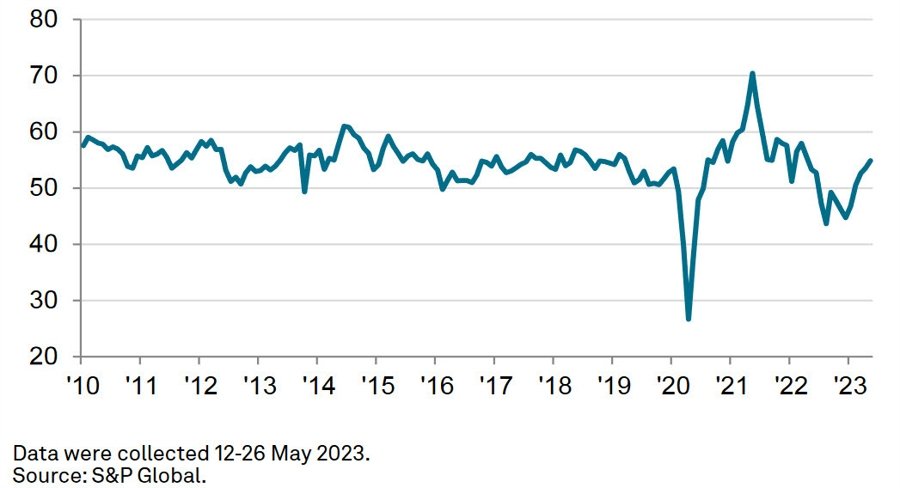
- The final PMIs for the US from S&P Global
- Fourth consecutive increase
- Best services reading in 13 months
- Prelim was 55.1
- Prior was 53.6
- Composite PMI 54.3 vs 54.5 prelim
- Prior composite 53.4
- Both input and output price inflation softened
This is a slight downgrade and adds a small negative bias to the ISM services data at the top of the hour.
Chris Williamson, Chief Business Economist at S&P
Global Market Intelligence, said:
“The US continued to see a two-speed economy in May, with
the sluggishness of the manufacturing sector contrasting
with a resurgent service sector. Businesses in sectors such
as travel, tourism, recreation and leisure are enjoying a mini
post-pandemic boom as spending is switched from goods
to services.
“The survey data are indicative of GDP
GDP
Gross Domestic Product (GDP) is the monetary value of all the goods and services produced within a country’s borders in a specific period of time, typically a year. It is used to measure the economic activity and growth of a country. Periods shorter than a year are often presented in an annualized or year-over-year format.There are three ways to calculate GDP:The expenditure approach: GDP is calculated by adding up all the spending on goods and services within a country. This includes consumer s
Gross Domestic Product (GDP) is the monetary value of all the goods and services produced within a country’s borders in a specific period of time, typically a year. It is used to measure the economic activity and growth of a country. Periods shorter than a year are often presented in an annualized or year-over-year format.There are three ways to calculate GDP:The expenditure approach: GDP is calculated by adding up all the spending on goods and services within a country. This includes consumer s
Read this Term growing at an
annualized rate of just over 2%, and an upturn in business
expectations points to growth remaining robust as we head
further into the summer.
“However, just as demand has moved from goods to services,
so have inflationary pressures. While goods price inflation
has fallen dramatically in May to register only a marginal
increase, prices charged for services continue to rise
sharply. Although down considerably on last year’s peaks,
service sector inflation
Inflation
Inflation is defined as a quantitative measure of the rate in which the average price level of goods and services in an economy or country increases over a period of time. It is the rise in the general level of prices where a given currency effectively buys less than it did in prior periods.In terms of assessing the strength or currencies, and by extension foreign exchange, inflation or measures of it are extremely influential. Inflation stems from the overall creation of money. This money is m
Inflation is defined as a quantitative measure of the rate in which the average price level of goods and services in an economy or country increases over a period of time. It is the rise in the general level of prices where a given currency effectively buys less than it did in prior periods.In terms of assessing the strength or currencies, and by extension foreign exchange, inflation or measures of it are extremely influential. Inflation stems from the overall creation of money. This money is m
Read this Term remains higher than any time in the
survey’s 10-year history prior to the pandemic, bolstered by
a combination of surging demand and a lack of operating
capacity, the latter in part driven by labor shortages.
“However, while rejuvenated service providers will make
hay in the summer season, the weakness of manufacturing
raises concerns about the economy’s resilience later in the
year, when the headwind of higher interest rates and the
increased cost of living is likely to exert a greater toll on
spending.”


