



The Target Bands Indicator MT4 was created to help solve this problem. Instead of relying only on support and resistance drawn by hand, it displays projected price bands that can act as potential target or reaction zones. Traders use these levels to improve entries, manage exits, and plan trades with better structure.
That said, no indicator can predict every market move. The best results usually come when the Target Bands Indicator MT4 is combined with price action, trend analysis, and sound risk management. Understanding how it works is the first step toward using it effectively in real trading conditions.
What Is the Target Bands Indicator MT4?
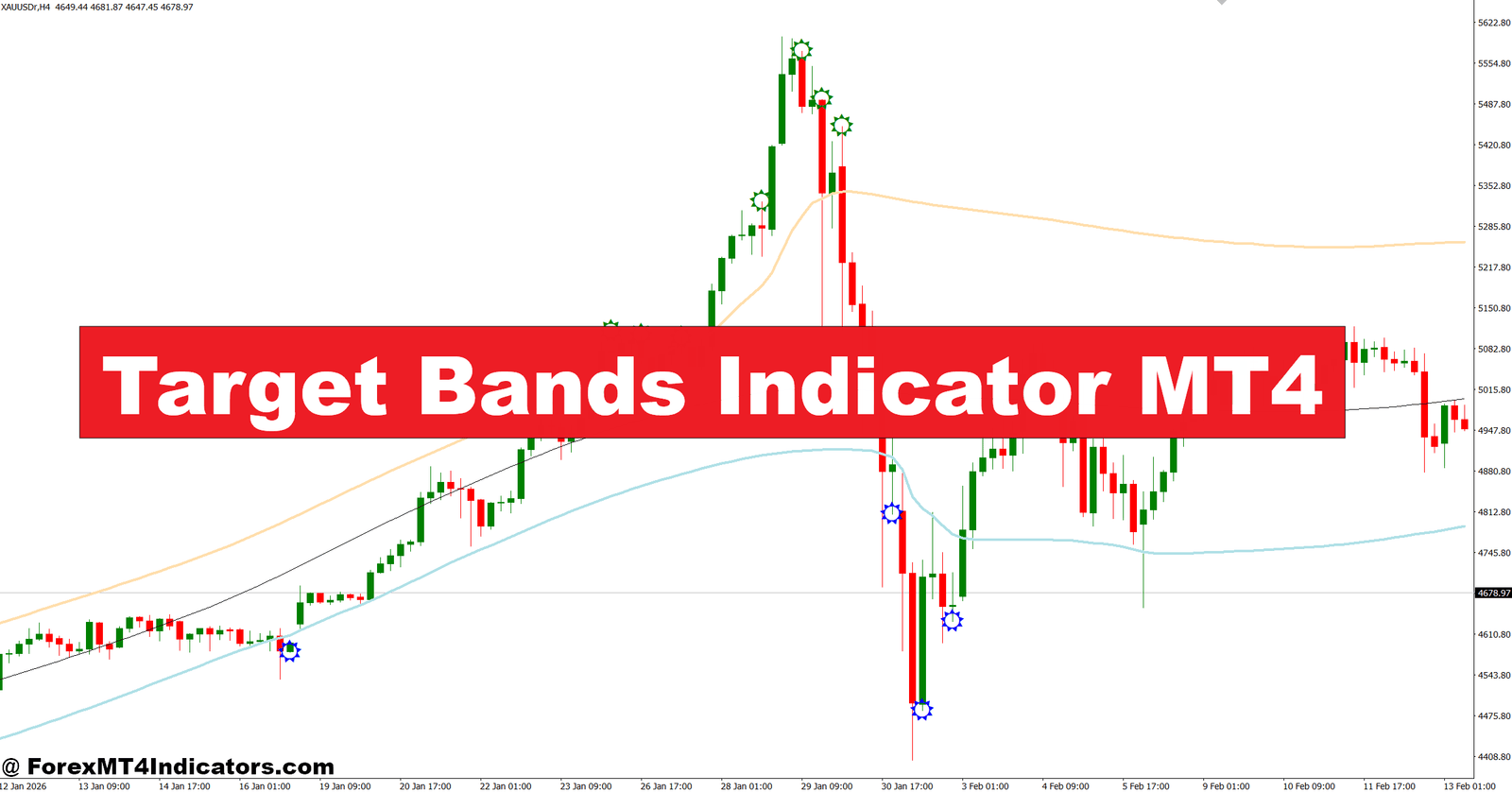
The Target Bands Indicator MT4 is a technical analysis tool that plots dynamic upper and lower price bands around the current market. These bands estimate areas where price may reach, pause, or reverse based on historical price behavior and market volatility.
Unlike fixed horizontal support and resistance levels, the bands adjust as new candles form. This allows traders to see changing market conditions instead of relying on outdated price levels.
Many traders use the indicator for:
- Finding realistic profit targets.
- Identifying possible reversal areas.
- Measuring the current market range.
- Confirming breakout strength.
- Planning stop-loss placement around volatility.
For example, a trader analyzing EUR/USD on the 1-hour chart may notice that price repeatedly reaches the upper target band before pulling back 25 to 40 pips. After seeing this pattern several times, the upper band becomes a useful reference when managing future long trades.
The indicator performs best during normal market sessions where price respects technical levels. During major news releases, price can break through both bands without slowing down, so traders should always consider the market environment before relying on projected targets.
How the Target Bands Indicator MT4 Works

The exact calculation depends on the version of the indicator, but most Target Bands indicators combine recent price movement with volatility measurements to create adaptive price channels. Instead of drawing fixed lines, the indicator recalculates its bands every time a new candle closes.
Many versions take into account factors such as:
- Recent highs and lows
- Average market volatility
- Price deviation from a moving average
- Historical price expansion
As volatility increases, the bands widen to reflect larger price swings. During quiet sessions, they move closer together because price typically travels shorter distances.
Here’s a practical example.
Suppose GBP/USD on the 30-minute chart has been trending higher for most of the London session. Price pulls back toward the middle of the bands and forms a bullish engulfing candle. The upper target band sits about 45 pips above the current price while the lower band remains nearly 35 pips below.
Rather than buying randomly, a trader can use the bullish candle as confirmation, place a stop-loss below the recent swing low, and use the upper target band as an initial profit objective. If momentum remains strong after reaching the band, part of the position may be left open while the stop-loss is moved to break even.
When testing this indicator during volatile Non-Farm Payroll (NFP) sessions, many traders notice that price often overshoots the projected bands before settling back into its normal range. Because of this behavior, experienced traders usually reduce position size or avoid opening new trades immediately before major economic announcements.
Another useful feature is how the bands respond during ranging markets. If price repeatedly bounces between the upper and lower bands without creating higher highs or lower lows, traders may identify a sideways market and avoid chasing false breakouts. This can reduce the number of trades taken during choppy conditions where fake-outs are common.
The indicator becomes much stronger when paired with trend confirmation tools. For instance, traders often combine it with a 50-period Exponential Moving Average (EMA). If price stays above the EMA and pulls back near the middle band before moving higher, the setup generally has more technical support than relying on the bands alone.
Still, traders shouldn’t assume every touch of a target band means the market will reverse. Strong trends can continue well beyond projected levels, while weak markets may fail to reach them at all. Waiting for price action confirmation often produces more consistent trading decisions than reacting to the bands by themselves.
Practical Trading Applications and Best Settings
The Target Bands Indicator MT4 works well as part of a structured trading plan instead of acting as a standalone signal generator. Traders often use it to estimate where price is likely to react while confirming the setup with candlestick patterns, trend direction, or another momentum indicator.
Consider USD/JPY on the 4-hour chart. The market has been making higher highs and higher lows for several days. Price retraces toward the center of the bands and forms a bullish pin bar near a previous support level. Since the overall trend remains bullish, a trader enters a long position with a stop-loss around 30 pips below the recent swing low. The upper Target Band sits approximately 75 pips above the entry, providing a logical first profit target with a risk-to-reward ratio close to 1:2.5.
The indicator can also help during range-bound markets. If EUR/GBP continues moving between the upper and lower bands without producing a clear breakout, traders may look for short-term reversal opportunities rather than expecting a strong trend. But if a candle closes well outside a band with increasing momentum and volume, it may signal that the range is ending instead of confirming another reversal.
Most versions of the indicator include adjustable settings. The default values often work well, but traders usually fine-tune them based on their trading style.
Scalpers on the M5 or M15 charts may reduce the calculation period to make the bands respond more quickly to changing price movement. Swing traders using the H4 or Daily chart often increase the period, creating smoother bands that filter out smaller market fluctuations.
Currency pair selection also matters. Highly volatile pairs such as GBP/JPY or XAU/USD (Gold) may require wider bands to avoid frequent false signals. Less volatile pairs like EUR/CHF usually perform better with moderate settings because price moves within narrower daily ranges.
A good practice is to test any setting over at least 100 historical trades before applying it on a live account. Small adjustments can noticeably change how often the indicator produces trading opportunities.
Advantages, Limitations, and Comparison with Similar Indicators
One reason traders like the Target Bands Indicator MT4 is its ability to provide objective price targets. Instead of guessing where to exit, they have predefined levels based on recent market behavior. This often leads to more consistent trade management and fewer emotional decisions.
Another strength is its adaptability. Because the bands adjust as volatility changes, they remain relevant in different market conditions. During active trading sessions, the indicator naturally expands to reflect larger price swings. During quieter periods, it contracts to match lower volatility.
Still, every indicator has weaknesses.
The Target Bands Indicator MT4 can produce misleading signals during strong news-driven moves. Interest rate decisions, inflation reports, or unexpected geopolitical events may push price far beyond the projected bands. In these situations, relying only on the indicator can result in poor trade timing.
Another limitation appears in highly choppy markets. When price lacks a clear trend, the bands may shift frequently, creating several potential signals that never develop into meaningful trades. Waiting for confirmation from market structure can help reduce these false entries.
How does it compare with other popular indicators?
Bollinger Bands also use upper and lower bands, but they focus mainly on standard deviation around a moving average. Traders often use them to identify volatility expansion and contraction.
Keltner Channels rely on the Average True Range (ATR), making them smoother during trending markets. They generally produce fewer sudden changes than Bollinger Bands.
The Target Bands Indicator MT4 places greater emphasis on identifying projected target zones rather than simply measuring volatility. This makes it especially useful for planning exits and estimating realistic price objectives.
Many experienced traders combine these tools instead of choosing only one. For example, if the upper Target Band aligns with the upper Bollinger Band and a previous resistance level, that price area may deserve extra attention because multiple technical factors point to the same zone.
Trading forex carries substantial risk. No indicator guarantees profits. Every trade should include a predefined stop-loss, sensible position sizing, and a plan for managing unexpected market conditions.
How to Trade with Target Bands Indicator MT4
Buy Entry

- Buy near the lower band – Enter on the EUR/USD 1-hour chart after a bullish candle forms, with a 20-30 pip stop-loss.
- Confirm the uptrend – Take buys only if price stays above the 50 EMA on the 4-hour timeframe.
- Wait for a bullish crossover – Enter after price closes back inside the Target Bands with at least 1% account risk.
- Use the upper band as target – Aim for 40-80 pips depending on market volatility.
- Trade after pullbacks – Buy on GBP/USD when price bounces from the middle band during an uptrend.
- Avoid major news – Skip signals 30 minutes before high-impact events to reduce fake-outs.
- Watch for higher lows – Enter only if recent swing lows continue rising on the 1-hour chart.
- Secure profits early – Move the stop-loss to breakeven after gaining 25-30 pips.
Sell Entry

- Sell near the upper band – Enter on the EUR/USD 1-hour chart after a bearish rejection candle, using a 20-30 pip stop-loss.
- Follow the downtrend – Sell only if price remains below the 50 EMA on the 4-hour timeframe.
- Wait for bearish confirmation – Open a trade after a candle closes back below the upper Target Band.
- Target the lower band – Look for 40-80 pip profit targets during steady trends.
- Sell after pullbacks – On GBP/USD, enter after price rejects the middle band in a downtrend.
- Skip weak markets – Avoid selling when price moves sideways inside a 20-pip range.
- Confirm lower highs – Enter only if the market continues making lower highs on the daily or 4-hour chart.
- Protect capital – Reduce risk to 1% per trade and trail the stop after 30 pips in profit.
Final Thoughts
The Target Bands Indicator MT4 gives traders another way to measure where price may travel before slowing down or changing direction. It isn’t designed to replace price action or trend analysis, but it can improve trade planning when used correctly. Traders should remember a few key points: it works best alongside confirmation tools, adaptive bands respond to changing volatility, realistic profit targets encourage disciplined exits, and proper risk management remains essential regardless of the indicator being used. Spend time testing the indicator across different currency pairs and timeframes before using it with real money. A consistent trading process will always matter more than relying on a single technical tool, and that’s where the Target Bands Indicator MT4 provides its greatest value.
Recommended MT4/MT5 Broker
XM Broker
- *FREE $50 To Start Trading Instantly! (Withdraw-able Profit)
- Deposit Bonus up to $5,000
- Unlimited Loyalty Program
- Award Winning Forex Broker
- Additional Exclusive Bonuses Throughout The Year


>> Sign Up for XM Broker Account here <<
(Free MT4 Indicators Download)