





Earlier this week we’ve seen a major whipsaw in crude oil, as WTI spiked above $119 per barrel then crashed right back below $100 in a single trading session.
This kind of 25% intraday swing doesn’t happen without a serious reason. And the reason still revolves around the Strait of Hormuz, the narrow waterway through which roughly 20% of the world’s oil supply, which is effectively closed due to the ongoing war in Iran.
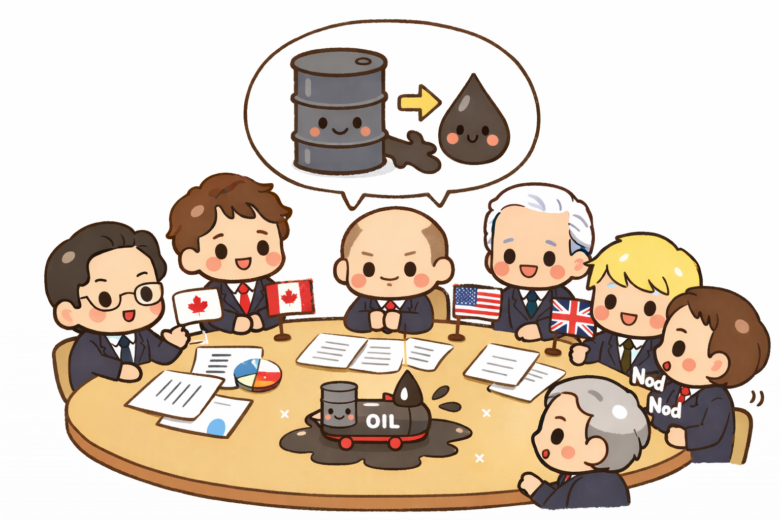
This is likely why G7 finance ministers held an emergency call on Monday to discuss releasing hundreds of millions of barrels of oil from their strategic petroleum reserves (SPRs).
That meeting ended without a decision, as officials said they needed “more analysis” on timing. And that hesitation tells you everything about why tapping into this emergency stockpile is more complicated than it sounds.
Here’s what you need to know about how strategic reserves work, why coordinated releases matter, and what this whole situation means for markets right now.
The Basics: What Are Strategic Petroleum Reserves?
Think of a strategic petroleum reserve as a giant national piggy bank, but instead of money, it’s filled with oil stored for genuine emergencies.
The U.S. SPR, the world’s largest, holds crude oil in massive underground salt caverns carved into natural salt domes along the Gulf Coasts of Texas and Louisiana. It has a capacity of 714 million barrels, though it currently holds around 415 million barrels, which is well below capacity partly because the Biden administration made the largest-ever SPR release in 2022 (180 million barrels) to fight post-Ukraine war price spikes.
Other G7 members (Japan, Germany, France, the UK, Canada, and Italy) maintain their own strategic stockpiles, all coordinated through the International Energy Agency (IEA). IEA members are required to hold reserves equivalent to at least 90 days of import protection.
Once a president or prime minister orders a release, oil can begin reaching markets in as little as 13 days from the decision. The U.S. SPR alone can pump out up to 4.4 million barrels per day at maximum drawdown, but reaching that rate takes time since the oil still needs pipelines, tankers, and barges to reach refineries.
The G7 was reportedly discussing a release of 300-400 million barrels — a staggering figure, significantly larger than anything done in 2022.
Why It Matters: The Hormuz Problem
Here’s the core challenge that makes this crisis unlike previous ones: the normal backup options aren’t available.
When past supply shocks hit (i.e. the Gulf War, Hurricane Katrina, Russia’s Ukraine invasion), Saudi Arabia and the UAE could always be called upon to pump more oil. But not this time.
Both countries’ exports move through the Strait of Hormuz, which is exactly what’s blocked. According to analysis firm Rapidan Energy, this is the biggest oil supply disruption in history, and there is genuinely no spare capacity to plug the gap.
Monday’s market action showed the emotional power of reserve release speculation:
- WTI crude spiked to $119.48/barrel before the G7 headlines hit
- After the reports broke, oil fell back toward $95-105/barrel — still sharply higher, but well off the panic highs
- Gas prices jumped from $3.00/gallon to $3.48 in a single week, according to AAA data
- European stock markets dropped, with Germany’s DAX falling 1.4% and France’s CAC 40 down nearly 2%
- Bond yields rose as traders priced in higher inflation, which complicated bets on Fed rate cuts
In short, just the mere mention of a potential reserve release was enough to pull oil off its highs. That’s the psychological power of these stockpiles: they can move markets before a single barrel is actually sold.
Promoted: Stop Risking Your Own Capital on Unpredictable Geopolitics.
You’ve read the geopolitical headlines and watched crude oil whiplash, but playing big macro shifts requires serious capital. With FundingPips, you trade a simulated account and can earn up to 100% of your rewards. Whether you’re looking for a 2 Step PRO evaluation starting at just $26 or seeking funding options up to $300K, you have the flexibility to trade your way.
Learn more about FundingPips and use code HELLO to get 20% OFF your first purchase!
Disclosure: We may earn a commission from our partners if you sign up through our links, at no extra cost to you.
Key Lessons for Traders
1. SPR releases buy time, they don’t fix the underlying problem.
A 400 million barrel release sounds enormous, but global consumption runs at 100 million barrels per day. The Hormuz closure is disrupting roughly 20 million barrels per day of supply. Even a historic release covers about 20 days of disrupted flow.
That’s why reserve releases typically cool price spikes rather than eliminate them, especially when the root cause of the disruption, in this case a blocked shipping lane, remains unresolved.
2. Governments hesitate because depleted reserves leave you vulnerable.
The U.S. SPR is already well below capacity after the 2022 releases, and President Trump had pledged to refill it. Using reserves now, when the stockpile isn’t full, leaves less cushion if the crisis drags on for months.
3. The physical oil and the market price move on different timelines.
Oil prices react the moment a reserve release is announced, before a single barrel hits the market. This is a feature, not a bug: the psychological signal is part of the tool. But physical oil still takes 2-4 weeks to meaningfully influence supply, and that lag matters enormously in a fast-moving crisis.
4. Oil price spikes complicate central bank decisions.
This is a big one for forex traders. Higher oil means higher inflation expectations. Higher inflation expectations make central banks reluctant to cut interest rates. The Fed was widely expected to cut rates later in 2026, but traders have already scaled back those bets since the crisis began. Delayed rate cuts = potential USD strength.
5. “Crude mismatch” is a real limitation.
Strategic reserves hold crude oil, not gasoline. And not all crude is equal since the Gulf region primarily exports medium-sour crude, which not all refineries can process. This means even a large G7 release may not fully replace the type of oil that’s actually missing. It’s a subtle but important limitation.
The Bottom Line
The Strait of Hormuz closure is a textbook supply emergency — the exact scenario these stockpiles were designed to address after the 1973 oil embargo.
However, the G7’s hesitation to act immediately reflects a genuine tradeoff: releasing oil now provides near-term relief but leaves countries with less buffer if the conflict stretches for months.
Watch for a few things going forward: whether the Strait reopens (the single biggest variable), whether the G7 reconvenes and actually pulls the trigger on a release, and how oil prices behave at key psychological levels like $100/barrel. Also watch Fed communications closely since the longer oil stays elevated, the harder it becomes for central banks to justify cutting rates.
Remember that markets can move violently on expectations, not just facts. The mere rumor of a reserve release knocked oil down $15-20 a barrel in hours. In volatile environments like this, risk management isn’t optional. Position sizing and stop-losses become more important than ever.
This article is for educational purposes only. It does not constitute financial advice. Trading involves substantial risk, and past performance is not indicative of future results. Always do your own research and consider consulting with a qualified financial advisor.
Promoted: Master Your Execution During Macro Shocks
When major geopolitical headlines spark oil price volatility, does your execution stay clinical or get emotional? TradeZella’s trade replay tool lets you revisit your past trades tick-by-tick. See exactly where your entry slipped or why you hesitated, so you can dominate the next volatility spike with a data-driven playbook.
Start Your Journal with Tradezella and use code “PIPS20” to save 20%!
Disclosure: To help support our free daily content, we may earn a commission from our partners if you sign up through our links, at no extra cost to you.


